
In an era of rapid AI advancement, citation counts have become a key metric for measuring research impact. Stanford University's "Top 2% Scientists Worldwide" list selects leading researchers based on standardized citation metrics in fields including AI and image processing. Unlike the Stanford "Top 2%" ranking (which is primarily ordered by a D‑index measure), this article re‑ranks those researchers by total citations on Google Scholar, focusing on the top 15 AI scientists by total citations (2025 data; because ResNet had enormous influence and its four authors all entered the top ten, this article expands the selected scientists to 15). Each scientist is briefly introduced with their total citations and their three most‑cited papers. Each paper description highlights technical contributions, innovations and impact on AI development. These works are not only citation peaks but also drove real‑world applications from image recognition to natural language processing, demonstrating these scholars' global leadership.
1. Yoshua Bengio (University of Montreal, Canada) ‑ Total citations: 1,027,145
Yoshua Bengio, born in Paris in 1964, is a Canadian computer scientist regarded as one of the "three giants" of AI who helped advance deep learning from the margins to the mainstream. He is a professor at the University of Montreal and founder of Mila, Quebec's AI research institute, leading one of the world's largest AI research centers and mentoring many top talents such as Ian Goodfellow. His pioneering work includes generative adversarial networks and word embedding models, revolutionizing natural language processing and generative AI applications; as the 2018 Turing Award laureate, he has been an active advocate for AI safety and ethics, signing an open letter in 2023 calling for a pause in training extremely large models, and in 2025 becoming the first living scientist to surpass one million citations, continuing to influence global AI policy. His three most‑cited papers are detailed below:
- "Deep Learning" (2015, coauthored with Hinton and LeCun): This Nature review systematically presents the principles, algorithms and applications of deep learning, covering neural network architectures, training methods such as backpropagation, and potentials in image, speech and natural language processing. The paper emphasizes deep models' ability to capture complex hierarchical features, marking the paradigm shift from shallow learning to deep learning, and helped pave the way for later developments such as Transformer models, with broad applications in computer vision and recommender systems.
- "Generative Adversarial Nets" (2014, coauthored with Goodfellow et al.): The paper introduces the generative adversarial network (GAN) framework, where a generator and discriminator are trained adversarially to produce realistic data. It discusses minimax optimization, training stability issues, and applications in image synthesis, style transfer and data augmentation. This innovation overcame limitations of traditional generative models, advanced unsupervised learning, influenced tools such as DALL·E, and has been widely adopted in artistic creation and medical image generation.
- "A Neural Probabilistic Language Model" (2003): This paper proposed a neural probabilistic language model that uses neural networks to learn word vector embeddings, replacing traditional n‑gram models. It explores the advantages of distributed representations, training algorithms and how continuous‑space embeddings capture semantic similarity. This work laid foundations for word embedding techniques and helped shift NLP from statistical to neural paradigms, with applications in machine translation and sentiment analysis.
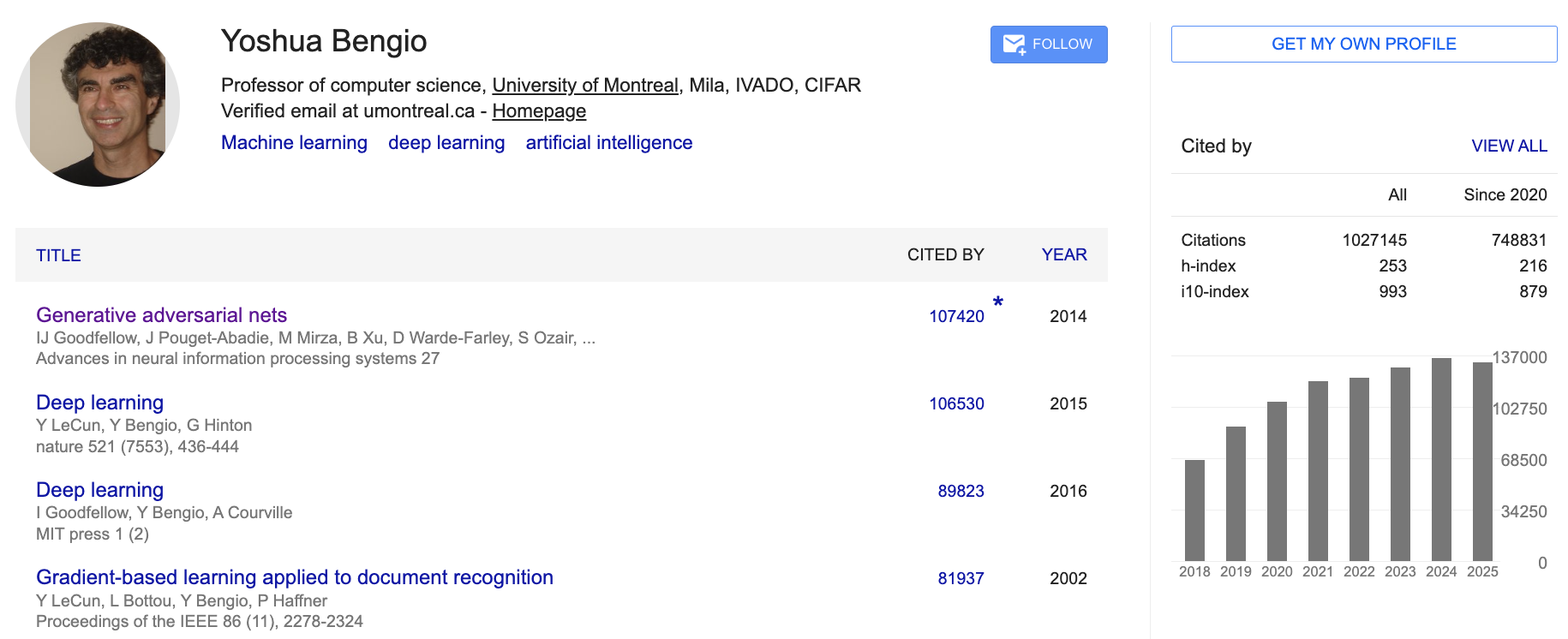
(Note: all screenshots in this article are taken from the Google Scholar website)
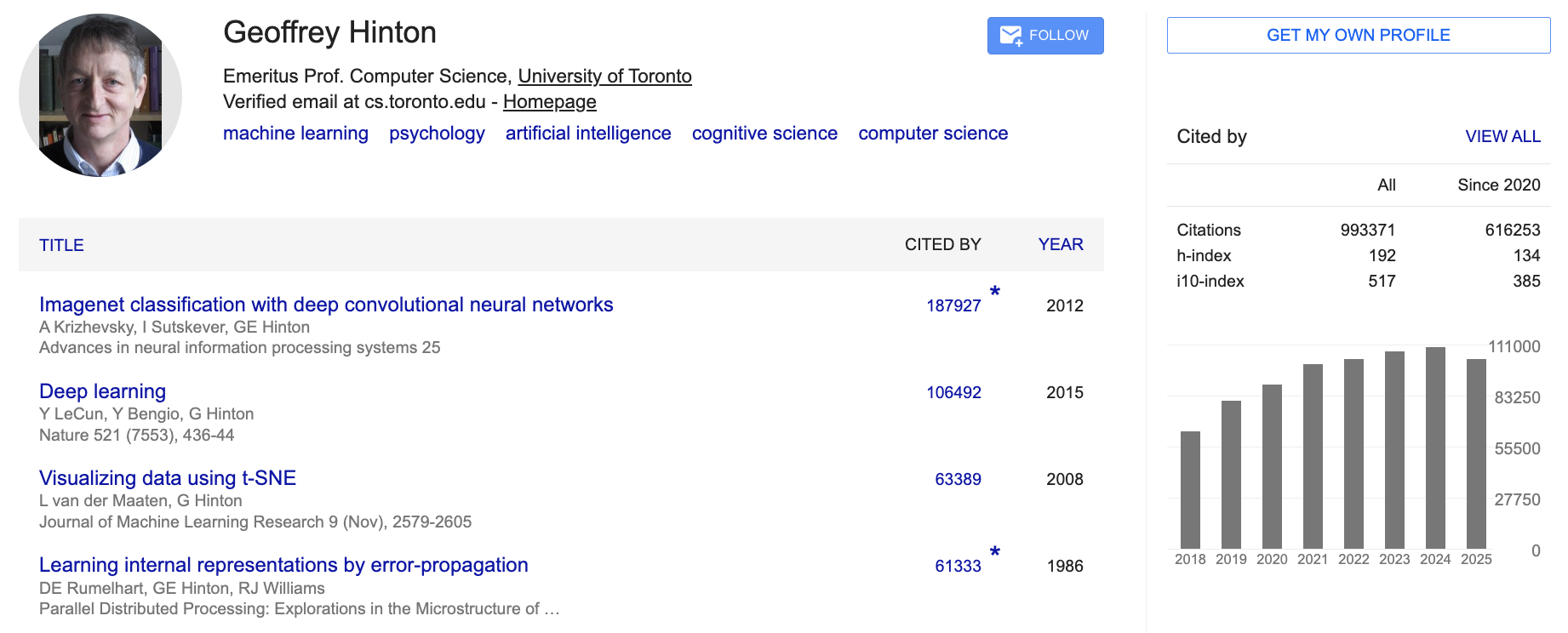
2. Geoffrey E. Hinton (University of Toronto, Canada) ‑ Total citations: 993,371
Geoffrey E. Hinton, born in the UK in 1947, is an emeritus professor at the University of Toronto, often called the "godfather of AI" for work that underpins modern neural networks. He was awarded the 2024 Nobel Prize in Physics for contributions including the backpropagation algorithm developed in the 1980s. As a deep learning pioneer, he invented Boltzmann machines and capsule networks, helped revive AI from its winter, and mentored students such as Ilya Sutskever. Hinton left Google in 2023 and has publicly warned about AI risks and the need to control superintelligent systems; his achievements include the 2018 Turing Award and the 2024 Nobel Prize, and he continues to speak on AI safety and ethics. His three most‑cited papers are analyzed below:
- "Deep Learning" (2015, coauthored with Bengio and LeCun): This review details the mathematical foundations of deep neural networks, optimization techniques such as stochastic gradient descent, and applications in multilayer perceptrons. The paper highlights deep architectures' advantages for nonlinear problems and discusses overfitting prevention methods like dropout, helping transition AI from academic experiments to industrial applications and influencing the design of modern large models such as the GPT family.
- "ImageNet Classification with Deep Convolutional Neural Networks" (2012, coauthored with Krizhevsky and Sutskever): The paper introduces the AlexNet architecture, using convolutional layers and ReLU activations to achieve breakthrough accuracy on ImageNet. It details data augmentation, GPU‑parallel training and local response normalization. This innovation marked the first large‑scale success of deep learning in computer vision, reducing error rates by around 15%, inspiring later models such as ResNet, and finding wide application in autonomous driving and medical diagnosis.
- "Visualizing Data using t‑SNE" (2008): This paper introduces the t‑SNE algorithm for nonlinear dimensionality reduction, mapping high‑dimensional data to low‑dimensional spaces via probability distribution transformations. It discusses perplexity tuning, gradient descent optimization and advantages for cluster separation. The tool has aided visualization of complex datasets such as gene expression or image features, advancing interpretability in machine learning and applications in clustering and anomaly detection.
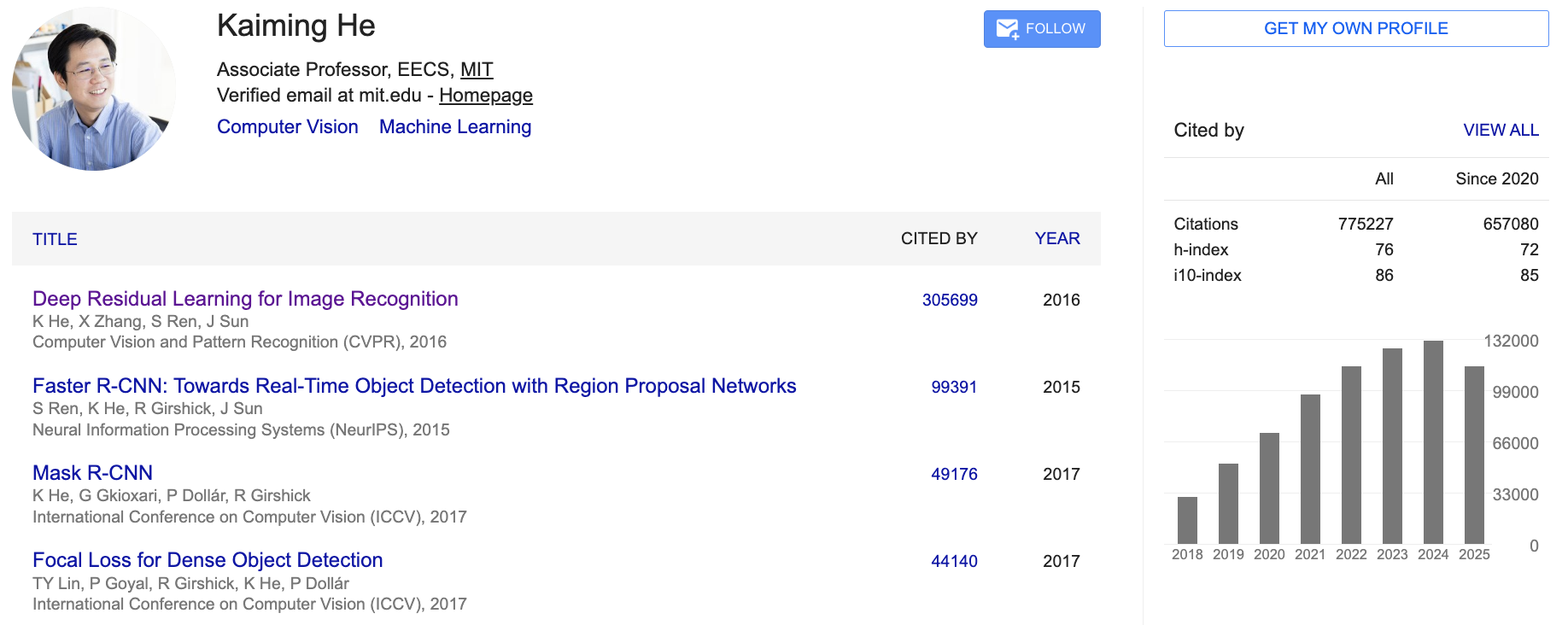
3. Kaiming He (MIT, USA) ‑ Total citations: 775,227
Kaiming He, born in China in 1985, is a professor at MIT's Computer Science and Artificial Intelligence Laboratory, focusing on computer vision and deep learning. He invented the residual network (ResNet), solving deep network training difficulties and enabling model scaling, and received the Future Science Prize in 2023 and the 2025 NeurIPS Test of Time Award. A former Meta researcher, his work has impacted autonomous driving and medical imaging; in 2025 he joined Google DeepMind to continue exploring visual intelligence and efficient AI architectures. His three most‑cited papers are detailed below:
- "Deep Residual Learning for Image Recognition" (2016, coauthored with Zhang et al.): The paper introduces ResNet, using skip connections to alleviate vanishing gradients and enable training of networks with hundreds of layers. It describes residual block design, bottleneck architectures and ImageNet experiments. This breakthrough reduced error rates to 3.57% and became a backbone architecture for deep learning, widely used in object detection and semantic segmentation. This paper is currently the most‑cited AI paper and the first AI paper to exceed 300,000 citations.
- "Mask R‑CNN" (2017, coauthored with Girshick et al.): The paper extends Faster R‑CNN by adding a mask branch for pixel‑level instance segmentation. It details the RoIAlign improvement, loss function design and multi‑task training on the COCO dataset. The framework unified detection, classification and segmentation, improving accuracy and advancing multimodal integration in computer vision, with applications in robotic grasping and medical image analysis.
- "Focal Loss for Dense Object Detection" (2017, coauthored with Lin et al.): The paper introduces focal loss to address class imbalance in dense detection by down‑weighting easy examples dynamically. It discusses the RetinaNet single‑stage detector architecture and compares one‑stage vs. two‑stage approaches. This innovation matched two‑stage detector accuracy while enabling real‑time detection development, influencing autonomous driving and surveillance systems.
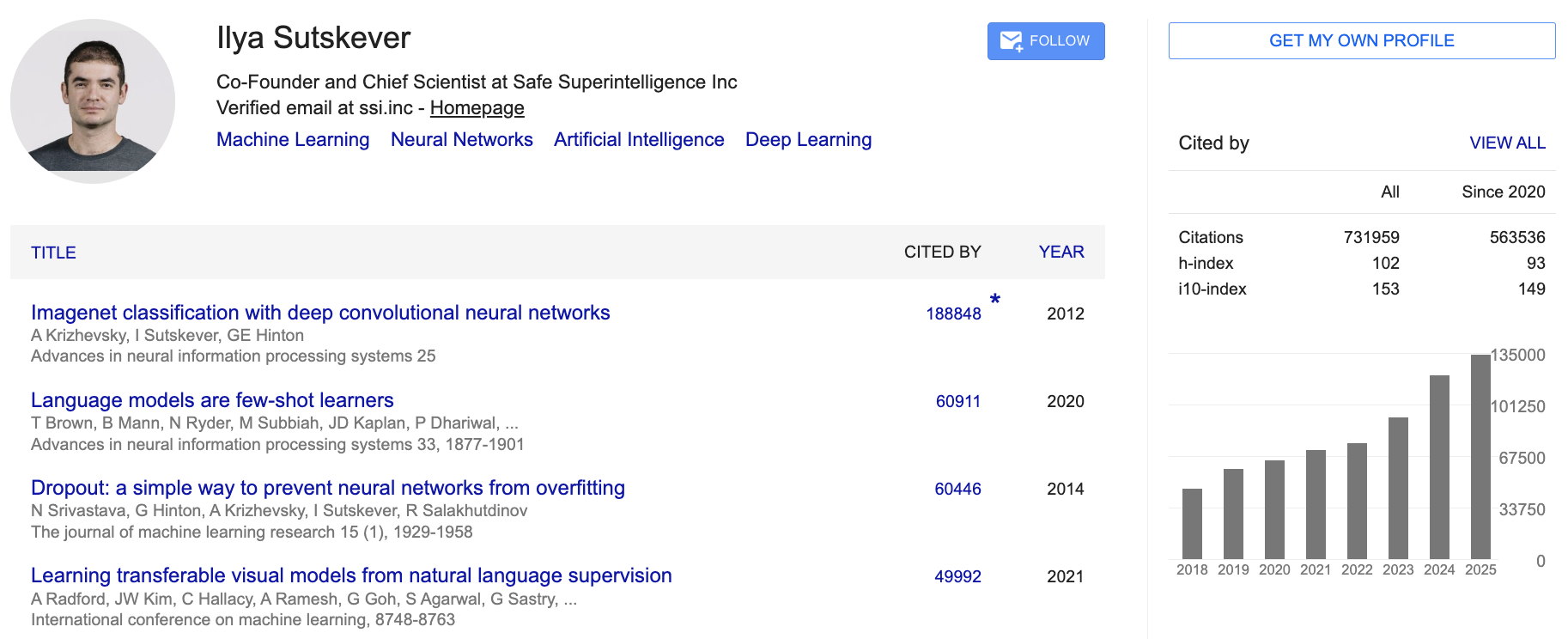
4. Ilya Sutskever (Safe Superintelligence Inc., USA) ‑ Total citations: 731,959
Ilya Sutskever, born in 1986 in Israel/Canada, is founder of Safe Superintelligence Inc., a former PhD student of Geoffrey Hinton, and a cofounder and former chief scientist of OpenAI. He helped bring Transformer architectures into production at OpenAI and advanced sequence learning. He collaborated with Hinton on early work such as AlexNet and led GPT model development, revolutionizing NLP; in 2025 he received an honorary degree from the University of Toronto and was elected a fellow of the Royal Society, emphasizing AI safety and focusing on superintelligence control after leaving OpenAI. His three most‑cited papers are:
- "ImageNet Classification with Deep Convolutional Neural Networks" (2012, coauthored with Krizhevsky and Hinton): This paper presents AlexNet, an eight‑layer convolutional network that won the ImageNet challenge. It describes ReLU activations, data augmentation and dropout regularization. The work demonstrated deep CNNs' potential, reducing classification error rates and enabling industrial applications in smartphone cameras and security systems.
- "Sequence to Sequence Learning with Neural Networks" (2014, coauthored with Vinyals et al.): The paper proposes the Seq2Seq model using LSTM encoder‑decoder structures to handle variable‑length sequences. It discusses early attention mechanisms, beam search decoding and experiments in machine translation. The framework addressed limitations of statistical translation and propelled NLP from rule‑based methods to neural models, influencing chatbots and speech recognition.
- "Zero‑Shot Text‑to‑Image Generation" (2021, coauthored with Ramesh et al.): The paper describes the DALL·E model, using a Transformer to generate images from text descriptions. It details discrete VAE encoding, zero‑shot training and evaluation metrics such as CLIP score. The innovation enabled cross‑modal generation and spurred creative applications in art design and virtual reality content creation.
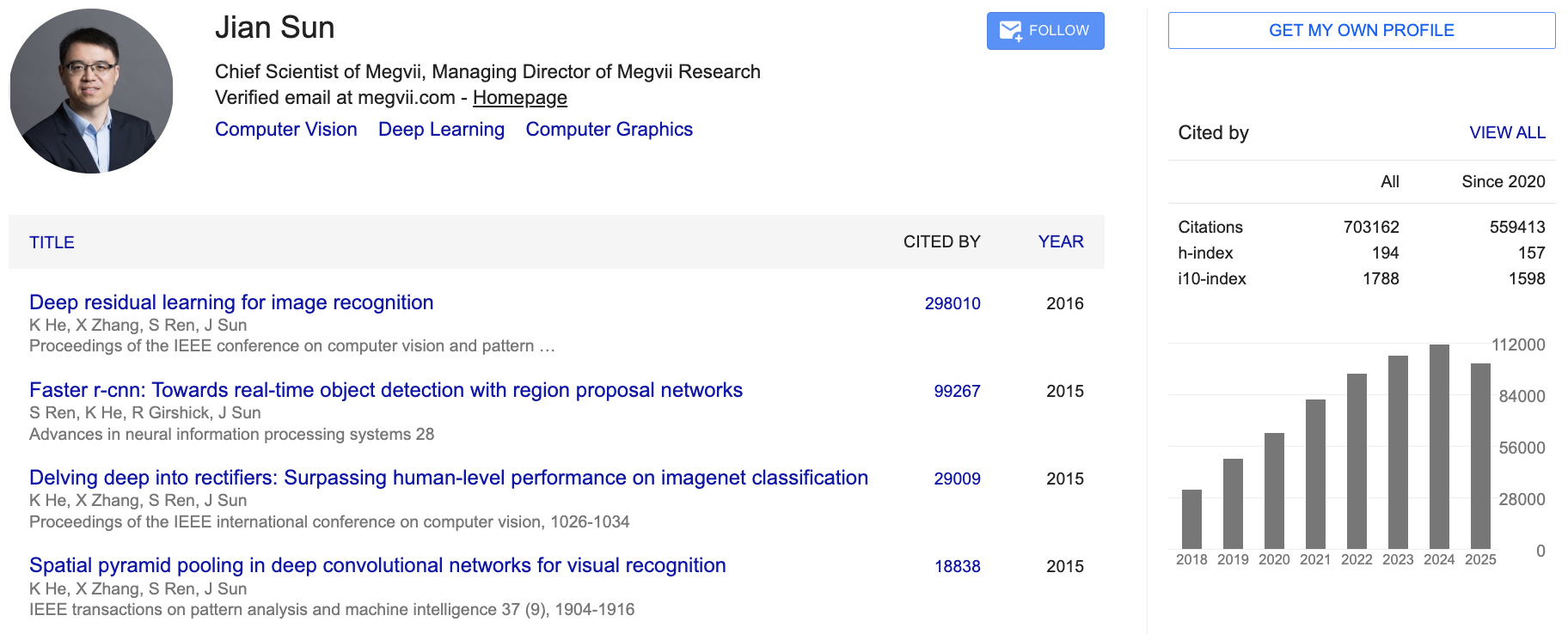
5. Jian Sun (Megvii, China) ‑ Total citations: 703,162
Jian Sun, born around 1977, was a Chinese computer scientist who served as chief scientist and director at Megvii (Face++) and made major contributions to computer vision and deep learning. He was a coauthor on ResNet and Faster R‑CNN and passed away in 2022 at age 45 from a sudden illness. A graduate of Xi'an Jiaotong University who worked at Microsoft Research Asia, he helped translate AI research into commercial applications such as face recognition and image processing. As a pioneer he received multiple awards including a CVPR Best Paper Award in 2016; his legacy continued through open‑source code and students in 2025. His three most‑cited papers are detailed below:
- "Deep Residual Learning for Image Recognition" (2016, coauthored with He, Zhang and Ren): The paper proposes ResNet, using residual blocks and skip connections to address vanishing gradients and enable training of very deep networks. It details architectural design, bottleneck blocks and ImageNet experiments, achieving a 3.57% error rate. The innovation became a backbone for visual AI and advanced object detection and semantic segmentation, with applications in autonomous driving and medical imaging.
- "Faster R‑CNN: Towards Real‑Time Object Detection with Region Proposal Networks" (2015, coauthored with Ren, He and Girshick): The paper introduces the region proposal network (RPN), integrating object proposal generation into an end‑to‑end detection framework. It discusses anchor mechanisms, shared convolutional features and multi‑task loss optimization to enable near real‑time detection. The breakthrough reduced computational cost and promoted real‑time computer vision applications in surveillance and robotic vision systems.
- "Delving Deep into Rectifiers: Surpassing Human‑Level Performance on ImageNet Classification" (2015, coauthored with He, Zhang and Ren): The paper investigates initialization and activation functions, proposing PReLU to outperform ReLU and optimizing initialization strategies. It analyzes variance‑preserving initialization for deep network stability and achieved human‑level performance on ImageNet. The work improved training robustness and advanced classification tasks, impacting recommender systems and image search.
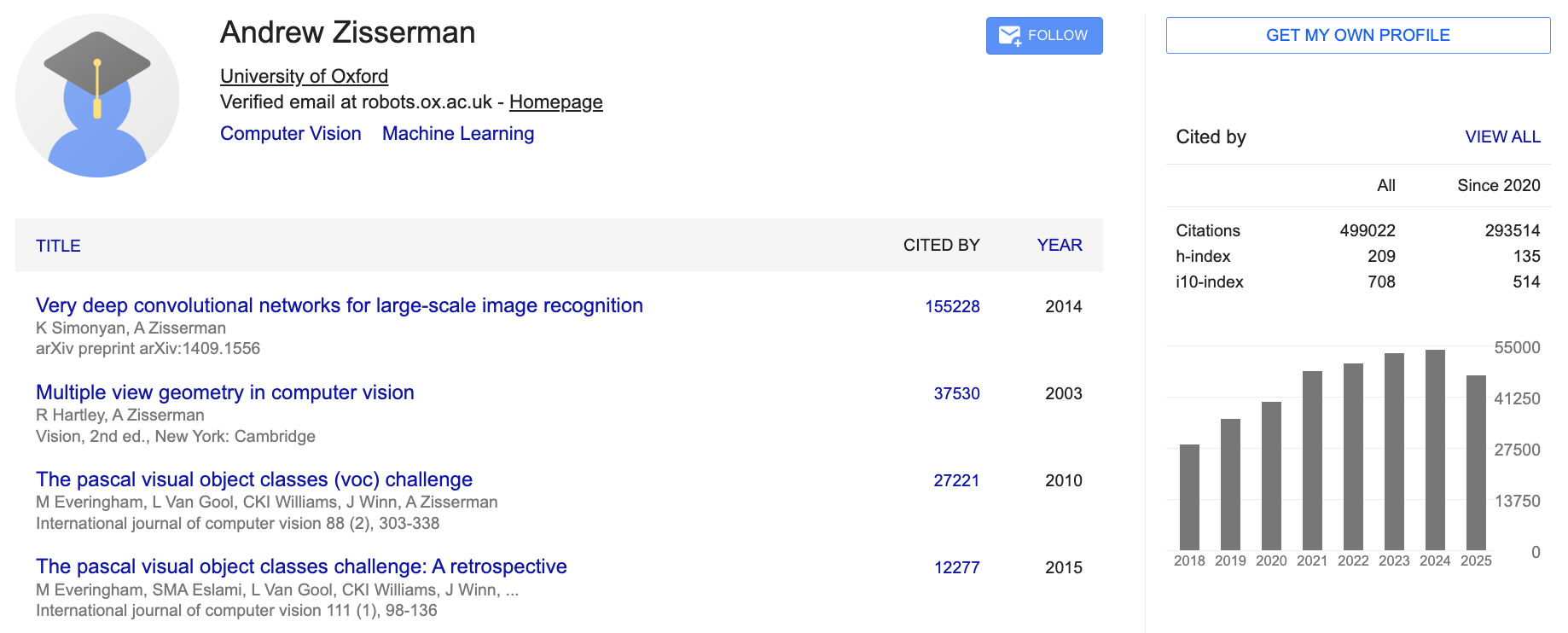
6. Andrew Zisserman (University of Oxford, UK) ‑ Total citations: 499,022
Andrew Zisserman, born in 1957, is a professor in the Department of Engineering Science at the University of Oxford and a Fellow of the Royal Society, who helped establish the geometric foundations of computer vision. He is a principal architect of modern computer vision, with pioneering work in surface reconstruction in the 1980s that advanced 2D‑to‑3D vision. As a DeepMind researcher he developed the VLFeat library and VGGNet, received multiple Marr Prizes and the 2022 Royal Society Bakerian Medal, and in 2025 continued to lead research in multimedia AI and robotic vision. His three most‑cited works are detailed below:
- "Multiple View Geometry in Computer Vision" (2003, coauthored with Hartley): This textbook systematically explains multiview geometry, including the fundamental matrix, projective transforms and 3D reconstruction algorithms. The work combines mathematical proofs and practical code examples to address camera calibration and structure‑from‑motion problems, becoming a standard reference in visual AI and advancing applications in augmented reality and robotic navigation.
- "Very Deep Convolutional Networks for Large‑Scale Image Recognition" (2014, coauthored with Simonyan): The paper proposes VGGNet, stacking small convolutional kernels to build very deep networks that achieve high accuracy on ImageNet. It discusses initialization strategies, batch normalization and transfer learning applications. This simple and effective architecture became a common feature extractor, impacting medical image analysis and satellite imagery processing.
- "The Pascal Visual Object Classes (VOC) Challenge" (2010, coauthored with Everingham et al.): The paper presents the VOC dataset and challenge covering object detection, segmentation and classification tasks. It defines mAP evaluation metrics and annotation standards, promoting standardized benchmarks. The contribution accelerated iterative improvements in vision algorithms, with applications in autonomous driving and intelligent surveillance systems.
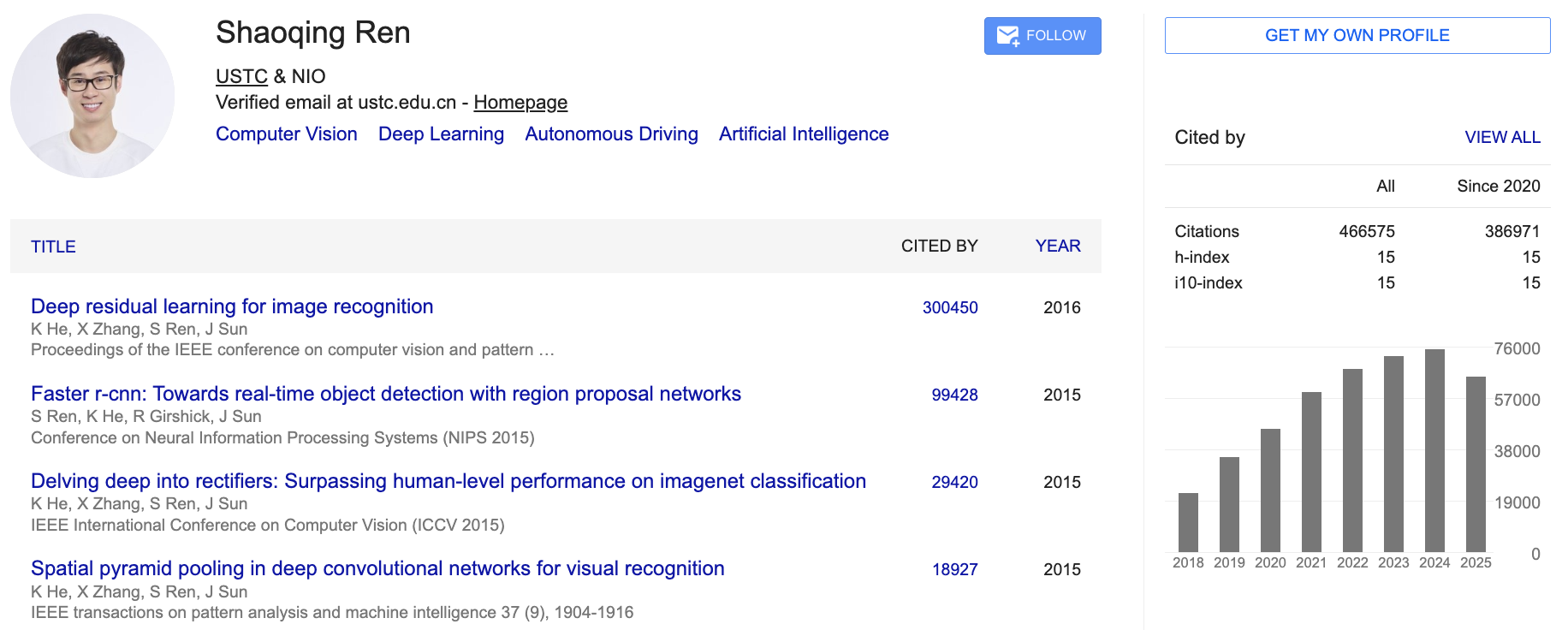
7. Shaoqing Ren (NIO, China) ‑ Total citations: 466,575
Shaoqing Ren, born in the 1980s, is NIO's vice president and chief expert in intelligent driving R&D, and also a professor at the University of Science and Technology of China. He focuses on autonomous driving and computer vision and is a coauthor of Faster R‑CNN and ResNet. A graduate of USTC and a doctoral alumni of Microsoft Research Asia, he founded Momenta.ai (2016–2020) and helped move autonomous driving from research to commercialization. As an AI leader he received the 2025 NeurIPS Test of Time Award and the ICCV Helmholtz Prize, and continues to lead NIO's ADAS development, influencing the global smart vehicle industry. His three most‑cited papers are:
- "Faster R‑CNN: Towards Real‑Time Object Detection with Region Proposal Networks" (2015, coauthored with Girshick, He and Sun): The paper introduces RPN to replace selective search and enable end‑to‑end object detection. It describes anchor generation, shared feature maps and NMS post‑processing, improving speed to about 5 fps. The innovation addressed traditional detection bottlenecks and advanced real‑time vision systems for autonomous vehicles and intelligent surveillance.
- "Deep Residual Learning for Image Recognition" (2016, coauthored with He, Zhang and Sun): The paper introduces ResNet and residual learning to ease training of very deep networks. It discusses identity mappings and projection shortcuts, with experiments on CIFAR and ImageNet demonstrating the benefits of depth. The framework became foundational for modern CNNs, enabling model scaling with impact in medical diagnosis and satellite image analysis.
- "Identity Mappings in Deep Residual Networks" (2016, coauthored with He, Zhang and Sun): The paper refines ResNet by using identity mappings to improve information propagation and avoid gradient explosion. It analyzes pre‑activation ordering and batch normalization effects to enhance training stability. The improvement boosted generalization and advanced efficient deep learning applicable to mobile and edge AI.
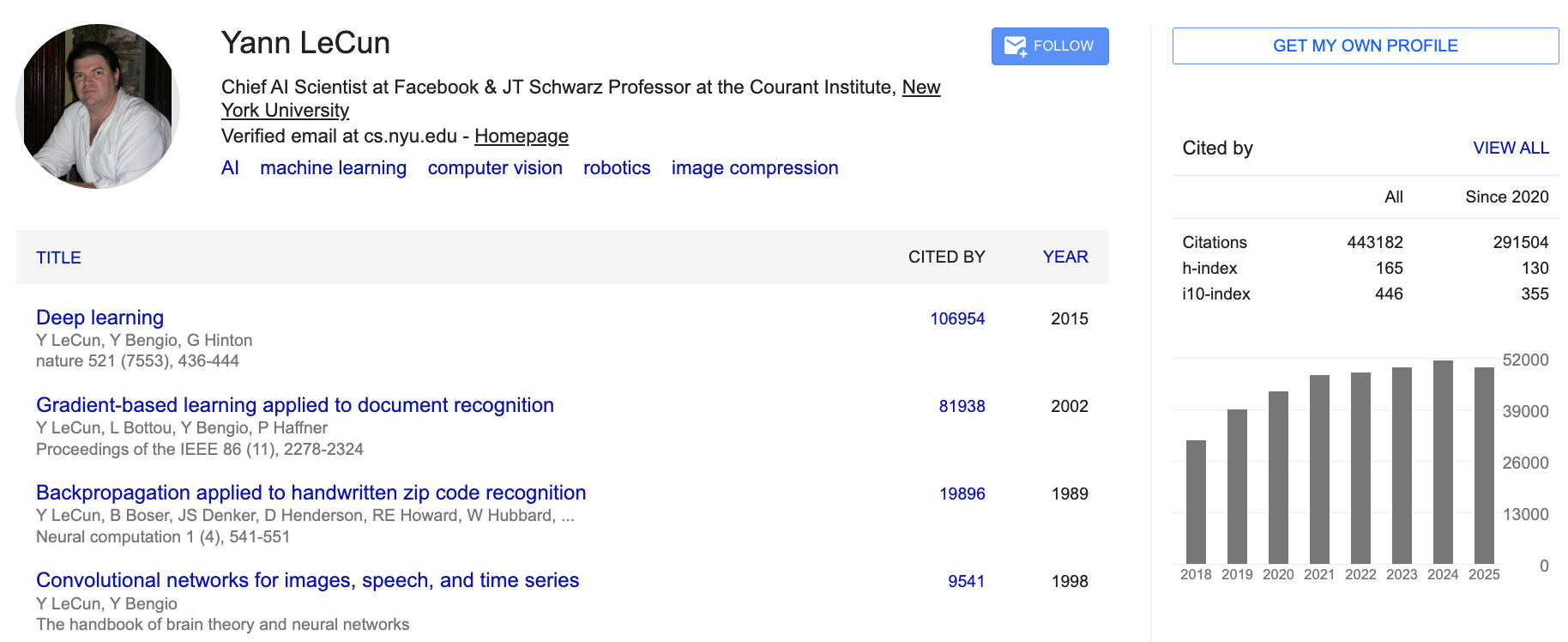
8. Yann LeCun (NYU / Meta, USA) ‑ Total citations: 443,182
Yann LeCun, born in France in 1960, is a professor at New York University and Chief AI Scientist at Meta, credited with inventing convolutional neural networks (CNNs) and advancing image AI. He developed the LeNet architecture that laid the groundwork for modern computer vision and has driven self‑supervised learning research. As one of the "three giants" of AI, he received the 2018 Turing Award, the 2025 Queen Elizabeth Engineering Award, and the 2025 New York Academy of Sciences prize, continuing to explore multimodal AI and robotics. His three most‑cited papers are:
- "Deep Learning" (2015, coauthored with Bengio and Hinton): The review explores biologically inspired deep networks, gradient flow issues and regularization techniques, illustrating successes in speech recognition and game AI. The paper helped consolidate deep learning as the core AI paradigm and influenced deployment across cloud and edge platforms.
- "Gradient‑Based Learning Applied to Document Recognition" (1998, coauthored with Bottou et al.): This paper describes LeNet‑5, using convolutions and subsampling for handwritten digit recognition, with detailed analysis of gradient descent optimization and error propagation. The early CNN application demonstrated parameter sharing benefits and advanced OCR technology and automated financial document processing.
- "Convolutional Networks for Images, Speech, and Time Series" (1995, coauthored with Bengio): The paper extends CNNs to speech and temporal data, discussing weight sharing and local connectivity for computational efficiency. It emphasizes end‑to‑end learning advantages and promoted multimodal AI, with applications in voice assistants and time‑series forecasting.
9. Xiangyu Zhang (StepFun, China) ‑ Total citations: 416,986
Xiangyu Zhang, born in the 1980s, is cofounder and chief scientist at StepFun, focusing on neural architecture design and efficient deep learning. He is an author of ResNet and ShuffleNet. A graduate of Xi'an Jiaotong University who worked at Microsoft Research Asia and Megvii, he has driven mobile AI optimization. As a researcher he holds multiple patents and awards, including a CVPR Best Paper Award in 2016, and in 2025 continues to lead efficient model research impacting embedded systems and edge computing. His three most‑cited papers are detailed below:
- "Deep Residual Learning for Image Recognition" (2016, coauthored with He, Ren and Sun): The paper introduces ResNet and residual modules for training very deep networks, discussing bottleneck designs and shortcut connections to improve gradient flow and achieving top performance on ImageNet. This innovation solved scalability issues in deep learning, advancing visual AI with applications in smartphone cameras and IoT devices.
- "ShuffleNet: An Extremely Efficient Convolutional Neural Network for Mobile Devices" (2017, coauthored with Xiang et al.): The paper proposes ShuffleNet, using group convolution and channel shuffle to reduce computation. It analyzes FLOPs optimization and experiments on ARM processors to enable efficient mobile deployment. The framework balances accuracy and speed, advancing edge AI for mobile apps and wearables.
- "ShuffleNet V2: Practical Guidelines for Efficient CNN Architecture Design" (2018, coauthored with Ma et al.): The paper upgrades ShuffleNet with practical design guidelines such as equal channel widths and avoiding costly group convolutions. It evaluates GPU/ARM efficiency metrics to improve real‑world performance. The work provided design principles that pushed efficient network research and applications in real‑time video processing and embedded systems.
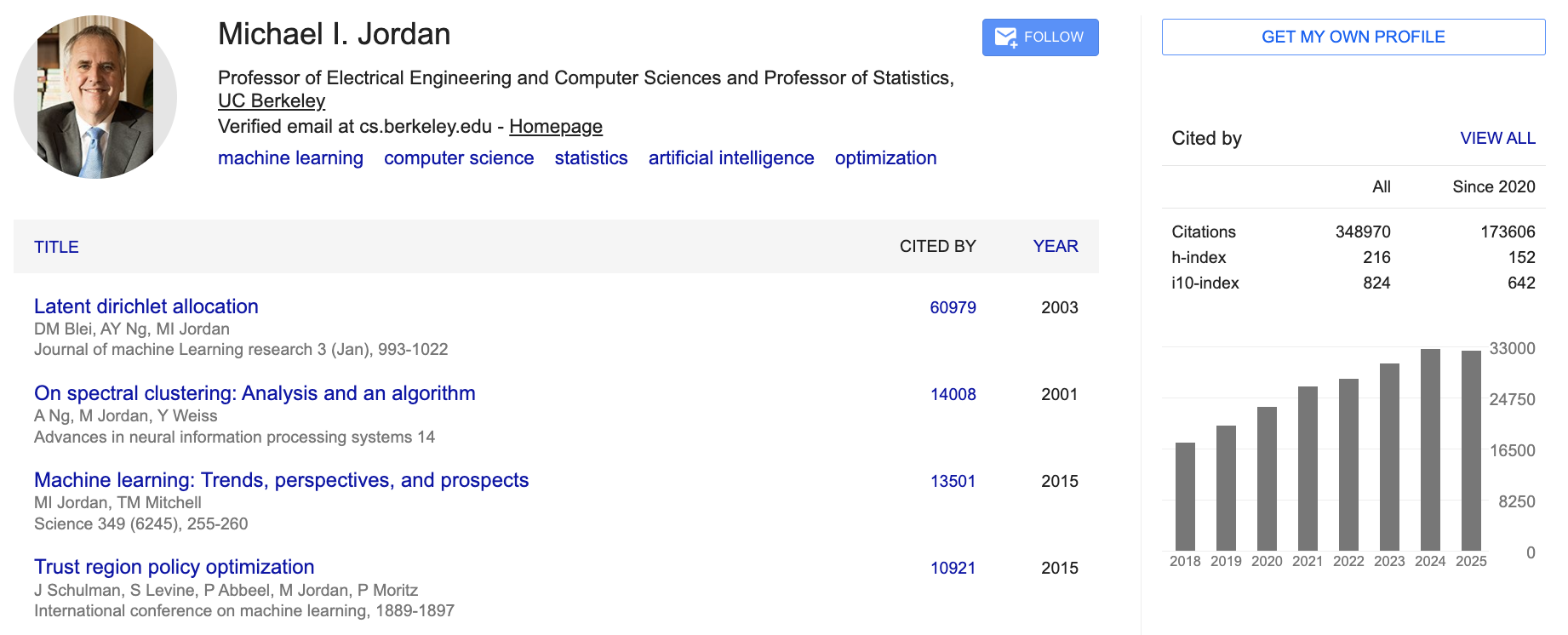
10. Michael I. Jordan (UC Berkeley, USA) ‑ Total citations: 348,970
Michael I. Jordan, born in 1956, is a professor at UC Berkeley who has integrated statistics and machine learning to advance AI foundations. He developed variational inference methods and the LDA topic model, bridging statistics and computational intelligence and impacting recommender systems and text analysis. As an AI pioneer he received the 2022 World Laureates Prize and the 2025 Knowledge Frontier Award, and continues to explore AI ethics and decision theory. His three most‑cited papers are detailed below:
- "Latent Dirichlet Allocation" (2003, coauthored with Blei and Ng): The paper introduces the LDA topic model using Dirichlet priors to model document‑topic distributions and details variational Bayesian inference and Gibbs sampling algorithms. This unsupervised method extracts latent topics and advanced text mining and recommender systems, with applications in news classification and social media analysis.
- "On Spectral Clustering: Analysis and an Algorithm" (2002, coauthored with Ng and Weiss): The paper presents spectral clustering using eigenvectors of the graph Laplacian to achieve nonlinear cluster separation. It analyzes normalized cuts and convergence properties. The algorithm handles complex data shapes and has been applied to image segmentation and bioinformatics clustering.
- "Hierarchical Mixtures of Experts and the EM Algorithm" (1994, coauthored with Jacobs et al.): The paper proposes hierarchical mixtures of experts using the EM algorithm to optimize gating functions and expert networks. It discusses soft‑assignment mechanisms' advantages and influenced ensemble learning, with applications in speech recognition and financial modeling.
11. Diederik P. Kingma (Anthropic, USA) ‑ Total citations: 336,511
Diederik P. Kingma, born in the Netherlands in 1987, is a machine learning researcher at Anthropic who focuses on generative models and scalable methods. He is co‑inventor of variational autoencoders (VAE) and the Adam optimizer. A graduate of the University of Amsterdam and a former OpenAI researcher, he has advanced deep learning from theory to large‑scale practice; as a pioneer he received the 2020 Nature Index Most‑Cited Paper Award and the 2025 Knowledge Frontier Award, and continues exploring generative AI and reinforcement learning. His three most‑cited papers are detailed below:
- "Auto‑Encoding Variational Bayes" (2013, coauthored with Welling): The paper proposes the variational autoencoder (VAE) using variational inference to approximate posterior distributions and enabling efficient generative model training. It details the reparameterization trick, ELBO loss and applications in image generation. The innovation addressed sampling challenges in traditional generative models and advanced unsupervised learning, with applications in data augmentation and drug discovery.
- "Adam: A Method for Stochastic Optimization" (2014, coauthored with Ba): The paper introduces the Adam optimizer, combining adaptive learning rates and momentum inspired by AdaGrad and RMSProp. It analyzes bias correction and empirical performance in deep networks, improving convergence speed. The algorithm became a standard in deep learning and boosted training efficiency across NLP and vision tasks.
- "An Introduction to Variational Autoencoders" (2019, coauthored with Welling): The paper surveys the VAE framework, including mathematical foundations, extensions such as conditional VAEs and applications in reinforcement learning. It discusses generative quality evaluation and latent‑space representations, solidifying VAE's role in generative AI and informing diffusion‑model research, with uses in art generation and anomaly detection.
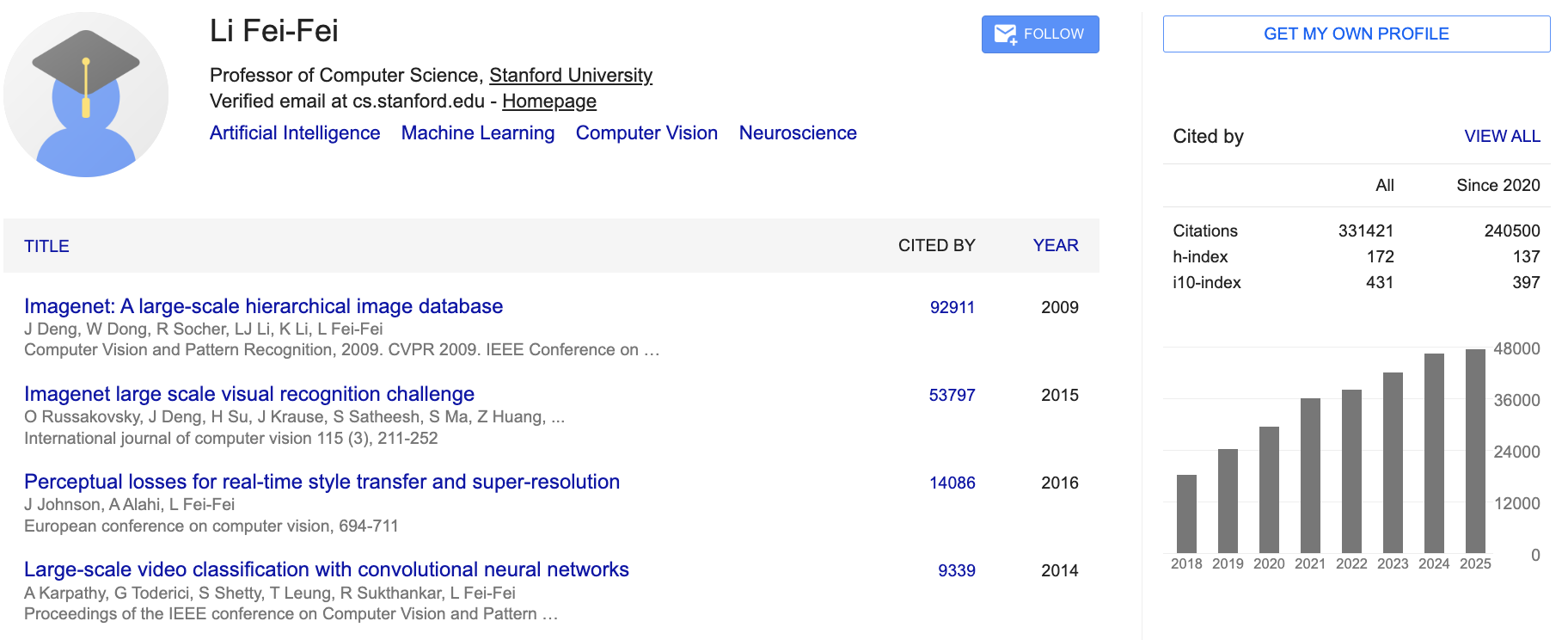
12. Fei‑Fei Li (Stanford University, USA) ‑ Total citations: 331,421
Fei‑Fei Li, born in Beijing in 1976, is the Sequoia Professor in Stanford's Computer Science Department and co‑director and founder of Stanford's Human‑Centered AI Institute (HAI), often called the "mother of computer vision." She created the ImageNet dataset, sparking the 2010s explosion in visual AI, served as Chief Scientist of Google Cloud AI/ML (2017–2018), and founded World Labs focusing on spatial intelligence and generative AI. Outside the "big three," she has been a key driver of computer vision, elected to the National Academy of Engineering and Medicine in 2020, the American Academy of Arts and Sciences in 2021, and named Time's "AI Architect" and recipient of the Queen Elizabeth Engineering Award in 2025. She continues to lead research in vision, robot learning and medical AI while advocating human‑centered AI ethics. Her three most‑cited papers are detailed below:
- ImageNet: A large‑scale hierarchical image database (2009, coauthored with Deng, Dong, Socher, Li and Li): The paper introduces the ImageNet dataset containing 14 million labeled images across 20,000 categories, constructed using the WordNet hierarchy. It details data collection methods, annotation workflows and benchmark evaluation protocols. The dataset became a training standard for deep learning, enabling breakthroughs such as AlexNet, revolutionizing computer vision and inspiring the ImageNet challenge, with wide use in detection, recognition and segmentation tasks.
- Visualizing and Understanding Convolutional Networks (2014, coauthored with Zeiler or related extensions): This work visualizes internal CNN representations using deconvolutional methods to reveal hierarchical feature learning. It discusses deconvnet techniques, feature inversion and interpretability experiments. The innovation improved deep models' explainability and fostered visualization tools, aiding model debugging and transfer learning with impact in medical imaging and autonomous driving.
- A Bayesian Hierarchical Model for Learning Natural Scene Categories (2005, coauthored with Perona): The paper proposes a Bayesian hierarchical model for natural scene classification that combines topic‑model ideas with variational inference to learn category distributions. It analyzes latent topic representations and unsupervised learning mechanisms. The work laid foundations for scene understanding and advanced semantic analysis from objects to whole images, influencing datasets such as Visual Genome.
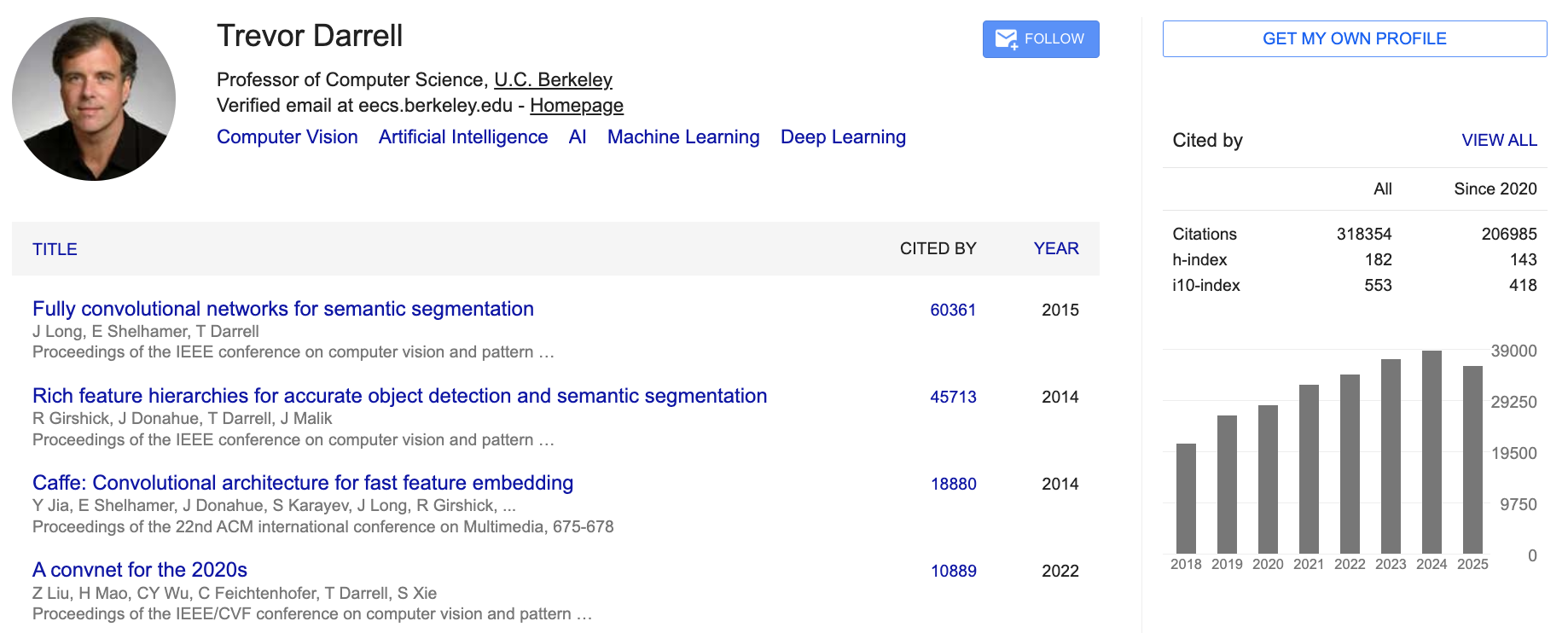
13. Trevor Darrell (UC Berkeley, USA) ‑ Total citations: 318,354
Trevor Darrell has advanced multimodal visual learning. His three most‑cited papers are below:
- "Rich Feature Hierarchies for Accurate Object Detection and Semantic Segmentation" (2014, coauthored with Girshick et al.): The paper introduces R‑CNN, using CNNs to extract region proposal features, detailing SVM classification and bounding‑box regression refinements. The framework increased detection accuracy and propelled end‑to‑end visual model development, with applications in autonomous vehicles and smart homes.
- "DeCAF: A Deep Convolutional Activation Feature for Generic Visual Recognition" (2014, coauthored with Donahue et al.): The paper proposes DeCAF, using pretrained CNN activations as general‑purpose visual features, and discusses transfer learning for classification and retrieval. The method simplified many vision tasks and supported AI deployment in resource‑constrained environments.
- "Long‑Term Recurrent Convolutional Networks for Visual Recognition and Description" (2017, coauthored with Donahue et al.): The paper combines CNNs and LSTMs to handle video sequences, describing spatiotemporal feature fusion and caption generation. The innovation advanced video understanding and enabled applications in surveillance and sports analytics.
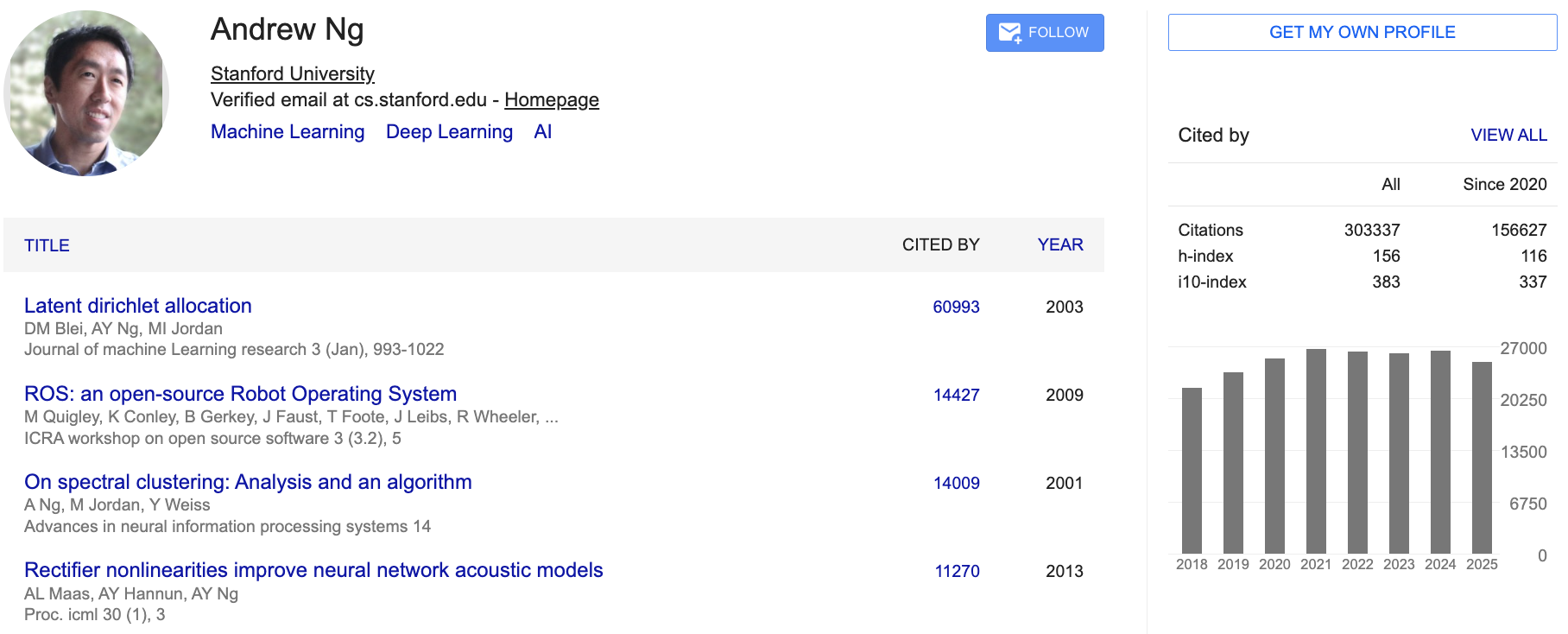
14. Andrew Ng (Stanford University, USA) ‑ Total citations: 303,233
Andrew Ng, born in London in 1976, is a professor at Stanford's Computer Science Department, cofounder and board chair of Coursera, founder of Landing AI and CEO of DeepLearning.AI. Educated at CMU, MIT and Berkeley, he led Google Brain and served as Baidu's chief scientist, promoting large‑scale deep learning adoption and founding the MOOC movement that educated millions. As an AI educator and entrepreneur he was named to Time's 2013 "100 Most Influential People," elected AAAI Fellow in 2020, and in 2025 joined a global AI governance council, continuing to lead work on machine learning, vision and enterprise AI transformation while advocating AI democratization and ethics. His three most‑cited papers are detailed below:
- "Latent Dirichlet Allocation" (2003, coauthored with Blei and Jordan): The paper introduces the LDA topic model that uses Dirichlet priors to model topic distributions in documents and presents variational Bayes and Gibbs sampling algorithms. This innovation addressed traditional topic‑modeling limits and advanced probabilistic methods in NLP, with broad applications in document classification, recommender systems and social media analysis.
- "On Spectral Clustering: Analysis and an Algorithm" (2001, coauthored with Jordan and Weiss): The paper presents spectral clustering using eigenvectors of the graph Laplacian, analyzing normalized cuts, dimensionality reduction and k‑means post‑processing. The work improved clustering robustness in high‑dimensional data and influenced applications in image segmentation and bioinformatics, as well as later graph neural network research.
- "Distance Metric Learning with Application to Clustering with Side‑Information" (2002, coauthored with Xing, Jordan and Russell): The paper proposes a distance metric learning framework that leverages side information such as pairwise similarity constraints to optimize a Mahalanobis distance, detailing convex optimization formulations and k‑means integration experiments. The innovation bridged supervised and unsupervised learning and advanced semi‑supervised clustering methods used in recommender systems and anomaly detection.
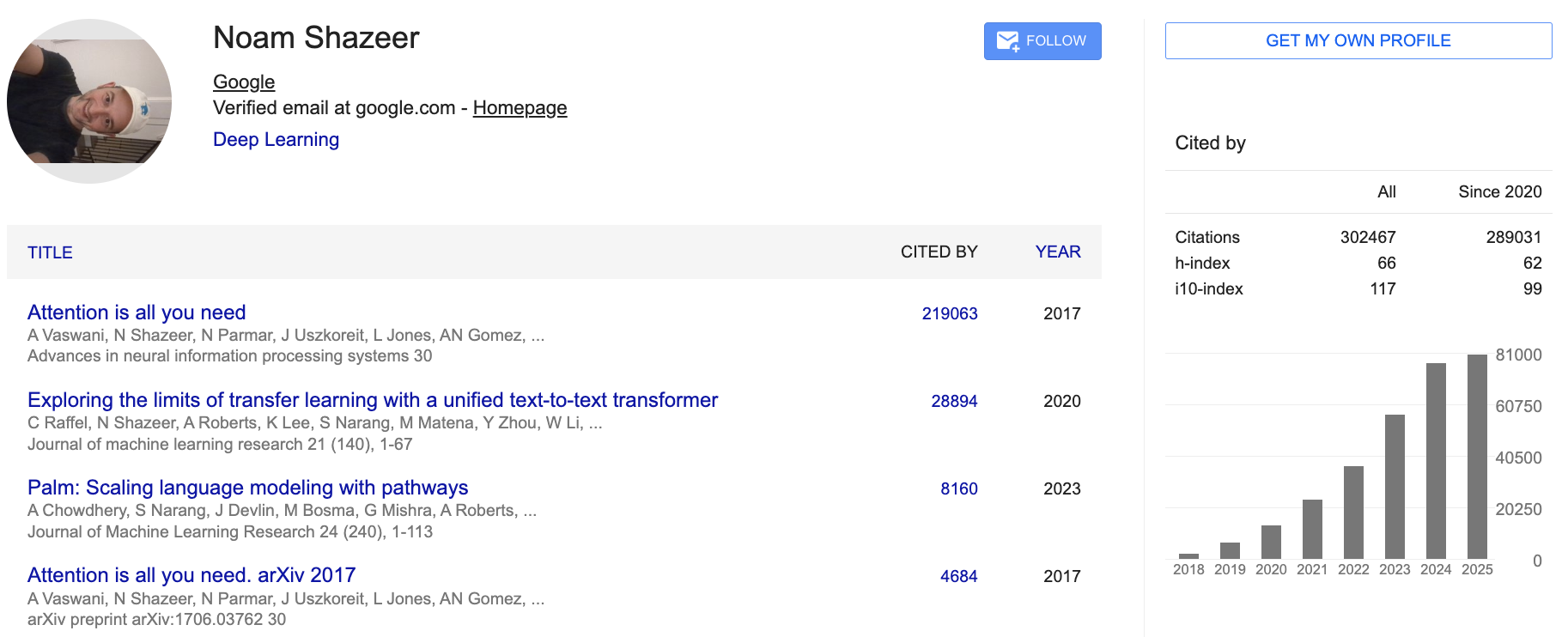
15. Noam Shazeer (Character.AI, USA) ‑ Total citations: 302,467
Noam Shazeer, born in 1975 or 1976, is founder and CEO of Character.AI and a former Google researcher who focuses on large‑scale neural networks and Transformer technology. He is a co‑inventor of attention mechanisms. A Duke University computer science graduate who led language model development at Google Brain, he helped move AI from sequential processing to multimodal systems. As an AI entrepreneur he appeared on TIME's 2023 AI list and in 2025 led Character.AI's innovations in conversational AI while exploring sparse activation and ethical applications of large models. His three most‑cited papers are:
- "Attention Is All You Need" (2017, coauthored with Vaswani et al.): The paper introduces the Transformer architecture, replacing RNNs with self‑attention for parallel computation. It details multi‑head attention, positional encodings and encoder‑decoder structures, outperforming RNNs on translation tasks. The innovation revolutionized NLP and propelled models such as BERT and GPT, with wide application in machine translation and text generation.
- "Outrageously Large Neural Networks: The Sparsely‑Gated Mixture‑of‑Experts Layer" (2017, coauthored with Lepikhin et al.): The paper proposes the mixture‑of‑experts (MoE) layer using sparse gating to scale models to trillions of parameters. It describes routing algorithms and noise injection for stable training, enabling efficient scaling. The framework reduced compute costs and influenced architectures like Switch Transformer and large‑scale distributed training.
- "Mesh‑TensorFlow: Deep Learning for Supercomputers" (2018, coauthored with Barham et al.): The paper develops Mesh‑TensorFlow to support distributed tensor computations, discussing strategies for data and model parallelism and demonstrating scalability on TPU clusters. The tool accelerated training of ultra‑large models and advanced AI hardware‑software co‑design for cloud and scientific simulation workloads.
The papers by these top 15 scholars are not only milestones in AI scholarship but also form core frameworks for deep learning, computer vision and data mining. From Bengio and Hinton's reviews to He's ResNet innovation, these works have driven technology from labs to commercial deployment, powering breakthroughs such as ChatGPT and autonomous driving. As multimodal and ethical AI rise, these contributions will continue to lead global innovation waves.
Notes:
h‑index is an author‑level metric that measures productivity and citation impact. Specifically, a scholar has an h‑index of h if they have at least h papers each cited at least h times, counting all publications regardless of discipline. The metric was proposed by physicist Jorge E. Hirsch in 2005 and is widely used to evaluate academic influence, though it can be affected by self‑citation, collaboration and field differences.
D‑index (Discipline H‑index) is a variant used by platforms such as Research.com similar to the h‑index (at least h papers each with at least h citations) but restricted to publications and citations within a specific discipline rather than across fields. This restriction makes the D‑index better suited to reflect contributions within a single field and avoids cross‑discipline inflation present in a global h‑index. The main difference is scope: the h‑index is global and may overestimate cross‑disciplinary researchers, while the D‑index is field‑specific and better for comparing influence within the same discipline. For example, in Research.com's computer science rankings the D‑index counts only papers in that field.
Related Articles:
2025 Global Top 10 LLMs: Comprehensive Comparison and Outlook of the US, China and Europe's Mistral
Top 10 Highly Cited AI Papers of the 21st Century (Video): Milestones from ResNet to Transformer
Top 10 Most‑Cited AI Papers of the 21st Century (Updated): From ResNet to Transformer
Microsoft Research's 2025 Top 10 AI Scientific Breakthroughs: From Quantum Chips to Biosecurity
Clarivate 2025 Highly Cited Researchers: China Doubles Share, CAS Tops Harvard for Third Year
▶️ Enjoyed this article? Creating great content takes effort!
Subscribe to our YouTube channel:
AI Rosetta
Your likes, subscriptions and shares mean the world to us! 🙏
For more AI news, visit:
https://www.airosetta.com