

Since deep learning was introduced to the AI field in 2006, artificial intelligence (AI)—particularly AI based on large language models (LLMs)—has been spreading worldwide at an unprecedented speed. Its profound influence has moved from laboratories into industrial practice, reshaping how we work, live and organize society. From generative AI to autonomous driving, from medical diagnosis to financial risk control, AI applications are virtually everywhere. Behind this wave of change, a number of seminal papers that laid the technical foundations have played a decisive role. They not only drove algorithmic breakthroughs but also deeply influenced the technical evolution of both academia and industry.
This article lists the ten AI top papers with the highest citation counts to date (data source: Google Scholar). Each of these papers has been cited more than 100,000 times and can be regarded as a cornerstone of the AI knowledge pyramid. The algorithms and frameworks they proposed—such as ResNet, Adam, Transformer and BERT—are deeply embedded in today’s mainstream AI systems and serve as the invisible pillars behind countless engineering projects and products.
1. “Deep Residual Learning for Image Recognition” (He et al., 2016)
🔗 Google Scholar: Kaiming He et al.
When training deep neural networks, increasing depth often leads to vanishing gradients or degradation (training error stops decreasing or even increases). To address this bottleneck, Kaiming He and colleagues proposed the residual network (ResNet) in 2015. Its core idea is to have the network learn a residual function—i.e., the increment between the input x and the desired mapping F(x)—rather than directly fitting H(x). This is implemented via identity skip‑connections that add the input directly to the output, making network optimization more stable.
They built ResNet variants such as ResNet‑50, ResNet‑101 and ResNet‑152; the deepest reached 152 layers yet remained efficiently trainable. On the ImageNet classification task, ResNet‑152 achieved a winning error rate of only 3.57% and secured top performance across competitions such as ImageNet and COCO. The paper broke the misconception that deeper networks are inherently harder to train or must be limited in depth, becoming a milestone in computer vision and visual AI.
To date, it remains one of the most‑cited papers in the AI field.
✨ Impact
- The ResNet architecture is widely used in image classification, object detection and segmentation
- It guided subsequent deep model designs such as DenseNet and Inception‑ResNet
- The skip‑connection idea has been adopted in Transformers, AlphaFold and many other domains

Screenshot 2025‑12‑11
2. Adam: A method for stochastic optimization (D. P. Kingma & J. Ba, 2014)
🔗 Google Scholar: Kingma & Ba, 2015
In 2015, Diederik P. Kingma and Jimmy Ba published “Adam: A Method for Stochastic Optimization” at ICLR, proposing an efficient stochastic optimization algorithm—Adam (Adaptive Moment Estimation)—which became one of the most commonly used optimizers in deep learning. The method combines ideas from Momentum (first‑moment estimation) and RMSProp (second‑moment estimation) to adaptively adjust learning rates for each parameter.
Adam computes exponential moving averages of the first and second moments of the gradients and applies bias correction to provide stable estimates during early training. Its update rules are robust and relatively insensitive to hyperparameters, so default settings work well across many deep learning tasks.
Compared with SGD, Adam offers fast convergence and the ability to handle sparse gradients, making it widely used in neural network training—particularly in natural language processing, image generation and reinforcement learning. It is also included as a default optimizer in mainstream frameworks like TensorFlow and PyTorch.
✨ Impact
- Supplanted SGD as one of the most commonly used optimizers in deep learning
- Inspired many variants such as AdamW, AMSGrad and RAdam
- Widely applied in training Transformers, GANs, BERT, GPT and other mainstream models
📈 Currently cited over 237,000 times, ranking among the top ten most‑cited papers in the history of machine learning.

Screenshot 2025‑12‑11
3. “Attention Is All You Need” (2017, Vaswani et al.)
🔗 Google Scholar: Vaswani et al. scholar.google.com
In 2017, a team at Google including Vaswani proposed the Transformer architecture, which revolutionized natural language processing (NLP). The core idea is to abandon traditional recurrent (RNN) or convolutional structures and rely entirely on self‑attention to compute the importance of each input token relative to others in the sequence. This design brought two major breakthroughs:
- Greater parallelism: Traditional RNNs and CNNs rely on sequential processing and face performance bottlenecks, while the Transformer enables highly parallel training and significantly faster throughput.
- Improved long‑range context modeling: Self‑attention allows the model to directly access any position in the input sequence, enhancing its ability to capture long‑distance dependencies.
The paper reported strong results on WMT English→German and English→French translation tasks and required only eight GPUs for efficient training. Since then, the Transformer has been widely used for LLMs, machine translation, summarization and question answering; virtually all GPT‑series models and many multimodal systems (such as GPT‑4) trace back to this mechanism. It is one of the most‑cited papers of the 21st century, with over 207,000+ citations to date.
✨ Impact
- Became the theoretical foundation for models like BERT, GPT and T5
- Propelled NLP into the era of large models
- Inspired researchers to apply attention mechanisms to images, audio and other multimodal tasks

Screenshot 2025‑12‑11
4. Random forests (L. Breiman, 2001)
🔗 Google Scholar citation page: Leo Breiman
In 2001, statistician Leo Breiman published the seminal paper “Random Forests” in the journal Machine Learning, formally introducing the random forest algorithm. The method combines ensembles of decision trees with random feature selection, greatly improving performance and generalization in classification and regression tasks. It is one of the most influential ensemble learning algorithms in machine learning.
Its core mechanisms include:
- Bagging (bootstrap sampling): Sampling the training data with replacement multiple times to train independent decision trees;
- Random feature subset selection: At each split, each tree considers only a random subset of features to find the best split, increasing model diversity;
- Majority voting / averaging: Use majority voting for classification and averaging for regression.
Random forests offer high accuracy, robustness to overfitting and the ability to evaluate feature importance. They are suitable for high‑dimensional and imbalanced data and are widely used in finance, medical diagnosis and bioinformatics. The paper laid the foundation for modern ensemble learning and has been cited more than 170,000 times as of the end of 2025.

Screenshot 2025‑12‑11
5. Very deep convolutional networks for large‑scale image recognition (K. Simonyan & A. Zisserman, 2014)
🔗 Google Scholar: Simonyan & Zisserman, 2014
In 2014, the Visual Geometry Group (VGG) at the University of Oxford—Karen Simonyan and Andrew Zisserman—published “Very Deep Convolutional Networks for Large‑Scale Image Recognition,” systematically exploring the impact of network depth on image recognition performance. The paper proposed a series of convolutional neural network architectures ranging from 11 to 19 layers, with the most representative models being VGG‑16 and VGG‑19.
The VGG design principle is to replace large convolutional kernels with stacks of multiple 3×3 small kernels to increase the model’s nonlinear expressiveness and deepen the network to improve performance. On the ImageNet ILSVRC 2014 classification task, VGG achieved a Top‑5 error rate of 7.3%, second only to GoogLeNet at the time.
Although VGG has a large number of parameters and heavy computational cost, its regular, modular structure made it a common backbone for later models (e.g., Faster R‑CNN, style transfer). It also provided practical groundwork for deeper networks like ResNet and is a milestone in the design history of deep visual models.
✨ Impact
- Introduced the “small convolution + deep stacking” design paradigm with lasting influence
- Became one of the most commonly used feature extractors in computer vision tasks
- Provided foundational structure and ideas for later architectures such as ResNet
📈 Currently cited over 154,000 times, making it one of the most‑cited papers in computer vision.

Screenshot 2025‑12‑11
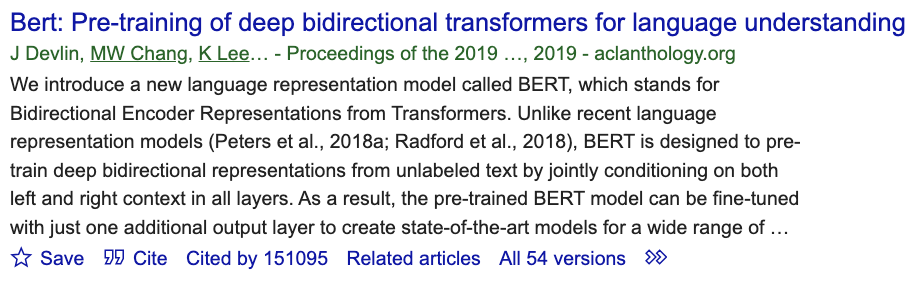
6. BERT: Pre‑training of Deep Bidirectional Transformers for Language Understanding (J. Devlin, M.‑W. Chang, K. Lee, 2019)
🔗 Google Scholar: Devlin et al., 2018
In 2018, Jacob Devlin and colleagues at Google AI released the groundbreaking paper “BERT,” which first proposed pretraining deep bidirectional Transformer representations for language modeling. BERT (Bidirectional Encoder Representations from Transformers) fundamentally changed the paradigm for natural language understanding (NLU) by introducing the “pretraining + fine‑tuning” methodology.
BERT’s innovation lies in using bidirectional self‑attention and pretraining objectives such as Masked Language Modeling (MLM) and Next Sentence Prediction (NSP), allowing the model to understand context without the left‑to‑right constraint of unidirectional models (e.g., GPT). This enabled BERT to capture richer syntactic and semantic information.
BERT set new state‑of‑the‑art results on benchmarks including GLUE, SQuAD and SWAG, and its released bert‑base and bert‑large models became industry standards. It also paved the way for subsequent variants like RoBERTa, ALBERT and DistilBERT.
✨ Impact
- Established the “pretraining + fine‑tuning” paradigm, reshaping the NLP ecosystem
- Promoted large‑scale corpus pretraining as mainstream practice
- Became a foundational model for tasks such as question answering, sentiment analysis and text classification
📈 Currently cited over 151,000+ times, making it one of the most influential papers in the history of natural language processing.
Screenshot 2025‑12‑11
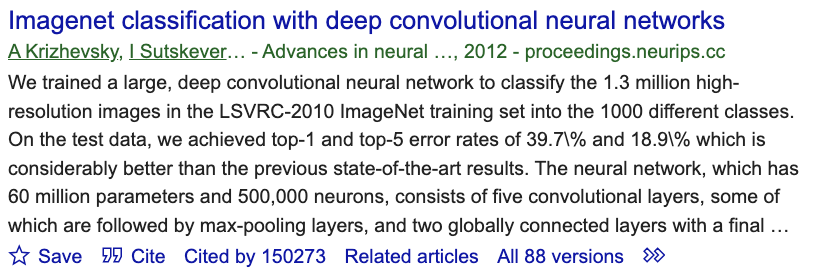
7. ImageNet Classification with Deep Convolutional Neural Networks (AlexNet, Krizhevsky et al., 2012)
🔗 Google Scholar citation page: Alex Krizhevsky / Geoffrey Hinton
In 2012, Alex Krizhevsky, Ilya Sutskever and Geoffrey Hinton published a revolutionary paper that introduced large‑scale convolutional neural networks (CNNs) to the ImageNet classification task and rewrote the history of computer vision. The network contained roughly 60 million parameters with 5 convolutional layers and 3 fully connected layers, achieving a Top‑5 error rate of 15.3% on 1000‑class ImageNet—more than 10 percentage points better than the previous runner‑up—breaking the performance record at the time.
Key innovations included:
- ReLU activation: Systematically using ReLU instead of tanh/sigmoid to speed up training and alleviate vanishing gradients;
- GPU‑accelerated training: Training on dual GPUs reduced training time from weeks to days;
- Dropout regularization: Introducing dropout in fully connected layers to reduce overfitting;
- Local response normalization (LRN): Encouraging competitive neuron responses to improve generalization.
This paper not only demonstrated CNNs’ feasibility for large‑scale image tasks but also integrated multiple key deep learning techniques, laying the foundation for modern vision models. It ignited a deep learning wave that propelled the GPU ecosystem and open‑source frameworks (such as Caffe and TensorFlow). According to Google Scholar, by the end of 2025 the paper has been cited more than 150,000 times and is among the most milestone‑defining works in AI research.
Screenshot 2025‑12‑11
8. U‑Net: Convolutional Networks for Biomedical Image Segmentation (O. Ronneberger, P. Fischer, T. Brox, 2015)
🔗 Google Scholar: Ronneberger et al., 2015
In 2015, Olaf Ronneberger and colleagues at the University of Freiburg published “U‑Net: Convolutional Networks for Biomedical Image Segmentation” at MICCAI, proposing the U‑Net architecture specifically designed for medical image segmentation. The network uses a symmetric encoder–decoder structure and employs skip connections to transfer high‑resolution features from the encoder to the decoder, improving segmentation accuracy.
The name U‑Net comes from its U‑shaped architecture: the left side extracts semantic features (the contracting path) while the right side recovers spatial information (the expanding path). This design is especially effective in medical imaging where training data are limited, balancing localization precision with contextual understanding.
The method achieved leading results in multiple medical segmentation challenges (e.g., ISBI 2015) and quickly expanded into remote sensing, agriculture and industrial inspection. Due to its clear structure and strong performance, U‑Net is regarded as one of the most influential architectures in semantic segmentation.
✨ Impact
- Introduced the encoder–decoder + skip‑connection segmentation paradigm
- Widely applied to medical imaging, satellite imagery and autonomous driving segmentation tasks
- Spawned many variants such as U‑Net++, Attention U‑Net and nnU‑Net
📈 Currently cited over 125,000 times, making it one of the most‑cited papers in image segmentation and medical imaging.

Screenshot 2025‑12‑11
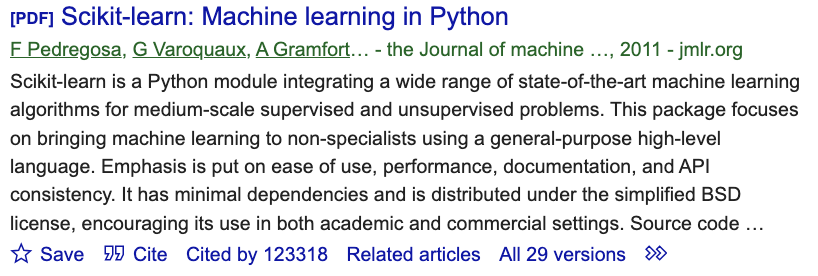
9. Scikit‑learn: Machine Learning in Python (F. Pedregosa, G. Varoquaux, A. Gramfort, et al., 2011)
🔗 Google Scholar: Pedregosa et al., 2011
In 2011, Fabian Pedregosa and colleagues published “Scikit‑learn: Machine Learning in Python,” introducing one of the most widely used machine learning libraries in the Python ecosystem—Scikit‑learn. Built on NumPy, SciPy and matplotlib, the library provides a rich, consistent and efficient API covering classification, regression, clustering, dimensionality reduction, model selection and preprocessing.
Scikit‑learn’s core philosophy is simple usability, modular design and an object‑oriented API, enabling non‑experts to quickly deploy machine learning models. Its unified .fit() / .predict() / .transform() interface greatly reduces the complexity of model switching and pipeline construction.
The library became a cornerstone of the Python data science stack, widely used in education, research and industry prototyping, and influenced the API design of other tools such as TensorFlow, PyTorch Lightning, XGBoost and LightGBM.
✨ Impact
- Established standard API practices for machine learning engineering
- Helped make Python the mainstream language for data science
- Became the preferred toolkit for learning and prototyping machine learning
📈 Currently cited over 123,000 times, making it one of the most‑cited papers in machine learning engineering practice.
Screenshot 2025‑12‑11
10. Deep Learning (Y. LeCun, Y. Bengio & G. Hinton, 2015)
🔗 Google Scholar: LeCun, Bengio & Hinton, 2015
In 2015, Yann LeCun, Yoshua Bengio and Geoffrey Hinton—three Turing Award laureates—published the review article “Deep Learning” in Nature, comprehensively summarizing the breakthroughs of deep learning across computer vision, speech recognition and natural language processing. The article systematically reviewed the evolution of deep neural networks (especially CNNs and RNNs) and articulated the fundamental principles of deep learning: multi‑level feature representation, end‑to‑end training and the support of large‑scale data.
The review traced developments from the perceptron to backpropagation, from autoencoders to deep belief networks, and from AlexNet to industrial applications, emphasizing the roles of GPU computation, large datasets and improved optimization algorithms (such as ReLU, Dropout and Adam) in the rise of deep learning.
The paper had profound influence across academia and industry and is considered a milestone marking deep learning as an independent research direction.
✨ Impact
- Consolidated the “big three” of deep learning and accelerated AI’s mainstream adoption
- Became an authoritative review for AI education, research and industrial practice
- Guided subsequent developments in Transformers, reinforcement learning and large models
📈 Currently cited over 105,000 times, making it one of the most‑cited computer science papers published in Nature.

Screenshot 2025‑12‑11
Overall, these ten highly cited papers collectively construct the core technology map of contemporary artificial intelligence. From image recognition (ResNet, VGG, AlexNet) to natural language understanding (Transformer, BERT), and from optimization algorithms (Adam) to tooling ecosystems (Scikit‑learn), each has played a key role in translating AI theory into engineering practice.
More importantly, these papers are not only summaries of scientific achievements but also starting points for future innovation. They have inspired numerous derivative studies and driven new waves of research in large‑model architectures, multimodal fusion, explainable AI and automated machine learning (AutoML). As AI continues to penetrate society, it is reasonable to expect more epoch‑making papers to emerge and keep writing the new chapters of “human + machine intelligence.”
▶️ 喜欢这篇内容?创作真的很辛苦!
欢迎关注我们的 YouTube 频道:
AI Rosetta
你的点赞、订阅和分享,是对我们最大的支持!🙏
更多AI新闻请访问:
https://www.airosetta.com