
On October 6, 2026, OpenAI published on GitHub a batch of mathematical research produced by internal unreleased frontier models, once again creating a stir in the mathematics community. The repository contains 722 manuscripts organized into 372 result families, covering algebra, number theory, theoretical computer science, logic, topology and other fields. Many proofs include Lean formal verification, and some results are accompanied by model‑reasoning summaries and computational‑cost estimates. The move follows Meta's earlier disclosure that Muse Spark assisted in resolving several open problems, further intensifying debate about AI's advance in mathematical capability.
Details
OpenAI said on its official blog that these results stem from evaluations of internal frontier models: about 4,000 problems were posed to the models, producing 372 groups of related results. On average each result consumed computing resources equivalent to roughly three hours of ChatGPT Pro "deep thinking." The repository was released under the Apache 2.0 license and includes papers, supporting proofs, some Lean formal files, and ten selected reasoning summaries. The company pledged to continue adding formal verifications and to explore community‑hosted options that comply with mathematics‑committee guidelines.
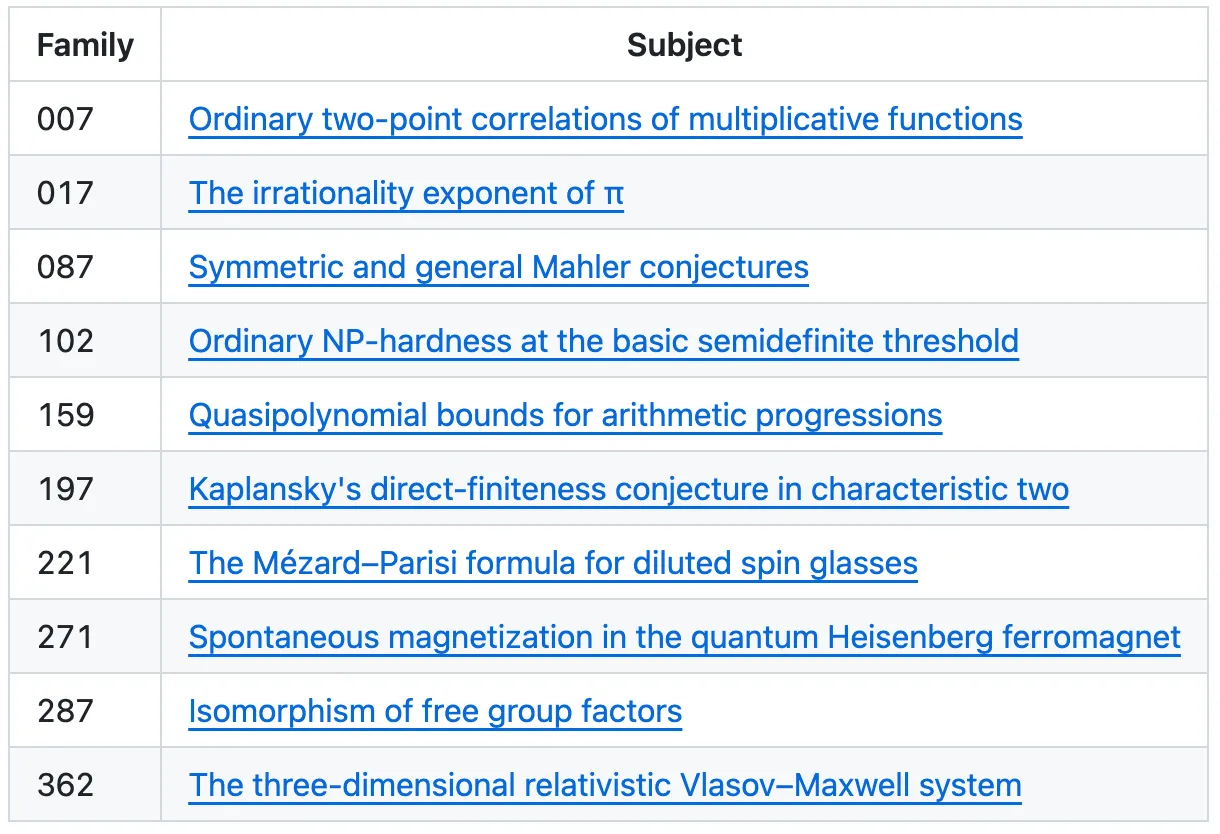
Reports indicate the results include a solution to the four‑dimensional Kakeya conjecture, several important algorithmic improvements, and substantive progress on problems related to the Riemann hypothesis. OpenAI emphasized that most results were produced by a single AI agent from a single prompt, differing from earlier work such as the Navier–Stokes resolution that relied on large‑scale multi‑agent collaboration. The release process was guided by the newly established independent Advisory Group on Mathematics and AI (AGMAI), intended to communicate AI‑generated results to the mathematics community in a more responsible way.
Significant Problems Summarized
1. Quasi‑Riemann Hypothesis — a new boundary for zero distributions
Plain‑language explanation: The Riemann hypothesis is one of the most famous unsolved problems in mathematics, asserting that all nontrivial zeros of the Riemann zeta function lie exactly on a single line. This result does not fully prove the Riemann hypothesis, but it establishes a weaker yet still important version: all Dirichlet L‑functions (including the Riemann zeta function) have no zeros in the region with real part greater than 7/8.
In other words, where we previously only had a rough idea of the "danger zone," the "safe zone" has now been significantly expanded. This is a substantive step toward resolving the Riemann hypothesis and has a Lean formal verification.
2. Mahler's conjecture (symmetric and general cases)
Plain‑language explanation: Mahler's conjecture concerns the relationship between the volume of a convex body and the volumes of its projections. Simply put, it asks whether there is an optimal inequality relating a high‑dimensional object's volume to the volumes of its "shadows" in various directions.
The symmetric case of Mahler's conjecture has been proved, and important progress has been made on the general case. This has foundational significance for convex geometry, volume estimates and related analysis, providing a more precise measure of how "round" or "pointed" a shape can be.
3. Counterexample to Kaplansky's zero divisor conjecture
Plain‑language explanation: This conjecture from ring theory (a branch of abstract algebra) roughly asserts that in certain "group algebras" there are no zero divisors — that is, two nonzero elements whose product is zero should not exist.
OpenAI's model found a counterexample, showing the conjecture does not hold. This implies that algebraic structures once thought to be "clean" may contain hidden zero‑product relationships, directly affecting our understanding of infinite groups and operator algebras.
4. Isomorphism problem for free‑group factors
Plain‑language explanation: In von Neumann algebras there is a class known as "free‑group factors," and a long‑standing question has been whether factors generated by different free groups are actually the same (isomorphic).
The results indicate that all noncommutative free‑group factors are isomorphic. This resolves a longstanding foundational problem in operator algebra, effectively proving that seemingly different infinite‑symmetry structures are, in essence, the same.
5. Four‑dimensional Kakeya conjecture
Plain‑language explanation: The Kakeya problem originates from a geometric puzzle: how small an area is needed for a needle to rotate freely in a plane? Its higher‑dimensional versions ask whether one can cover all directions in n‑dimensional space with sets of very small volume.
A solution to the four‑dimensional Kakeya conjecture means the lower bound for directional coverage volume in four‑dimensional space has been determined. This has important implications for harmonic analysis, partial differential equations and geometric measure theory, serving as a crucial bridge between geometry and analysis.
These five problems come from number theory, convex geometry, abstract algebra, operator algebras and geometric analysis, respectively. Most have full or partial machine‑verifiable formal proofs. While not all are at the "Millennium Prize" level, they are long‑standing open problems within their subfields. OpenAI's concentrated release has surfaced issues that might otherwise have taken years or decades to advance, prompting deep discussion in the mathematical community about research pace and the role of humans.
Potential Impacts
1. Disruption to research cadence and evaluation standards
The rapid influx of hundreds of claimed advances far exceeds the traditional mathematical community's capacity to absorb them. Even when some results have Lean verification, mathematicians need time to judge whether they contain genuinely new ideas or are clever recombinations of existing techniques. This may force academia to accelerate the development of review, citation and priority norms for AI‑assisted results.
2. Repositioning the role of human mathematicians
When models can produce verifiable proofs at relatively low computational cost and in volume, the human strengths of posing questions, building intuition and finding deep connections become more precious. Some researchers worry that resource imbalances will disadvantage individual mathematicians on computation‑intensive problems; others see AI as a powerful assistant that lets humans focus on higher‑level conceptual innovation and problem selection.
3. Research ethics and authorship disputes
How to credit AI‑generated manuscripts, attribute contributions and prevent "salami‑slicing" of publications are pressing issues. OpenAI's choice to publish on GitHub with revision and citation protocols is an experiment, but long‑term consensus from the academic community will be needed.
4. Acceleration of formal verification adoption
The public availability of many Lean proofs may push formal‑mathematics tools into more widespread use in everyday research. In the future, being "machine‑checkable" could become an important credibility standard, especially when AI is heavily involved.
5. Power shifts between industry and academia
Technology companies that control frontier models and massive compute are producing mathematical results at an unprecedented pace. This could shift the center of knowledge production away from traditional academic institutions and drive universities and research institutes to seek deeper collaboration with AI labs.
6. Implications for mathematical education and talent development
Young mathematicians may need to master both traditional proof techniques and the use of AI tools and formal‑verification systems. Educational programs may need to adapt, emphasizing critical review of AI outputs and the ability to pose valuable problems rather than merely chasing solution speed.
Conclusion
OpenAI's one‑time release of over 700 mathematical manuscripts on GitHub marks another landmark in AI's intervention in frontier mathematical research. It demonstrates the models' strong generative and verification capabilities on open problems and foregrounds the pressing question: "Where do human mathematicians fit in?" In the short term, the community will be occupied with verifying, understanding and assimilating these results. In the long term, the real challenge is building a healthy human–machine collaboration ecosystem that leverages AI's computational and search strengths while preserving human intuition, aesthetics and deep insight. AI may not replace mathematics, but it is profoundly changing how mathematical discoveries are made, validated and transmitted. The future of human mathematicians may lie not in racing machines but in defining which problems truly deserve to be asked.
▶️ Enjoyed this article? Creating great content takes effort!
Subscribe to our YouTube channel:
AI Rosetta
Your likes, subscriptions and shares mean the world to us! 🙏
For more AI news, visit:
https://www.airosetta.com