
On October 2, 2026, Meta AI Research formally announced a set of results: its latest reasoning model, Muse Spark, collaborated with several mathematicians to produce six research papers, five of which provide solutions to previously open problems. The collaboration was carried out through the regular meta.ai chat interface (Thinking Mode) without a customized research framework or specialized agent system. The papers clearly indicate which parts were primarily drafted by humans and which were generated by the model, and they were independently reviewed by a second group of mathematicians. Meta also acknowledged that parts of the work were independently solved by other teams using different methods.
Details
Previously, Meta models have reached gold‑medal level in multiple high‑school Olympiad‑style competitions (mathematics, physics, chemistry). This work further tests the model's contribution on genuinely open research problems with no predetermined solution path. Fields covered include probability, partial differential equations (PDEs), group theory, optimization, arithmetic physics and nonassociative algebra.
Specific results include:
1. Probability: Sharp threshold for exact Gaussian ellipsoid fitting
Paper: The Strict Threshold for Gaussian Ellipsoid Fitting
Lead contributor: Aykut Arslan (in collaboration with Muse Spark), reviewed by Babak Modami, Alexander Roitershtein, Mark Sepanski and Grigory Sokolov.
Core result: In high‑dimensional space there is a sharp threshold determining whether random Gaussian points can lie exactly on an ellipsoidal surface centered at a fixed point. Below the threshold exact fitting exists with high probability; above it, it is almost surely impossible.
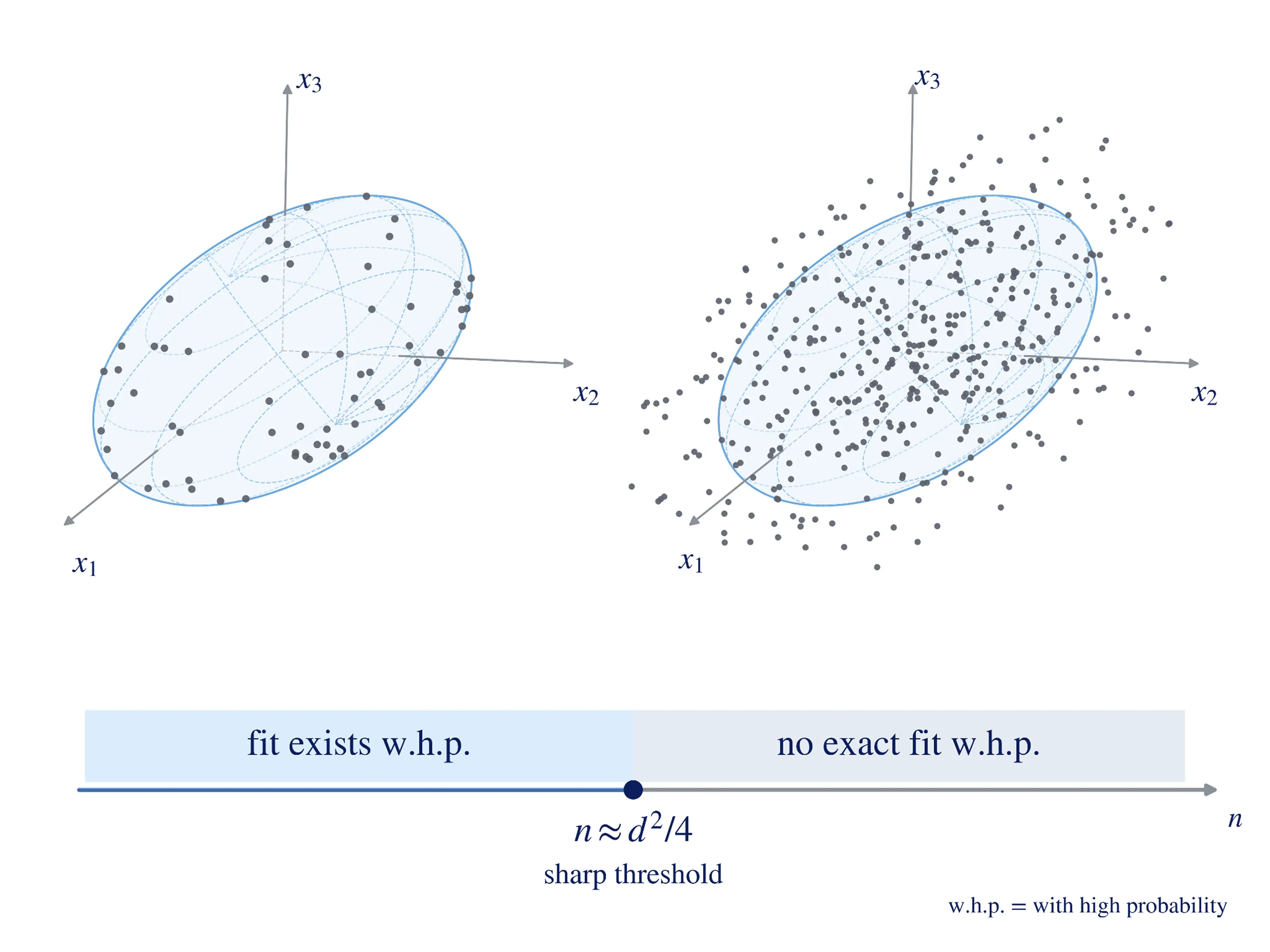
Figure 1: Illustration showing the abrupt transition from "possible" to "unlikely" for exact ellipsoid fitting as the number of random points grows in high dimensions.
The result establishes a benchmark for theoretical limits of exact data fitting (behavior at the threshold point itself remains unresolved). The proof strategy was iteratively developed and revised with Muse Spark's assistance. Three independent teams (Misiakiewicz & Wen, De la Cerda et al., Koehler & Sohn) obtained related results by different methods around the same time.
2. PDEs: Finite‑time blow‑up for the mass‑critical biharmonic nonlinear Schrödinger equation
Paper: Finite‑Time Blow‑Up of Radial Negative‑Energy Solutions for the Mass‑Critical Biharmonic Nonlinear Schrödinger Equation
Lead contributor: Leonard Dinh (in collaboration with Muse Spark), reviewed by Fazel Hadadifard and Salem Selim.
Core result: For the mass‑critical biharmonic nonlinear Schrödinger equation motivated by laser physics, it is proven that radially symmetric solutions with negative energy must blow up in finite time in two or more dimensions.
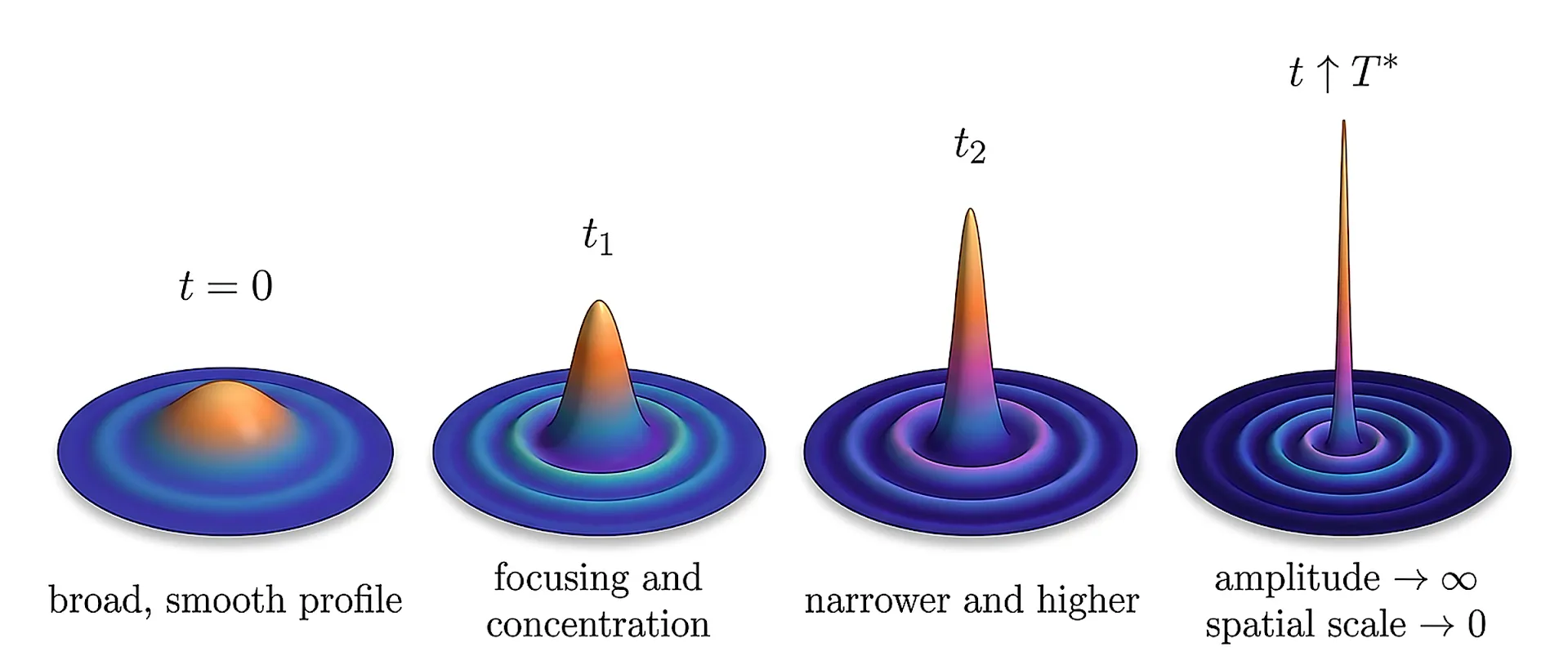
Figure 2: Illustration showing waves becoming increasingly narrow and tall as they approach finite‑time collapse.
This resolves a question that had been open since around 2015 and confirms predictions from 2002 numerical simulations, clarifying conditions under which wave collapse is unavoidable in this setting. Muse Spark mainly assisted with symbolic computation, testing argument paths and revising the proof.
3. Group theory: Semiabelian groups need not be monomial (counterexample)
Paper: Semiabelian Groups Need Not Be Monomial
Lead contributors: Joseph Phillip Brennan, Milana Golich (in collaboration with Muse Spark), reviewed by Andres Barei and John Portin.
Core result: This disproves a conjecture by M. Kida (2024) that "every finite semiabelian group is monomial." The team found a counterexample of order 384, proving the two properties do not always coincide.
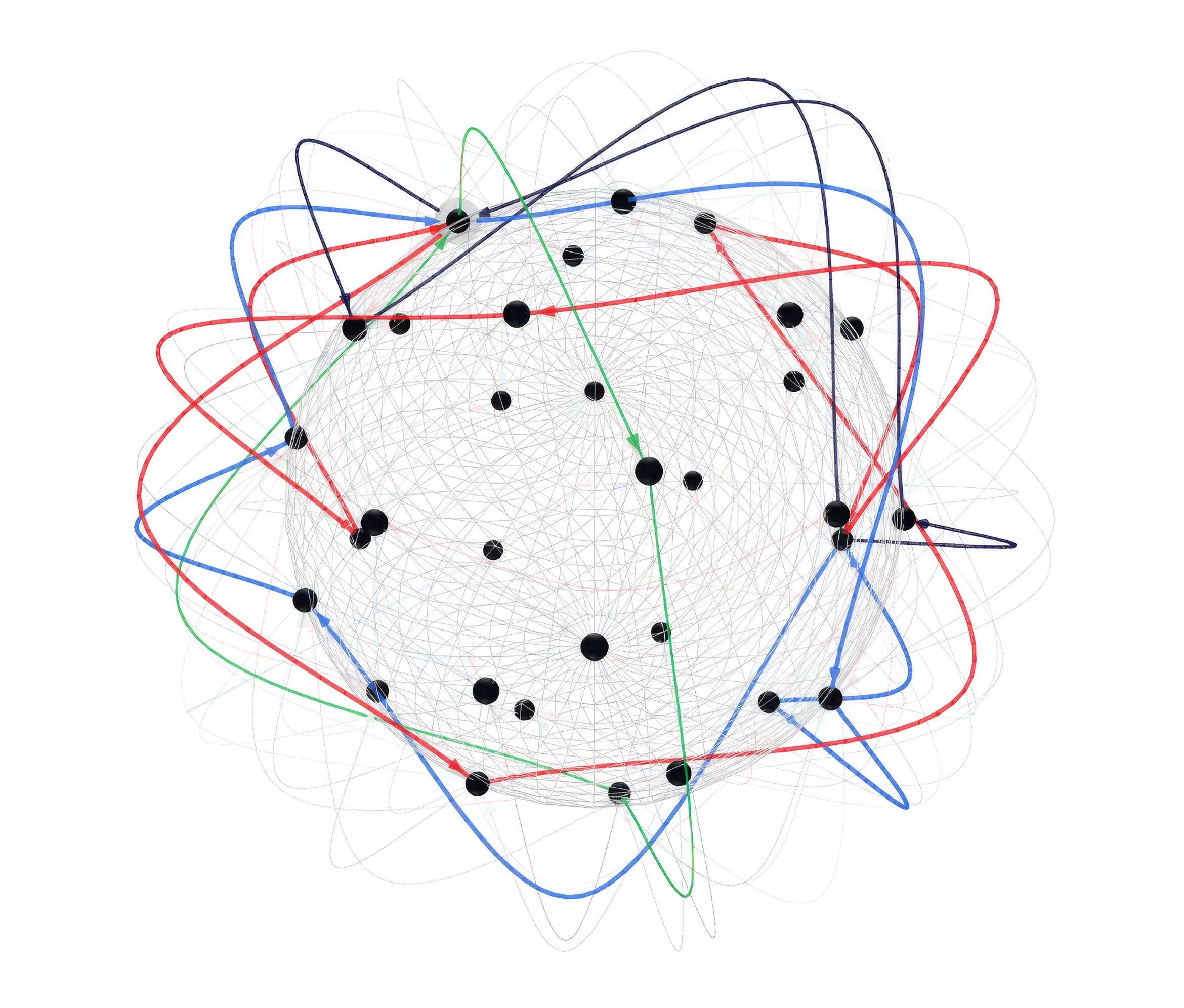
Figure 3: Visualization of the order‑384 counterexample viewed as a permutation group action.
Muse Spark generated a GAP (group‑theory computation system) search program that directly found the counterexample; the mathematicians then verified and completed the proof. Separately, the AI agent Nilradical independently reported a different counterexample on September 16, 2026.
4. Optimization: Tightness of the cycle‑based relaxation for completed length‑three alpha‑cycles
Paper: Tightness of the Cycle‑Based Relaxation for Completed Length‑Three Alpha‑Cycles
Lead contributor: Aykut Arslan (in collaboration with Muse Spark), reviewed by Kien Trung Le.
Core result: Answers a question of Del Pia and Khajavirad (2026) on when a cycle relaxation for a class of binary polynomial optimization problems is exactly equivalent to the original problem.
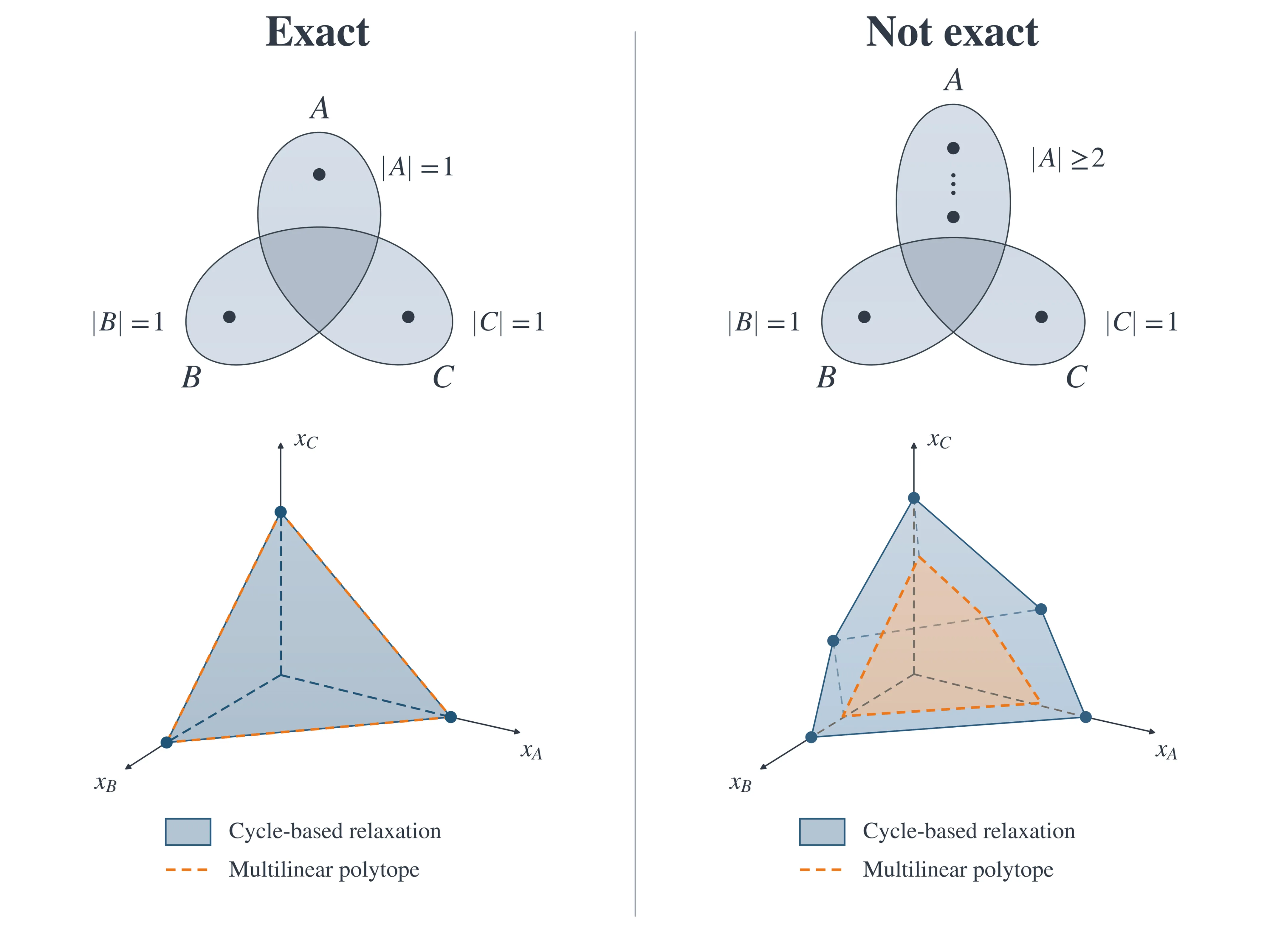
Figure 4: The blue approximate region matches the exact orange region on the left but includes extra possibilities on the right.
Specific rule: The relaxation is tight (exact) when any region shared by exactly two sets but not the third contains precisely one decision variable; if any such region contains more than one variable, a gap appears. Muse Spark helped reframe the problem probabilistically, search for counterexamples and construct the proof strategy.
5. Arithmetic physics: String two‑point function = height function on a curve
Paper: String Two‑Point Function = Height Function on a Curve
Lead contributors: Anindya Dey, Gabriel Herczeg, An Huang, Nicolas Jaramillo Torres, Jacob H. Swenberg (in collaboration with Muse Spark).
Core result: Establishes a link between height functions in number theory and two‑point functions in p‑adic string theory, proving that they describe the same quantity on a broader class of curves than previously known. The work extends known connections from the Tate curve to more general Mumford curves and related cases. In simple terms, the result can be reduced to how many initial p‑adic digits two point coordinates share.
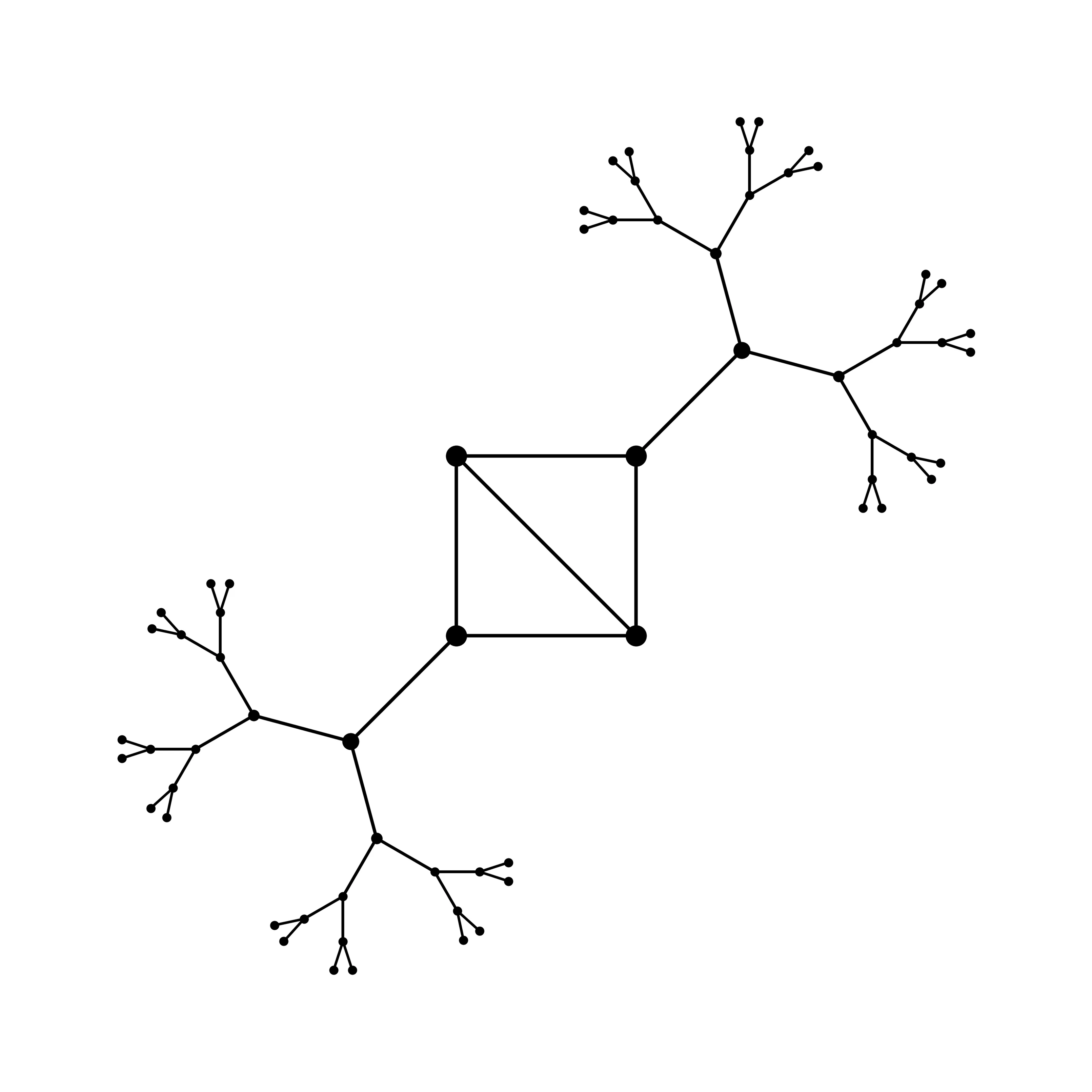
Figure 5: A schematic of a genus‑2 Mumford curve with two central loops and outward‑branching tree structures.
Muse Spark assisted in discovering the connection, generating candidate proofs, and drafting three technical chapters that were later checked and revised by the researchers. The direction traces back to ideas of Yuri Manin from the 1980s.
6. Nonassociative algebra: Solvable evolution algebras and a conjecture (counterexample + new characterization)
Paper: On Solvable Evolution Algebras and a Conjecture by García‑Martínez and Pérez‑Rodríguez
Lead contributor: Andres Barei (in collaboration with Muse Spark), reviewed by Nicolás Jaramillo Torres.
Core result: Disproves a proposed test for "solvable" evolution algebras by García‑Martínez and Pérez‑Rodríguez, finding a small three‑dimensional example that passes the test but is not solvable. The paper proposes an alternative characterization based on whole subspaces (rather than single elements), yielding a more accurate classification.
Muse Spark generated the counterexample and proposed the alternative characterization and proofs; Barei verified, refined and rewrote the material. Independently, Hu & Wen also reported a counterexample around the same time. The collaboration model emphasizes human leadership: mathematicians chose problems and key proof ideas, while the model assisted with computations, testing arguments, generating search code and revising proof details. All papers document human–model contribution shares and underwent external review. Several results were produced almost concurrently by other teams, reflecting the competitive nature of current research hotspots.
Potential impacts
1. Changes to mathematical research workflows
Muse Spark demonstrates that a general chat interface can support exploration of open problems, lowering the technical barrier to AI‑assisted research. Mathematicians may increasingly treat models as "computation and trial‑and‑error partners," focusing their effort on problem selection, intuition and final rigor. This could accelerate solutions to technically intensive, computation‑heavy problems.
2. Establishing a human–AI collaboration paradigm
Unlike fully autonomous agent‑based large‑scale searches, this work highlights a model of "human direction + model execution of details + independent review." Transparent attribution in the papers helps build traceable, verifiable norms for AI‑assisted mathematical research and reduces trust issues around "black‑box proofs."
3. Concerns and debate within the mathematical community
Rapid AI progress in olympiad‑style problems, formal verification and now some open problems has raised concerns: unequal resources (large companies' compute far exceed individual researchers), impacts on early‑career scholars' career paths, and a tendency to prioritize solvable problems over deeper conceptual innovation. While Meta's results are collaborative rather than wholly replacement, they reinforce the view that "AI is shifting from a problem‑solving tool to a research partner," likely accelerating discussions on attribution, peer review standards and education adjustments.
A joint letter signed by 25 Fields Medalists has made these concerns concrete, especially for early‑career mathematicians and researchers who have not yet effectively adopted AI: the perceived loss of meaning for some types of work could pose an unprecedented challenge for sustaining talent in what is traditionally a highly pure discipline.
4. Demonstration effects for other fields
Successes in probability, PDEs, group theory and optimization may encourage related disciplines such as physics and theoretical computer science to try similar collaborations. The model's ability to generate executable search code (e.g., GAP scripts) shows potential in symbolic computation and experimental mathematics.
5. Competition and an open ecosystem
Meta's choice to publish the papers and acknowledge concurrent work demonstrates a degree of openness. Contrasts with other efforts (e.g., by OpenAI) on higher‑difficulty Millennium Prize‑type problems may push the AI+math community to emphasize reproducibility and independent verification.
Conclusion
Meta Muse Spark's collaboration with mathematicians to resolve five open problems is a notable advance in AI‑assisted frontier mathematics. It shows current models can effectively contribute to computations, counterexample searches and proof revisions under human guidance, while problem selection and final rigor remain dependent on human judgment. For the mathematical community this is both an opportunity to improve efficiency and a prompt to rethink research evaluation, training and the human–AI boundary. As more such work appears, human–AI collaboration in mathematics may move from experiment to routine practice, though its long‑term effects will depend on the community establishing transparent, fair norms that still encourage originality.
▶️ Enjoyed this piece? Creating content is hard!
Follow our YouTube channel:
AI Rosetta
Your likes, subscriptions and shares are our greatest support! 🙏
More AI news at: https://www.airosetta.com