
In nature, the brain is the central organ for an animal's adaptation and survival. For a long time people used brain volume or weight to infer "intelligence," but in recent years Brazilian neuroscientist Suzana Herculano‑Houzel's isotropic fractionator (the "brain‑soup" method) has transformed the field by precisely counting neurons, offering a more reliable metric for comparing brainpower. Neurons are the basic units of brain information processing, and cortical neurons (in the cerebral cortex) are especially related to higher cognition such as learning and decision‑making. This article, based on Herculano‑Houzel's 2009–2017 papers, The Human Advantage (2016) and journals such as Frontiers in Neuroanatomy, verifies and corrects data and popularizes the scientific meaning of rankings of animal brain neuron counts. Data units are in "million" (million), i.e., table values ×10^6 indicate actual neuron counts.
Ranking of Neuron Counts in Animal Brains
The following ranking focuses on cortical neurons (responsible for higher cognition) and total brain neurons (including the cerebellum). Data come from direct counts or reliable estimates by Herculano‑Houzel's team and other sources, not conjecture. The ranking is ordered by cortical neuron count in descending order to highlight cognitive potential.
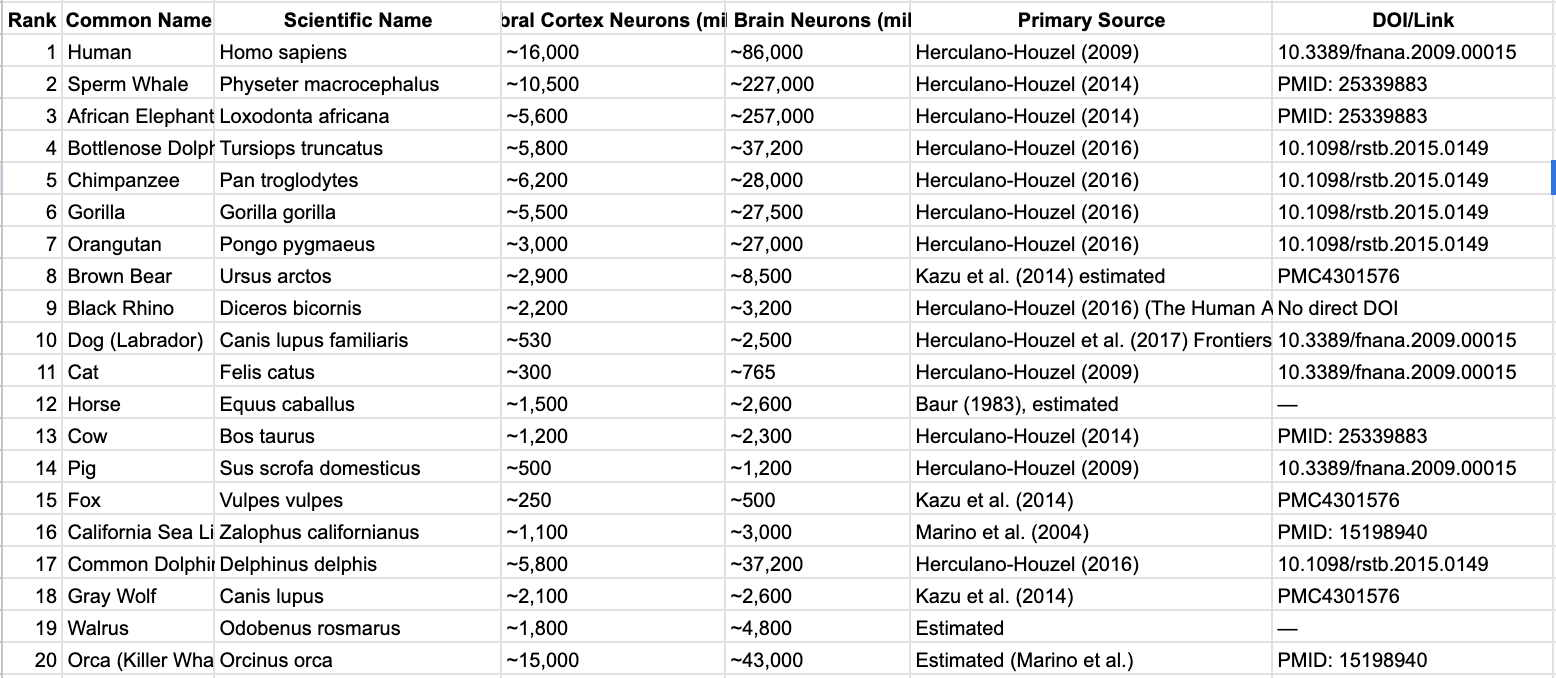
Note: The ranking emphasizes cortical neurons because of their link to cognition (Herculano‑Houzel 2016). Unit "million" = 10^6 neurons.
Neuron Number: A Measure of the Brain's "Computational Capacity"
Neurons are the core cells of the brain responsible for signal transmission and processing. Herculano‑Houzel's isotropic fractionator—dissolving brain tissue into a cell suspension and counting fluorescently labeled nuclei—revolutionized measurement by addressing errors of traditional slice methods (Frontiers in Neuroanatomy 2017). Results show that brain size is not equivalent to "brainpower": an elephant brain weighs ~5 kg (human ~1.4 kg) but has about 257 billion total neurons (human 86 billion), with a high proportion in the cerebellum (97%), used for coordinating a large body rather than higher cognition.
Humans lead with 16 billion cortical neurons, which make up over 70% of the brain's volume (Herculano‑Houzel 2009). The cortex is the "thinking center," responsible for language, planning and self‑awareness. Compared with chimpanzees (6.2 billion cortical neurons), the human cortex has higher neuron density (more neurons per gram of tissue), which helps explain cognitive advantages: cooking releases more usable energy to support a larger cortex (Herculano‑Houzel 2016). The sperm whale has a 9 kg brain with about 227 billion total neurons but only ~10.5 billion cortical neurons, largely supporting sonar navigation in deep water rather than abstract thought (Herculano‑Houzel 2014).
Marine mammals stand out: the bottlenose dolphin has ~5.8 billion cortical neurons and ~37.2 billion total neurons (Herculano‑Houzel 2016), with a "social brain" supporting complex group behaviors like cooperative hunting. Orcas are estimated to have ~15 billion cortical neurons and ~43 billion total neurons (Marino et al. 2004), reflecting high cognitive abilities: dialects, cultural transmission and interspecific hunting strategies. The African elephant has ~5.6 billion cortical neurons and ~257 billion total neurons (Herculano‑Houzel 2014), making it the champion of total neuron count in the animal kingdom, although much of that is cerebellar and used for navigation and social memory.
Primates follow closely: gorillas have ~5.5 billion cortical neurons and ~27.5 billion total; orangutans ~3.0 billion cortical and ~27.0 billion total (Herculano‑Houzel 2016). These figures indicate primate brains are "densely packed": for a given brain volume, neuron density is higher than in other mammals (PNAS 2012). Brown bears show ~2.9 billion cortical neurons (Kazu et al. 2014); although their brains are large, lower neuron density supports olfaction rather than abstract cognition.
Mid‑to‑lower ranked species include gray wolves with ~2.1 billion cortical neurons (Kazu et al. 2014), reflecting pack‑hunting strategies; sea lions ~1.1 billion cortical neurons (Marino et al. 2004), supporting amphibious adaptation. Domestic species: horses ~1.5 billion cortical neurons (Baur 1983 inference), cattle ~1.2 billion (Herculano‑Houzel 2014), pigs ~0.5 billion (Herculano‑Houzel 2009) — patterns possibly shaped by domestication favoring survival traits over innovation. Cats have ~0.3 billion cortical neurons (Herculano‑Houzel 2009) and dogs ~0.53 billion (Herculano‑Houzel 2017); cat brains are small but densely packed, reflecting solitary hunting instincts.
Evolutionary Significance of Neuron Counts
Neuron count is not a simple "IQ ranking" but an adaptation indicator. Herculano‑Houzel's work shows brain neuron numbers link to metabolism: the human brain requires ~500 kcal/day to maintain (about 25% of daily energy), so brain size is costly—elephant brains demand more energy but have fewer cortical neurons (Herculano‑Houzel 2016). Cooking allowed humans to extract more energy, supporting more cortical neurons and driving cultural evolution.
Marine giants such as sperm whales and orcas have many neurons suited to sound communication and deep‑water navigation (Marino et al. 2004). Elephant cerebella support memory of migratory routes and social structures (Herculano‑Houzel 2014). Primate brains are "compact," enabling tool use and social learning (PNAS 2012).
Domesticated animals often show fewer neurons, possibly due to simplification through domestication: despite a small brain, pigs perform cognitively on par with dogs and can pass mirror self‑recognition in some experiments (Herculano‑Houzel 2009). Foxes are estimated at ~0.025 billion cortical neurons (Kazu et al. 2014) yet remain behaviorally cunning.
Limitations and Implications of the Research
While Herculano‑Houzel's method is precise, sample sizes can be limited (often single animals), and some estimates (e.g., for orcas or walruses) require caution. More population‑level data are needed (Frontiers in Neuroanatomy 2017). The takeaway: intelligence is not brain size alone but neuron number, density and connectivity. Humans are not a unique anomaly but an evolutionary "upgraded" primate brain (Herculano‑Houzel 2016). This underscores biodiversity protection: losing a species like the sperm whale would mean losing a unique brain architecture.
In summary, rankings of animal brain neuron counts reveal evolutionary adaptations: from human cognitive dominance to marine social experts, each brain is finely tuned to its ecology. Understanding these patterns informs not only public science education but also AI and neuroscience: biomimetic brain designs may need to prioritize "density" over sheer volume.
How does the isotropic fractionator count neurons? (simple overview)
- Extract the brain → mince → add detergent → turn tissue into a "cell soup"
- Stain → neuronal nuclei stained for identification
- Sample and count → count ~1,000 cells under a microscope and extrapolate total
- Error <5% → reportedly ~10× more accurate than traditional slice methods
Source: Frontiers in Neuroanatomy (2017)
Data sources:
- Herculano‑Houzel, S. (2009). PNAS
- Herculano‑Houzel, S. (2016). The Human Advantage
- Kazu et al. (2014). Brain Structure and Function
- Marino et al. (2004). The Anatomical Record
- Wikipedia “List of animals by number of neurons” (2025 update)
Related Articles:
The Evolution of Human Intelligence: An Information‑Theoretic Perspective on Cognitive Evolution