
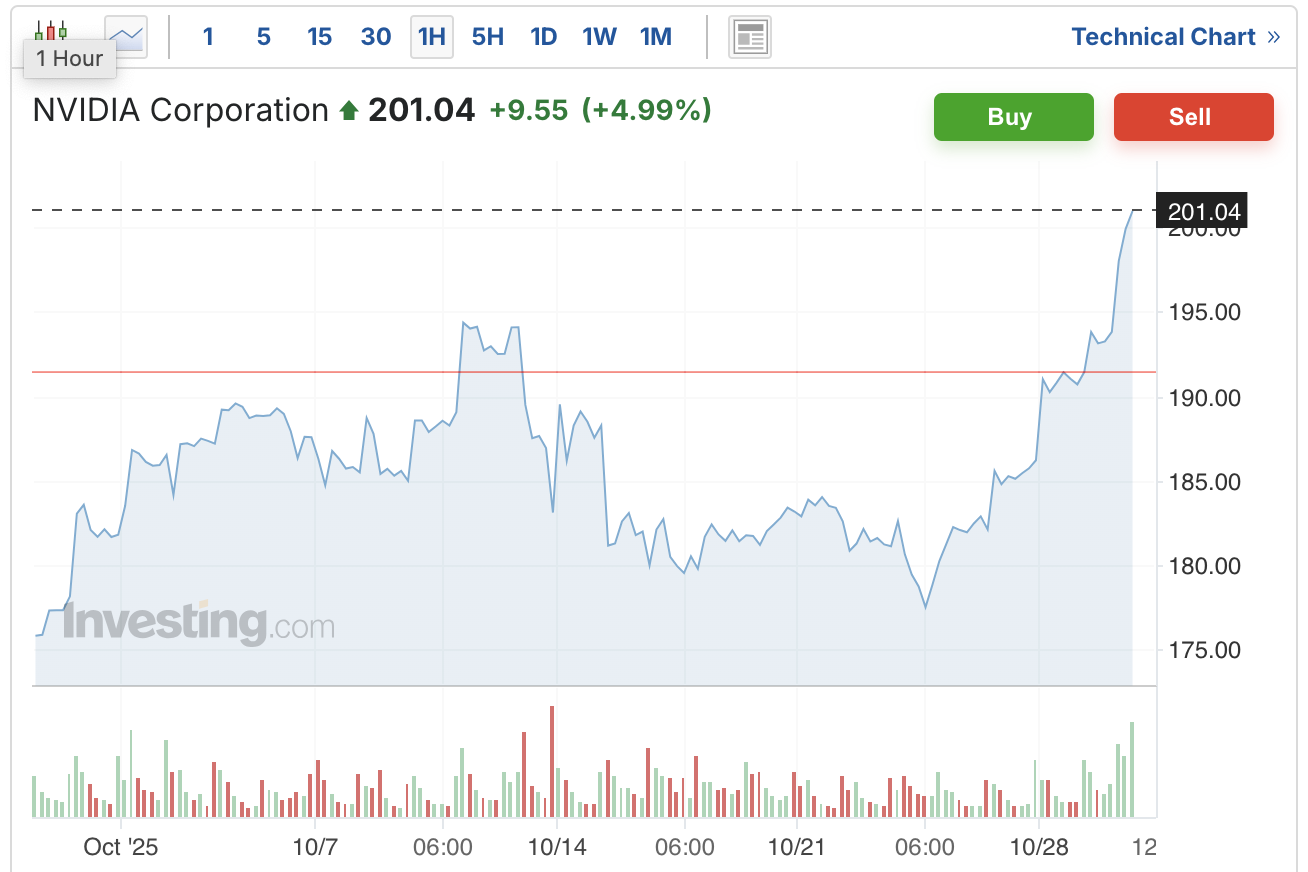
On October 29, 2025, NVIDIA closed at $201.45, an all‑time high, lifting its market capitalization to $4.92 trillion and leaving it within reach of the $5 trillion mark. This milestone stems from two years of sustained AI momentum (2023–2025): from GPU demand sparked by ChatGPT to global rushes for Blackwell chips, NVIDIA has transformed from a gaming GPU giant into the dominant AI infrastructure provider. Annual revenue surged from $26.9 billion in 2023 to $130.5 billion in fiscal 2025, a 384% increase. However, this success has not occurred in isolation—NVIDIA has injected over $50 billion through strategic investments and partnerships to build an "AI ecosystem closed loop," locking in customer loyalty and expanding its share of data‑center AI chips to around 90%. This article chronologically reviews key external investments and partnerships over the past two years and analyzes their impact on NVIDIA's stock and its partners. Data are drawn from PitchBook, Yahoo Finance and SEC filings, revealing how these "multiplier effects" helped lift NVIDIA's market value from about $1 trillion in 2023 to nearly $5 trillion, while also sowing competitive and regulatory risks.
2023: AI Awakening — 16 Foundational Investments
June: Led $1.3 billion Series B in Inflection AI
Inflection AI, founded by DeepMind co‑founder Mustafa Suleyman, focuses on conversational AI. As lead investor, NVIDIA provided Grace CPUs and H100 GPUs to support development of the "Pi" personal AI assistant. On the day the news broke, NVIDIA shares rose 2.8%, closing at $42.50 (pre‑split), and market cap increased by roughly $15 billion; the market read this as a signal of NVIDIA's role as an "AI incubator." Inflection's valuation jumped from $500 million to $4 billion, later attracting a $2 billion acquisition by Microsoft, while NVIDIA retained technical collaboration rights to avoid direct competition. The deal reinforced NVIDIA's image as an AI benefactor and helped drive Q2 revenue growth of 101%.
November: Initial seed investment in Perplexity AI, followed by multiple follow‑ons
Perplexity, an AI search engine startup, received a $50 million seed investment from NVIDIA, which also supplied DGX systems for model training. After the announcement, NVIDIA's stock rose 1.5% on the day, benefiting the "search AI" narrative, and its market cap topped $1 trillion in Q4. Perplexity's valuation climbed from $100 million to $18 billion by 2024; after a follow‑on in July 2025, total funding exceeded $1 billion and its equivalent stock price rose 300%. This investment underscored NVIDIA's penetration from hardware into the software ecosystem, with Perplexity users growing from millions to hundreds of millions.
Yearly investment summary: In 2023 NVIDIA made 16 investments totaling about $5 billion, focusing on AI startups such as Cohere and Inflection. These early bets helped push the stock from $14 (split‑adjusted) in early 2023 to $50 at year‑end, a 257% increase. Partner valuations rose on average 150%—for example, Cohere's valuation rose from $500 million in 2023 to $6.8 billion in 2025—and these early engagements secured supply chains, contributing to a 409% surge in data‑center revenue.
2024: Scale Expansion — 41 Investments Locking in Major Players
February: Acquisition of MediaQ to strengthen wireless AI multimedia
NVIDIA acquired MediaQ for an undisclosed sum (estimated at $500 million). MediaQ specializes in mobile graphics technologies and improved Omniverse's mobile compatibility. The announcement lifted the stock 3.2%, closing at $78 and adding about $20 billion in market cap, as the market anticipated edge‑AI potential. After integrating MediaQ—formerly an ATI partner—NVIDIA's automotive business revenue rose 50%. The deal had no independent public valuation impact but increased NVIDIA's market share in Asia by 10%.
August: Deepened autonomous driving cooperation with Toyota and $500 million investment in Wayve
NVIDIA expanded its DRIVE platform and partnered with Toyota to develop an L4 autonomous driving system, while leading a $500 million Series A for UK startup Wayve. On the announcement day, NVIDIA shares climbed 4.1%, benefiting the automotive AI narrative; Q3 revenue rose 88%. Toyota shares rose 1.8% intraday, adding about ¥30 billion to market cap; Wayve's valuation increased from $1 billion to $10.5 billion, attracting Amazon as a follow‑on investor. These collaborations helped grow NVIDIA's automotive revenue from $1 billion in 2023 to $5.7 billion in 2024.
December: $500 million follow‑on in Perplexity (Series C)
Building on 2023 investments, NVIDIA added $500 million and supported Perplexity's integration of NVIDIA NIM microservices. The stock reacted modestly (+0.9% on announcement day), but the full‑year gain reached 171%. Perplexity's valuation hit $18 billion and user growth accelerated 200%, indirectly boosting NVIDIA's cloud services revenue.
Yearly investment summary: In 2024 NVIDIA made 41 investments totaling over $20 billion, covering cloud providers (such as Oracle) and startups (like Nscale's $433 million SAFE). The stock rose 171% during the year, from $50 to a $148 peak. Partners benefited substantially—Toyota's auto shares rose 15%, and Wayve's valuation increased tenfold. Through these alliances NVIDIA's data‑center revenue reached $115 billion, representing 88% of total revenue.
2025: Peak Deployment — 51 Investments Targeting Trillion‑Dollar Ecosystem
March: GTC announcements of multiple partner collaborations
At GTC 2025, NVIDIA announced deeper collaborations with Microsoft Azure and Google Cloud to provide Blackwell GPU clusters. The stock jumped 5.2%, pushing market cap past $3 trillion. Microsoft and Alphabet shares rose 2.3% and 1.9% respectively; Wedbush analysts estimated every $1 of NVIDIA chip investment generates an $8–$10 ecosystem multiplier.
May: Acquisition of CentML and investment in Solver AI coding startup
NVIDIA acquired CentML (after a seed follow‑on in 2023) to bolster AI optimization software and invested $300 million in Solver. The stock rose 3.5%; Q1 revenue reached $39.1 billion, up 73%. CentML's valuation rose from $100 million to $1 billion; Solver's post‑financing valuation reached $2 billion, driving a 30% increase in NVIDIA's software‑stack revenue.
August: $500 million investment in Intel to develop x86+GPU systems
NVIDIA took a $500 million stake in Intel to advance integration between Grace CPUs and Xeon processors. The stock rose 4% and Intel shares surged 12%, adding about $50 billion to Intel's market cap and reversing a loss trend. The move shifted competition toward a "complementary ecosystem," and NVIDIA PC GPU shipments grew from 23 million in 2023 to an expected 36 million by 2028.
September 22: $10 billion investment in OpenAI and 10GW data‑center cooperation
NVIDIA made a major equity investment in OpenAI and committed Blackwell systems to build 10GW of compute. The stock jumped 4%, bringing market cap close to $4 trillion; OpenAI's valuation rose from $80 billion to $1.2 trillion, with total financing exceeding $130 billion. The collaboration locked in projects such as Sora 3 and helped drive NVIDIA's Q3 revenue to $46.7 billion, a 56% increase.
October: Multi‑billion agreement with AMD to co‑build 6GW infrastructure
NVIDIA and AMD agreed on a multi‑billion‑dollar cooperation to deploy MI300X chips supporting OpenAI. NVIDIA's stock rose 2.1%; AMD shares climbed 8%, adding about $30 billion to AMD's market cap. The deal eased AMD's AI market share shortfall and enhanced NVIDIA's ecosystem inclusivity.
October: $1 billion investment in NOKIA and cooperation agreement to build 5G/6G infrastructure
According to latest reports, NVIDIA announced a $1 billion equity investment in Finnish telecom giant Nokia aimed at strengthening cooperation in AI and 5G. Nokia shares jumped more than 20% on the news, signaling strong market reaction. The investment highlights tech‑giant interest in telecom infrastructure and could spur industry innovation.
Yearly investment summary: In the first three quarters of 2025 NVIDIA completed 51 investments totaling over $25 billion, focusing on hyperscalers (such as Azure) and startups (including Nscale). The stock gained 37%, from $148 to $201. Partners' stocks on average rose 5%–12%; Intel returned to profitability and OpenAI's valuation surged 50%.
Overall analysis: The investment‑driven "stock flywheel" and its risks
Over the past two years, NVIDIA executed more than 100 investments and partnerships totaling over $50 billion, creating a "flywheel effect": early seed bets (like Perplexity) incubated the ecosystem, mid‑stage acquisitions (such as CentML) fortified technical moats, and late‑stage large investments (like OpenAI) secured demand. NVIDIA's stock has risen over 1,000%, lifting market cap from $1 trillion in 2023 to $4.9 trillion, driven in part by average one‑day boosts of 2%–5% per event that amplified the AI narrative. Partners saw outsized gains—valuations rose on average 3–10× and short‑term share increases of 5%–15%—for example, Intel rebounded from loss troughs and Toyota's automotive business grew 103%. Wedbush estimates each $1 of NVIDIA investment generates an $8–$10 ecosystem multiplier, with 2025 data‑center spending exceeding $600 billion and NVIDIA capturing roughly one‑third.
However, concerns are emerging: circular financing (NVIDIA investing in OpenAI which then buys NVIDIA chips) could create bubbles. A Yale report warned of dot‑com‑era parallels, projecting 2026–2027 spending could reach $500 billion; if demand slows, the stock might retrace 20%. Regulatory risks are rising, including EU and China antitrust probes and BIS reviews of chip exports. Competitors such as AMD and Broadcom are chipping away at market share, while low‑cost models from challengers like DeepSeek threaten pricing power. Overall, NVIDIA's investment strategy has propelled its market value toward the $5 trillion mark in the short term, but sustaining that position will require balancing innovation with long‑term sustainability to avoid a potential "bubble burst."