
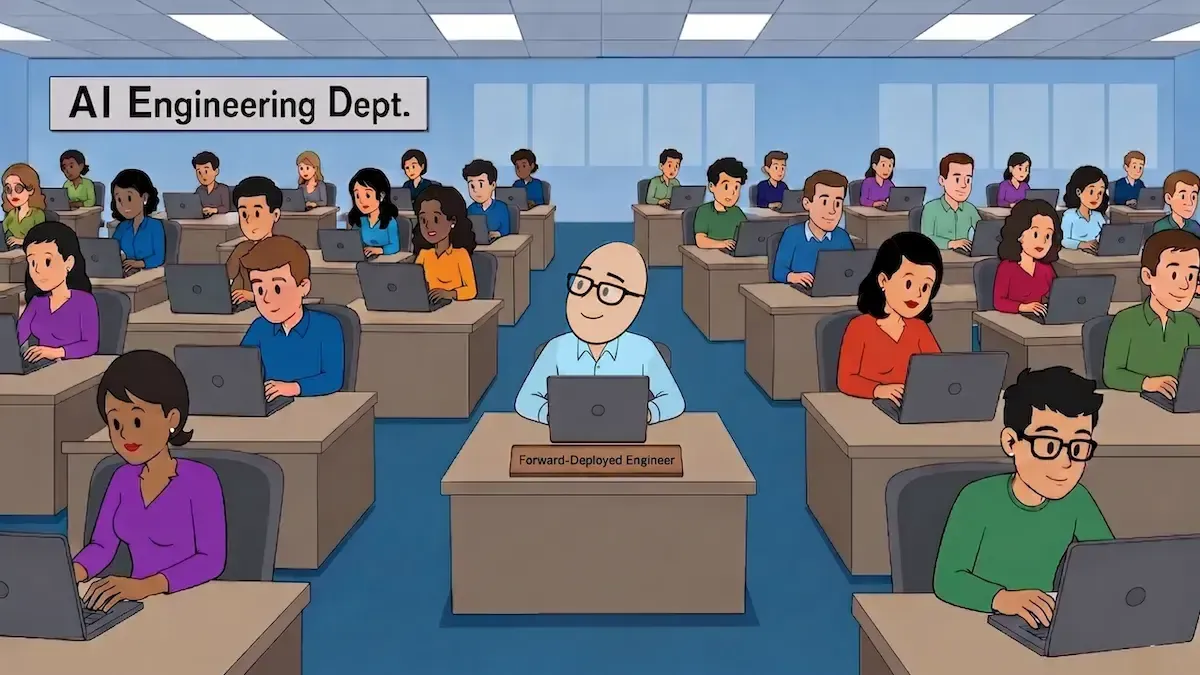
By 2026, with the rapid deployment of AI Agents, a new profession — AI Forward Deployed Engineer (FDE) — is quickly gaining prominence in Silicon Valley. Top AI firms such as OpenAI and Anthropic have begun building dedicated teams to embed FDEs inside client organizations to help customize and optimize agentic workflows. The role is seen as a key bridge for AI to move from "lab technology" to real enterprise productivity, and has become one of the most sought‑after and debated positions in today's AI talent market.
Origins and evolution of the FDE
The concept of the FDE is not new; it was first pioneered by data analytics company Palantir roughly 20 years ago. At that time, Palantir provided data analysis services to governments and large institutions and, because of highly sensitive data and secure networks, could not simply deliver solutions via the cloud. Instead, Palantir dispatched engineers to be stationed long‑term on client premises to deploy and customize systems directly on air‑gapped networks. This "embedded delivery" model later became widely known as the Forward Deployed Engineer.
In the AI era, the FDE role has been reactivated and given new meaning. Companies like OpenAI and Anthropic found that merely offering powerful base models (such as GPT‑5.5 or Claude Opus 4.7) is insufficient for enterprise needs. Businesses require these models to be deeply customized into tailored agentic workflows, which necessitates engineers on‑site to understand business pain points, design solutions, debug systems, and continuously optimize.
Core skills and requirements for FDEs
Compared with other AI roles, the FDE demands a very high level of cross‑disciplinary capability, mainly across the following dimensions:
1. Technical depth
- Expertise in LLM fine‑tuning, RAG (retrieval‑augmented generation), and agent frameworks (e.g., LangChain, CrewAI, Antigravity)
- Proficiency in designing agentic workflows, multi‑agent coordination, tool invocation, and evaluation systems (Evals)
- Strong coding skills and system integration experience to handle complex problems in production environments
2. Communication and business understanding
- Ability to communicate deeply with executives and business teams to accurately capture requirements
- Translate complex technical concepts into business terms and set appropriate project priorities
- When necessary, diplomatically push back on unrealistic customer demands
3. Project management and soft skills
- High adaptability and resilience to independently drive projects on client sites
- Good documentation and knowledge‑transfer skills to ensure client teams can maintain systems after handover
4. Professionalism
- High professional ethics and confidentiality awareness (especially when handling sensitive client data)
- Continuous learning ability to quickly master new models and tools
Differences between FDEs and regular AI Engineers, and relative numbers
Although FDEs attract attention, industry figures like Andrew Ng note that the total number of AI Engineers will be far greater than that of FDEs.
- A company may accept only a small number of on‑site FDEs but will hire many more internal AI Engineers to develop and maintain systems in‑house.
- The main constraint of FDEs is "vendor lock‑in": they deeply integrate particular vendors' products, which can reduce a client's future optionality. In a fast‑iterating AI landscape, companies prefer to cultivate internal AI teams to remain technology‑neutral.
- Therefore, most companies adopt a hybrid model of "a few FDEs + many internal AI Engineers."
The AI Engineer role is maturing rapidly and is likely to further subdivide, for example:
- AI FDE (on‑site deployment focus)
- LLMOps Engineer (model operations)
- Evals Engineer (evaluation systems)
- AI Data Engineer (data engineering)
- Harness Engineer (agent framework engineer)
Future directions
As agentic AI becomes more deeply adopted, the FDE role is expected to exhibit the following trends:
- Specialization and niche expertise: Generalist FDEs will gradually split into industry‑focused FDEs (e.g., finance FDEs, healthcare FDEs, manufacturing FDEs).
- Hybrid working models: Some FDEs may adopt a "remote + periodic on‑site" hybrid model to reduce client costs.
- Upgraded skill requirements: Future FDEs will need not only technical skills but also strong change‑management and organizational coordination abilities.
- Collaboration with AI Engineers: FDEs will more often act as "bridges" and "catalysts," while internal AI Engineers take responsibility for long‑term maintenance and secondary development.
Conclusion: AI is creating, not destroying, jobs
The rise of FDEs further demonstrates that the AI era is not a "jobpocalypse" but is creating many high‑value new roles. Hybrid talents who understand both AI technology and business and can communicate effectively will have a significant advantage in the coming wave of AI adoption.
For engineers hoping to enter this field, now is an ideal window to gain agentic practical experience and improve business understanding and communication skills. The AI Forward Deployed Engineer may well become one of the most sought‑after AI careers of the next decade.
▶️ Enjoy this article? Creating content is hard work!
Subscribe to our YouTube channel:
AI Rosetta
Your likes, subscriptions, and shares are our greatest support! 🙏
For more AI news visit: https://www.airosetta.com