
On August 14, 2026, Zhipu AI officially released its next‑generation flagship large model GLM‑5.3. The model's base parameter count remains at around 740 billion (the same MoE architecture as GLM‑5.2) and, contrary to some rumors, was not upgraded to the trillion‑parameter level. Zhipu achieved roughly a 50% overall performance improvement over the previous generation through extreme post‑training scaling (dozens of times longer task environments, more diverse environment types, and very long training durations), placing the model at the top among current open‑source models on several mainstream benchmarks. Its programming and agent capabilities approach Claude Fable 5, and it surpasses other domestic models in coding fluency. Model weights are expected to be open‑sourced two weeks after release.
Details: Performance Leap Driven by Post‑Training
GLM‑5.3 reuses the GLM‑5.2 base (about 743B–753B total parameters, active parameters on the order of ~40B, supports 1M context); all improvements come from the post‑training stage. Zhipu emphasizes that efficient reinforcement learning based on IndexShare, SAO and the new‑generation Slime framework fully unlocked the base model's potential.
Key capability highlights:
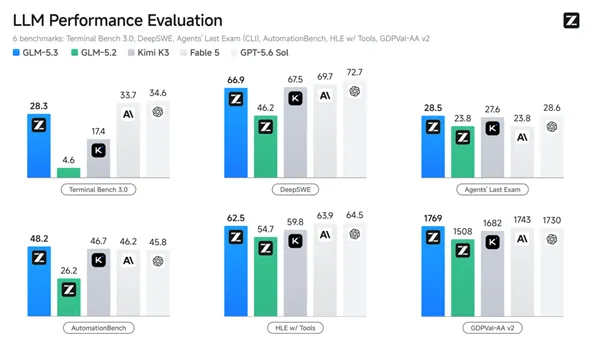
- Programming ability: Internal experiential evaluations show a 50% improvement over GLM‑5.2, making it the strongest open‑source model for coding. Terminal‑Bench 3.0 rose from 4.6 to 28.3 (first among open models); DeepSWE v1.1 improved from 46.2 to 66.9; Agents’ Last Exam rose from 23.8 to 28.5.
- Efficiency advantage: At the High setting accuracy reaches 31.4%, exceeding Claude Opus 4.8's 29.5%, while producing fewer average output tokens (about 50k vs 120k), indicating shorter solution paths.
- Agent and knowledge work: GDPval‑AA v2 scored 1769, demonstrating strong professional task execution capability.
- Cybersecurity: CyberGym score is 84.5%, slightly above Mythos 5 (83.8%) and GPT‑5.6 Sol (83.6%). In real projects the model assisted in finding a large number of vulnerabilities, showing potential for cross‑stage reasoning and attack‑chain planning.
The model is available immediately in Zhipu's official coding tool ZCode, productivity tool AutoClaw, and the GLM Coding Plan. Several coding platforms (such as Trae, Qoder, OpenCode, etc.) have opened early access.
Release Background and Strategy
This release did not pursue a parameter‑count breakthrough but focused on post‑training efficiency, reflecting Zhipu's pragmatic choice under compute and data constraints. A trillion‑parameter upgrade may be reserved for later versions (e.g., GLM‑5.5). The open‑source plan will proceed after completing security assessments and hardening, balancing capability release with risk control.
Possible Impact: A New Benchmark in Open‑Source Coding
1. Impact on developers and the open ecosystem: With coding and agent abilities approaching closed‑source flagships and lower token consumption, GLM‑5.3 provides powerful tools for the open community. Once weights are released in two weeks, local deployment and secondary development barriers will further lower, likely accelerating adoption of domestic coding agents.
2. Impact on domestic large‑model competition: In a landscape where strong open/semi‑open models like Kimi K3, DeepSeek V4‑Pro, and Qwen3.8 coexist, GLM‑5.3's post‑training efficiency and coding specialization create a differentiated advantage, intensifying competition based on cost‑effectiveness and vertical capabilities.
3. Impact on the global landscape: Coding and cybersecurity capabilities approaching top models like Fable 5 demonstrate that post‑training scaling can partially compensate for base‑model size gaps in specific scenarios. The open‑source strategy may also encourage more providers to emphasize the balance between post‑training and security alignment.
4. Potential challenges
- The unchanged base means the long‑term ceiling for general intelligence remains limited by pretraining scale.
- The dual‑use nature of cybersecurity capabilities requires strict controls; pre‑open‑source security evaluation is crucial.
- Stability and generalization in production environments require large‑scale validation.
Industry Takeaway: Post‑Training as a New Competitive Edge
The release of GLM‑5.3 again demonstrates that beyond ultra‑large‑scale pretraining, high‑quality post‑training and reinforcement‑learning environment construction can bring significant performance gains. Zhipu's choice of a "fixed base, extreme post‑training" path controlled costs while achieving breakthroughs in coding and agent tasks, offering a replicable model for resource‑constrained teams.
For developers, this is a high‑value coding model worth trying immediately; for the industry, it signals that open models are narrowing the gap with closed‑source leaders through refined training. With weight release and future iterations, the GLM series' position in the domestic large‑model ecosystem is likely to strengthen.
▶️ Enjoy this article? Creation is hard work!
Follow our YouTube channel:
AI Rosetta
Your likes, subscriptions and shares are our greatest support! 🙏
More AI news at:
https://www.airosetta.com