
On December 23, 2025, Beijing‑based Zhipu Huazhang Technology Co., Ltd. (Zhipu AI) officially released and open‑sourced its next‑generation flagship model GLM‑4.7. As the latest iteration of the GLM‑4 series, this version focuses on deep optimization for coding capabilities, achieving best‑in‑class results among open‑source models on several mainstream benchmarks and even surpassing closed‑source models such as GPT‑5.2 and Claude Sonnet 4.5 in certain coding tasks. Zhipu AI states the model has 355B parameters and marks a major domestic breakthrough in programming by enhancing long‑range task planning, tool collaboration, and complex reasoning. Authoritative outlets such as OSCHINA and Pacific Tech report that GLM‑4.7 not only strengthens the competitiveness of the open‑source community but also provides developers with a more reliable programming partner, advancing AI from a general tool to a professional assistant. This special report is based on Zhipu AI's official announcement and related benchmark data, analyzing GLM‑4.7's technical highlights, performance comparisons, and industry impact while ensuring the content is fact‑based.
Technical specifications and core upgrades of GLM‑4.7
GLM‑4.7 is the seventh major release in Zhipu AI's GLM‑4 series, totaling 355B parameters. It inherits prior multimodal support and efficient inference capabilities, while this upgrade specifically targets coding scenarios. Official data show significant gains in code generation, debugging, optimization, and multilingual support. Compared with GLM‑4.6, it introduces "Preserved Thinking" and "Turn‑level Thinking" mechanisms, enabling the model to behave more like a senior engineer in multi‑turn interactions: planning steps first and then executing code to avoid blind outputs.
Architecturally, GLM‑4.7 optimizes tool invocation and long‑range planning, supporting complex terminal tasks such as installing dependencies in a virtual environment, running scripts, and handling errors. Zhipu AI emphasizes that the training data cover vast programming scenarios, including GitHub repositories and real development logs, ensuring outputs better match real‑world needs. Additionally, it performs well on multilingual codebases, supporting mixed projects in Python, JavaScript, C++ and other mainstream languages, reducing cross‑language bugs.
On the open‑source front, GLM‑4.7 is available on Hugging Face and ModelScope, where developers can download weights and inference code for free and deploy using frameworks like vLLM and SGLang. This lowers the barrier to use and injects new vitality into the global open‑source community. Zhipu AI's move aligns with its "open‑source first" strategy; since the GLM‑4 series began, multiple versions have been open‑sourced, helping build the domestic AI ecosystem.
Benchmark performance: open‑source leader in coding
The release of GLM‑4.7 is backed by strong benchmark results, standing out in multiple programming evaluations. Official reports show the model scored 84.9 on the LiveCodeBench V6 benchmark, ranking first among open‑source models and far exceeding GLM‑4.6's 64.0. On the SWE‑bench Verified benchmark, GLM‑4.7 achieved a solve rate of 73.8%, with 66.7% for multilingual settings, demonstrating robustness in real software engineering tasks.
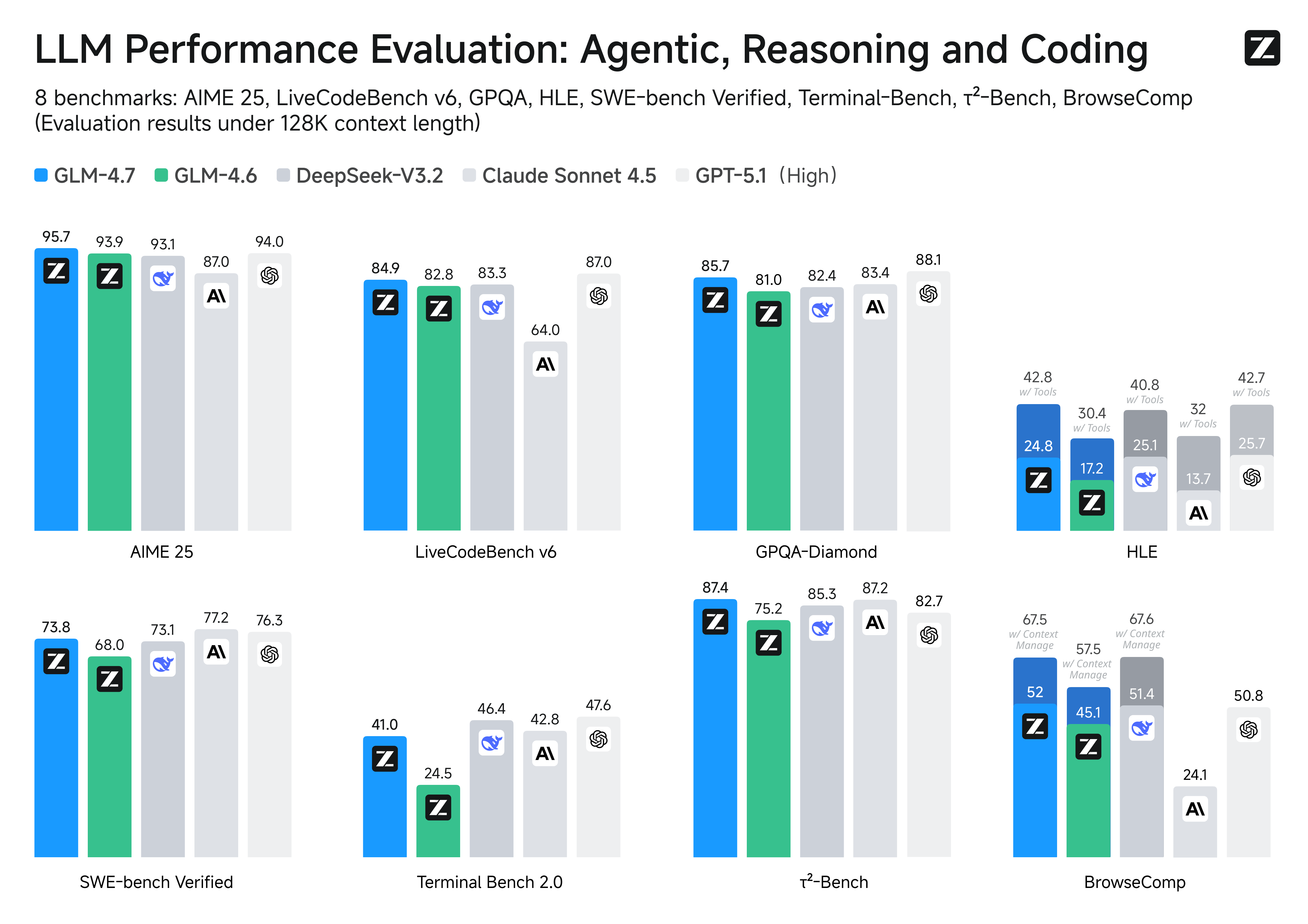
Notably, in the Code Arena blind test—an evaluation involving millions of global users—GLM‑4.7 won top honors among open‑source and domestic models, even outperforming GPT‑5.2. Terminal Bench 2.0 scores rose from GLM‑4.6's 24.5% to 41%, evidencing improvements in terminal operations and tool collaboration. In τ²‑Bench and BrowseComp, GLM‑4.7 also shows clear gains in tool use and complex reasoning.
Compared with closed‑source models, GLM‑4.7 approaches or surpasses Claude Sonnet 4.5 and GPT‑5.2 in coding expertise, especially in long‑range planning and multi‑turn debugging. Zhipu AI credits this progress to a dedicated coding reinforcement dataset and algorithmic optimizations, such as enhanced Chain of Thought mechanisms. In general capabilities, the model's responses are more concise and natural, and its writing contains richer sensory detail, though it remains within the prior generation's framework.
Industry impact: a catalyst for a "programming for everyone" era
The release of GLM‑4.7 signals that open‑source large models are entering a "programming‑for‑everyone" era. OSCHINA reports that the model, as a dependable partner, can handle end‑to‑end tasks from code generation to bug fixes, lowering development barriers—particularly for beginners and small‑to‑medium enterprises. The Tencent Cloud developer community highlights that its optimizations for mixed‑language projects and terminal tasks will accelerate AI Agent applications such as automated DevOps and intelligent IDEs.
From a global perspective, GLM‑4.7's open‑source posture challenges the closed‑source dominance of OpenAI and Anthropic. Pacific Tech analysis suggests this will spur innovation in the open‑source community and promote ecosystems like Hugging Face. As a domestic model, it enhances China's competitiveness in AI on the international stage and supports Zhipu AI's Hong Kong IPO progress.
However, challenges remain: the model's large scale (355B parameters) requires substantial compute resources; although open‑source access is free, deployment demands specialized hardware. Discussions on Zhihu note that Zhipu needs stronger protections around privacy and ethics to prevent misuse.
Strategic background and future outlook
The release of GLM‑4.7 coincides with a critical phase in the company's IPO push. Sina Finance reports that Zhipu is racing toward a Hong Kong listing, aiming to become the first global listed large‑model company, and open‑sourcing this version is part of its ecosystem strategy. Xueqiu commentary notes that open‑sourcing attracts developers and helps Zhipu build a closed‑loop ecosystem from models to applications and one‑stop services.
Looking ahead, GLM‑4.7 is expected to drive a paradigm shift in AI programming. Baidu AI Studio predicts the model will accelerate "AI‑native" development and promote the adoption of low‑code/no‑code platforms. At the same time, it injects momentum into China's AI scene and may inspire more innovation among domestic models.
▶️ Enjoyed this article? Creating content is hard!
Follow our YouTube channel:
AI Rosetta
Your likes, subscriptions, and shares are our greatest support! 🙏
More AI news at: https://www.airosetta.com