
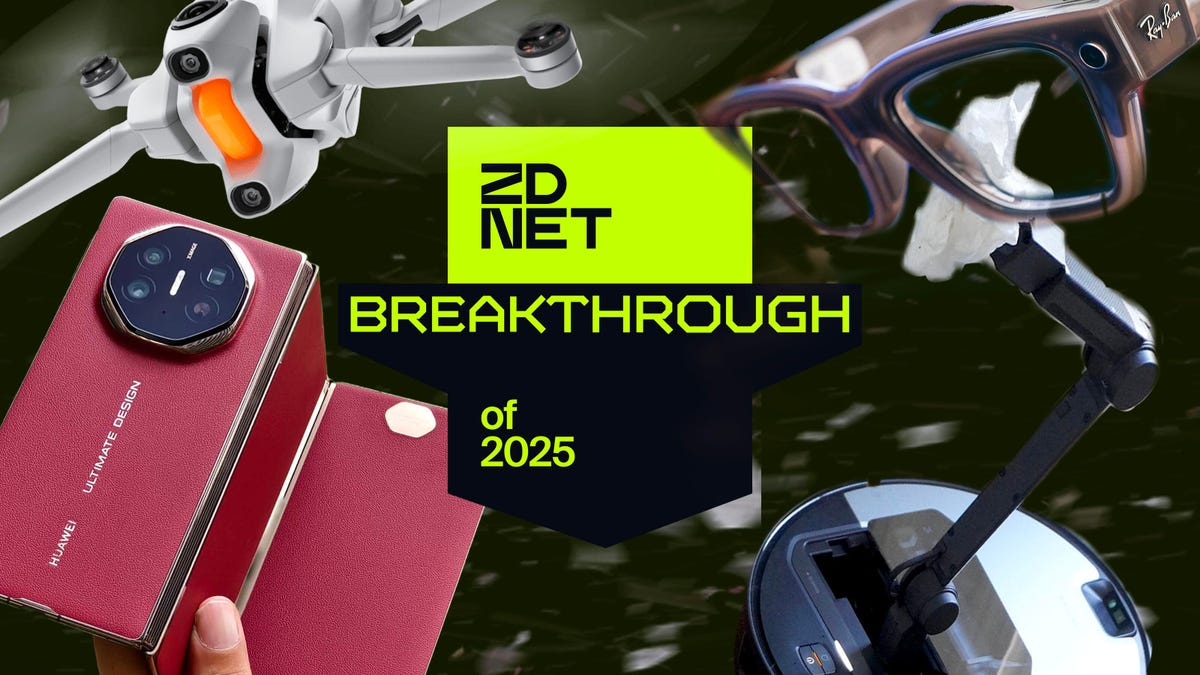
In its Breakthrough Awards published on December 12, 2025, ZDNET selected five of the most groundbreaking products from the many prototypes and shipping devices it tested this year, honoring the most innovative and forward‑looking tech the editors encountered. Over the past 12 months, the outlet spent countless hours testing the foldable phones shaping the mobile space, spending full workweeks with new smart glasses and VR headsets, and benchmarking a range of robots. Those robots included AI chatbots that use a phone camera for ideation and context extraction, as well as smart devices that sweep, vacuum, mop and perform household chores.
In a product category that is maturing yet still innovating, identifying a true "breakthrough" has never been harder. These awards are not just for the fastest chip or the most premium design; they go to products that fundamentally change the conversation, set new standards for innovation, and show how technology will be defined over the next decade. Below, in no particular order, are ZDNET's 2025 Breakthrough Award winners.
1. Huawei Mate XT Ultimate: The leading triple‑fold phone
While Samsung's upcoming Galaxy Z TriFold continued to make headlines toward the end of the year, the triple‑fold phone that left the biggest impression was the Huawei Mate XT Ultimate. Announced globally in February, it immediately caused a stir. We witnessed the buzz at the Mobile World Congress in Barcelona, where hundreds of reporters, analysts and tech fans flocked to Huawei's booth to experience the company's transforming handset firsthand.
Unlike traditional foldables that bend only at a central crease, the Huawei Mate XT Ultimate uses two inward‑folding hinges to expand a single 6.4‑inch display into a larger, tablet‑like 10.2‑inch screen. The result is a genuinely multimedia‑oriented device that can still fit into a pocket or backpack compartment. Although the lack of Google services is a clear drawback, we found the phone's overall functionality and uncompromising feature set impressive.
ZDNET's Prakhar Khanna summed it up best: "The Huawei Mate XT Ultimate sets a new benchmark for triple‑fold phones, proving they are no longer experimental devices but a bold step toward the future of mobile computing."
2. Roborock Saros Z70: A robot that really lends a hand
Robot vacuums continue to play a major role in thousands of homes, but is there room beyond sweeping and mopping? Roborock bet on "true object pickup" in 2025 with the Saros Z70, a move that impressed ZDNET's smart‑home expert Maria Diaz.
The Saros Z70 is equipped with an OmniGrip arm that can detect and pick up lightweight objects under 300 grams, such as socks, tissues and sandals. In our tests the maneuver worked most of the time, though the automation requires time and practice.
With its built‑in camera, users can remotely pilot the Saros Z70 from their phone, driving the unit like a crane game and operating the arm.
Diaz said, "The Saros Z70 is the next level of robot vacuum technology. It pioneers the idea of functional, multipurpose home robots you can truly rely on." That's why it made ZDNET's Breakthrough list this year.
3. Samsung Micro RGB TV: A color‑perfect future
Multiple TV makers introduced their first micro‑RGB LED TVs in 2025, marking a major advance in LCD backlight and color accuracy. At the core of the technology are extremely small RGB LEDs—Samsung's version measures under 100 microns each—allowing a television to cover the full BT.2020 color gamut.
We saw Samsung's 115‑inch Micro RGB TV in person; its color accuracy, contrast and brightness outshone even many OLEDs. Notably, Samsung's Micro RGB does not use the company's self‑emissive MicroLED panels; instead, the latest TV relies on a separate backlight (LCD) to produce color. Despite the confusing name, the in‑person experience vindicates the approach.
Ultimately, the Samsung Micro RGB TV is a beautiful paradox: a glorious coda to the backlit LCD era and a dazzling, perplexing prelude to the true mini‑LED era. Expect more competition in this space over the coming years.
4. Meta Ray‑Ban Display: The next frontier for smart glasses
Building on the popularity of Ray‑Ban branded smart glasses, Meta hit a home run with the Ray‑Ban Display at this year's Connect event. While retaining core hands‑free features like photo and video capture, the glasses introduce a waveguide full‑color display that projects contextual information—enabling truly multimodal AI wearable experiences.
Paired with an accessory—the EMG neural wristband—users can navigate the floating interface with a range of gestures. Our team learned and became comfortable with those controls within minutes of testing. Since then, the Ray‑Ban Display has become a carrier of ambient information, from live subtitles of conversations to Meta AI responses and incoming notifications.
The bundled price of the Meta Ray‑Ban Display remains a selling point at $799. In the first weeks after the announcement, demo appointments for the new glasses were pushed back by a few months. The question now is how competitors such as Google, Samsung and even Apple will respond in 2026.
5. Antigravity A1: A drone that rarely misses
Antigravity, a sub‑brand of popular camera maker Insta360, launched this summer with a first product that set a high bar. ZDNET's Cesar Cadenas tested the A1 in Los Angeles and found its 360‑degree video capture transformative for creators. Practically, you never miss a shot from the A1's 8K sensor, and its 249‑gram weight sits just below the U.S. 250‑gram recreational drone threshold.
The Antigravity A1 works with a Grip Controller and Vision Goggles, the latter giving users a first‑person view from the drone's sensors as it hovers in the sky. Thanks to the goggles' micro‑OLED panel and commendably low‑latency video streaming, Cadenas was impressed by the overall flight experience.
"Yes, it's expensive ($1,599), but I'd still recommend the A1 to anyone interested in drones. Its ease of use is friendly to newcomers, and creators will be impressed by the video quality," Cadenas said.
These products are not just technical achievements; they hint at where technology is heading. From foldable devices to AI‑enhanced everyday tools, 2025 showed how innovation is reshaping our lives. ZDNET will continue to track these trends and bring you the most reliable insights.
▶️ Like this story? Creating this content is hard work!
Follow our YouTube channel:
AI Rosetta
Your likes, subscriptions, and shares are our greatest support! 🙏
More AI news at: https://www.airosetta.com