
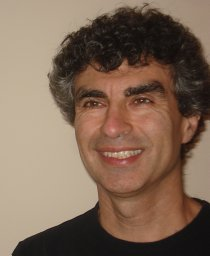
One of the "godfathers" of artificial intelligence and a computer scientist at the Université de Montréal, Yoshua Bengio recently became the first living scholar to accumulate more than one million citations on Google Scholar. This milestone marks the striking transformation of deep learning from an academic idea into a global technological revolution and underscores Bengio's enduring place in the history of AI. As of 16 November 2025, Bengio's total citations reached 1,010,305, and Nature and Scientific American reported that he has become the most‑cited living scholar worldwide. This achievement stems not only from his pioneering work but also reflects the explosive application of AI in healthcare, finance and autonomous driving. Bengio himself said: "Citations are not the end; they remind us of AI's responsibility—to ensure technology benefits humanity." This report is based on Google Scholar, Wikipedia and official Mila materials, and details his life, contributions, representative works and honors.
Curriculum vitae: From Paris immigrant to AI pioneer
Yoshua Bengio was born on 5 March 1964 in Paris, France, and is currently 61 years old. He is of Jewish Moroccan descent; his family emigrated from Morocco to France and later to Canada. Bengio's brother, Samy Bengio, is a computer scientist at Apple; both are active in the AI field.
Education:
- McGill University: Bachelor of Engineering in Electrical Engineering (BS), Master of Science in Computer Science (MSc) and PhD (1991). His doctoral thesis, "Artificial Neural Networks and Their Application to Sequence Recognition," was supervised by Renato De Mori.
- Postdoctoral research: Massachusetts Institute of Technology (MIT, supervised by Michael I. Jordan) and AT&T Bell Laboratories.
Career:
- Since 1993, Professor of Computer Science at the Université de Montréal.
- In 2000, founded the Montreal Institute for Learning Algorithms (MILA), serving as scientific director until 2025 (MILA is now the world's largest deep learning laboratory, with over 500 members).
- In 2016, co‑founded Element AI (an AI incubator); the company was sold to ServiceNow in 2020, and he served as an advisor.
- Since 2023, scientific and technical advisor to Recursion Pharmaceuticals and scientific advisor to Valence Discovery.
- In June 2025, he co‑founded the nonprofit LawZero (serving as co‑chair and scientific director), focused on developing "honest AI systems" (such as Scientist AI) to detect harmful behavior by autonomous agents; LawZero is funded by the Future of Life Institute and Schmidt Sciences.
- Other roles: Chair of IVADO and CIFAR AI; lead author of the international AI safety science report (full version released January 2025); signatory of a 2023 open letter calling for a pause on training systems more powerful than GPT‑4 and supporter of California's SB 1047 AI safety bill.
Bengio's career trajectory moved from early neural network research to AI ethics and safety; in 2025 he stepped down as MILA's scientific director to devote himself fully to LawZero.
Main contributions: Foundations of deep learning
Bengio is regarded as one of the "AI godfathers" alongside Geoffrey Hinton and Yann LeCun. His work laid the foundations of modern deep learning and helped propel AI from theory to application. Key contributions include:
- Neural probabilistic language model (2003): Introduced distributed representations (word embeddings) to address the curse of dimensionality in natural language processing.
- Revival of deep learning (1990s–2000s): Developed new recurrent neural network (RNN) architectures that helped overcome vanishing gradients and advanced computer vision and sequence modeling.
- Generative Adversarial Networks (GANs, 2014): Co‑authoring the seminal paper with Ian Goodfellow, helping establish the foundations of generative models.
- Deep Learning textbook (2016): Co‑author of Deep Learning (with Ian Goodfellow and Aaron Courville), now a standard global reference.
- AI safety and ethics: Since 2023 he has led international AI safety reports warning about deception, reward hacking and goal misalignment risks; in June 2025 he published an article in Fortune calling for regulation and international cooperation.
Bengio's students include Ian Goodfellow (the inventor of GANs). His h‑index reached 252 (November 2025), the highest among computer scientists worldwide. Since 2020 his papers have been cited over 730,000 times, and in 2024 alone he received approximately 136,000 citations.
Top ten cited papers
According to Google Scholar data (as of November 2025), Bengio's top ten most‑cited papers focus on deep learning, representation learning and generative models, with total citations exceeding one million. The following list is ordered by citation count (estimated values, subject to change):
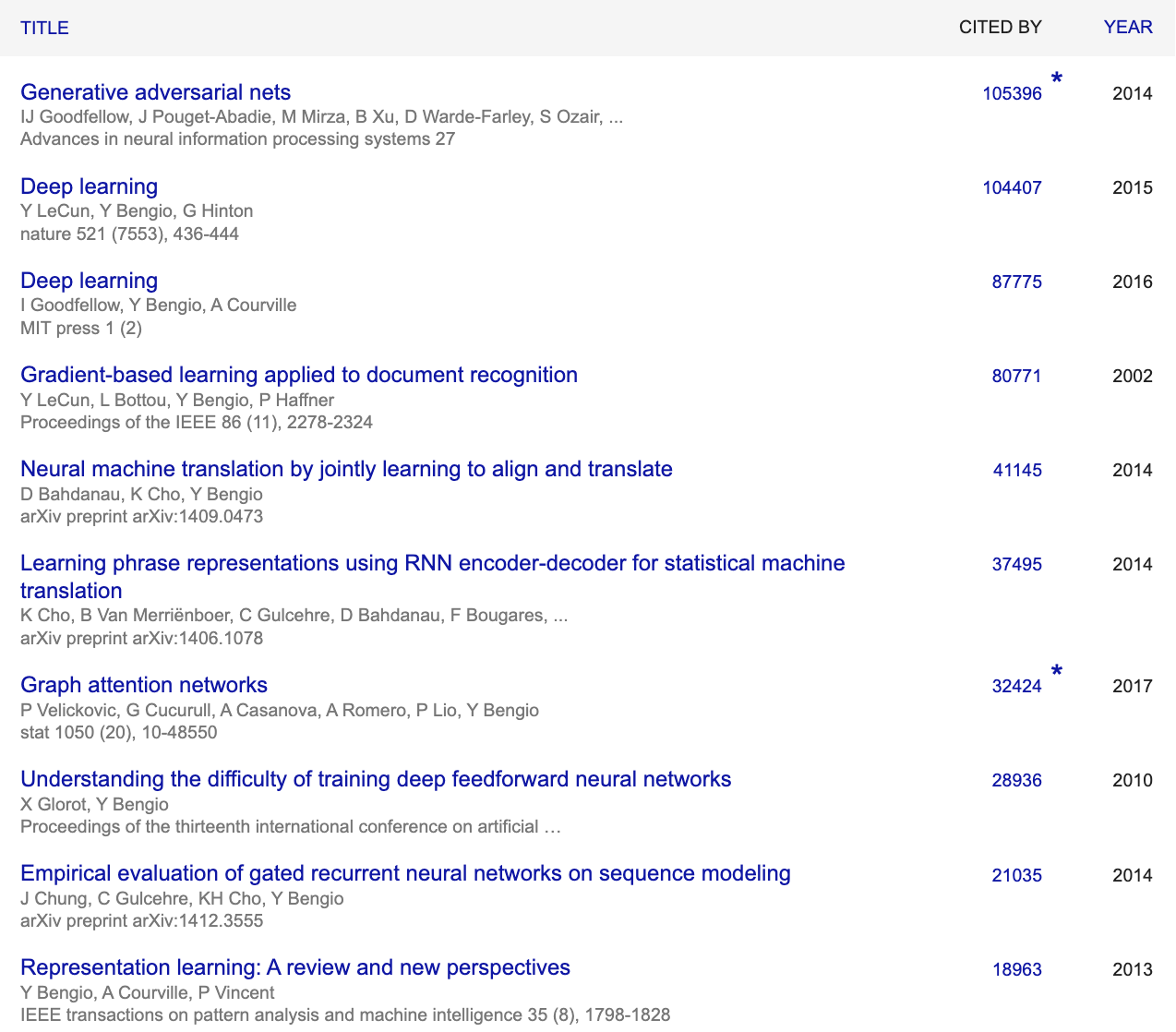
Data source: Google Scholar profile. These papers account for more than 56% of his total citations and helped drive the field's shift from supervised learning toward generative and self‑supervised approaches.
Major awards: From the Turing Award to Queen Elizabeth Prize for Engineering
Bengio's honors reflect his leadership in AI, with over 20 awards. Key awards include (in chronological order):
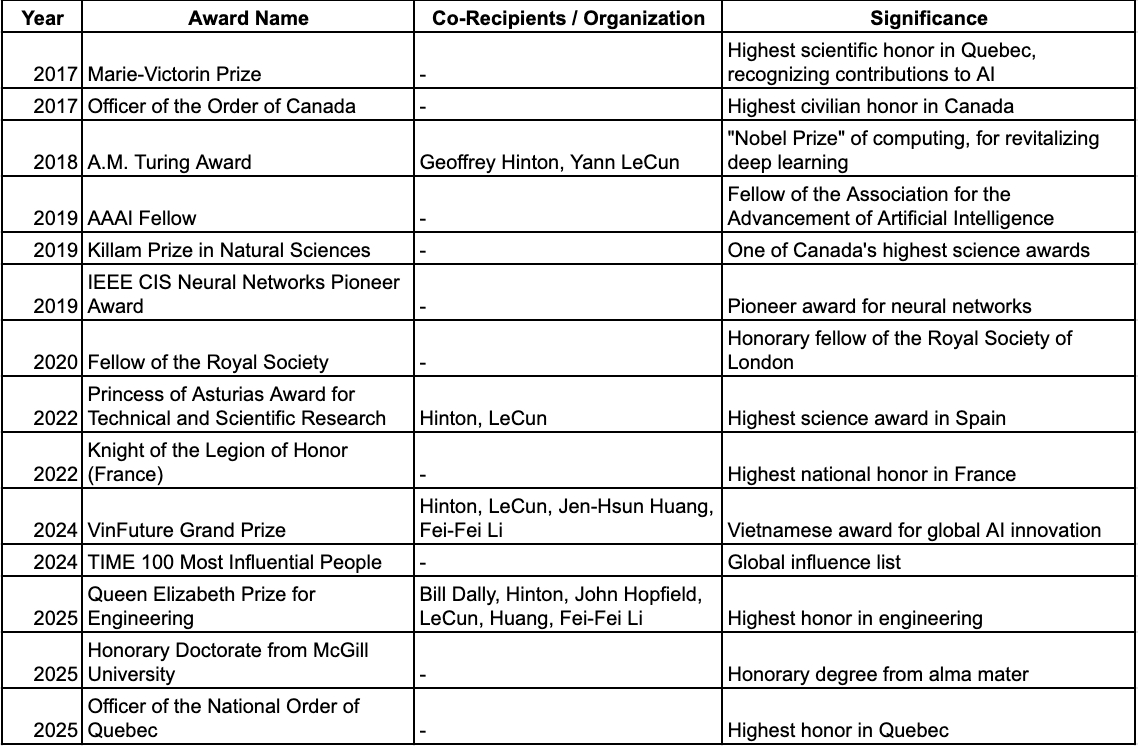
Bengio has the highest h‑index among computer scientists (November 2025) and has served as CIFAR AI chair.
Conclusion: From citation king to AI guardian
Bengio's million‑citation milestone is not only a personal honor but also a testament to the global impact of deep learning. From 2003's word embeddings to 2025's AI safety initiatives, his work has shaped the ChatGPT era while consistently warning of "AI deception risks." The Mila Institute said this achievement "inspires a new generation of researchers." Looking ahead, Bengio's LawZero may lead a new era in AI ethics. For more details, see his Google Scholar page (https://scholar.google.com/citations?user=kukA0LcAAAAJ&hl=en&oi=ao).