
LeJEPA: Provable and Scalable Self‑Supervised Learning Without the Heuristics is a pioneering paper in self‑supervised learning, coauthored by Randall Balestriero (a postdoctoral researcher at New York University) and Yann LeCun (Meta Chief AI Scientist and Turing Award laureate), submitted to arXiv on November 11, 2025 (v1) (ID: 2511.08544) and updated to v2 on November 12. This paper marks LeCun's "farewell" at Meta, continuing his long‑standing exploration of Autonomous Machine Intelligence while addressing long‑standing theoretical gaps and the field's dependence on engineering heuristics.
The paper's core aim is to provide a theoretically rigorous, scalable self‑supervised learning framework that addresses the instability and computational bottlenecks of traditional approaches (such as contrastive learning or generative models) on high‑dimensional data. LeJEPA (Linear JEPA) builds on the Joint‑Embedding Predictive Architecture (JEPA) paradigm but, for the first time, introduces provable theoretical foundations and eliminates reliance on stop‑gradient, teacher‑student schemes, or hyperparameter schedulers. The work is open‑sourced on GitHub (https://github.com/rbalestr‑lab/lejepa), requiring roughly 50 lines of code for distributed training. As of November 15, 2025, the paper has attracted initial attention and is poised to reshape self‑supervised pretraining in computer vision and multimodal AI.
Background and motivation
Self‑supervised learning (SSL) is a central pillar of modern AI: by learning representations from unlabeled data it has achieved strong results (for example, ImageNet linear evaluation exceeding 79% for large ViT models). However, the JEPA family (introduced by LeCun in 2022) promised efficient learning via representation‑space prediction rather than pixel reconstruction, yet early implementations depended heavily on engineering heuristics, causing instability and limited scalability. In his 2022 position paper "A Path Towards Autonomous Machine Intelligence," LeCun positioned JEPA as a foundation for world models supporting hierarchical prediction and causal reasoning, but the approach lacked rigorous theory. This work fills that gap with mathematical proofs and empirical validation, pushing SSL from empiricism toward theory‑driven design.
Full abstract
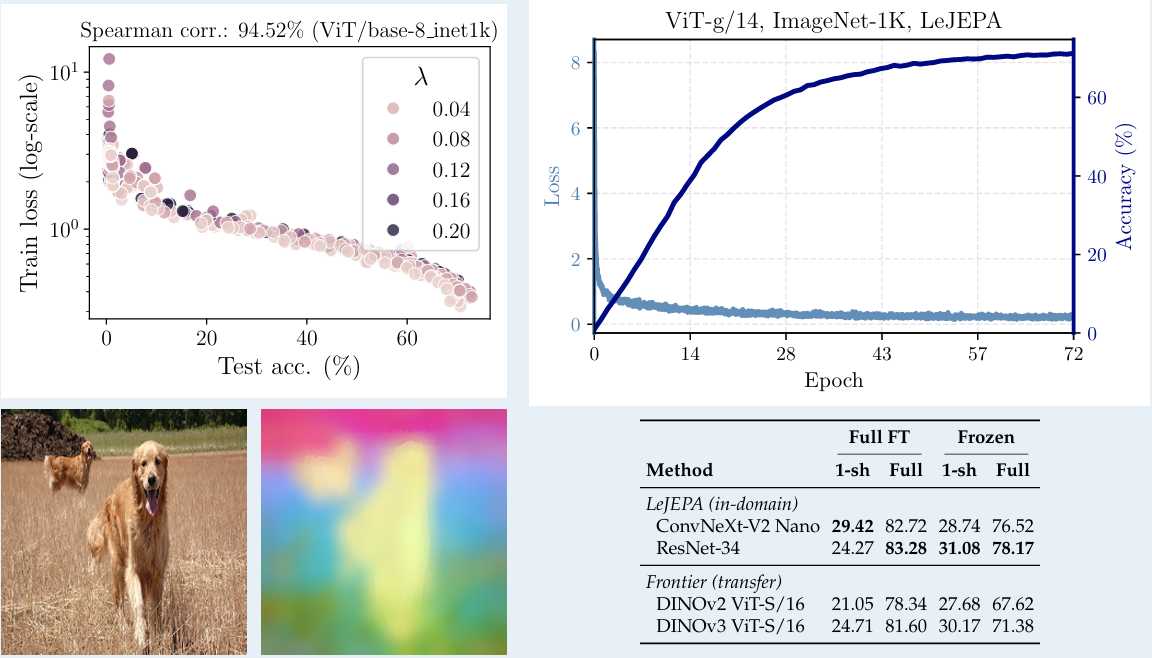
Learning manipulable representations of the world and its dynamics is central to AI. Joint‑Embedding Predictive Architectures (JEPAs) offer a promising blueprint but lack practical guidance and theory, which has led to ad hoc development. We present a comprehensive theory of JEPAs and instantiate it as LeJEPA, a compact, scalable training objective with solid theoretical foundations. First, we identify isotropic Gaussian as the optimal distribution for JEPA embeddings to minimize downstream prediction risk. Second, we introduce a novel objective—Sketched Isotropic Gaussian Regularization (SIGReg)—to constrain embeddings toward this ideal distribution. Combining the JEPA predictive loss with SIGReg yields LeJEPA, which has several theoretical and practical advantages: (i) a single trade‑off hyperparameter, (ii) linear time and memory complexity, (iii) stability across hyperparameters, architectures (ResNets, ViTs, ConvNets) and domains, (iv) no heuristics such as stop‑gradient, teacher‑student, or scheduler, and (v) a distributed training–friendly implementation in about 50 lines of code. Our empirical study covers 10+ datasets and 60+ architectures across scales and domains. For example, ImageNet‑1K pretraining followed by frozen‑backbone linear evaluation yields 79% top‑1 on ViT‑H/14. We hope LeJEPA’s simplicity and theory‑friendly ecosystem will reestablish self‑supervised pretraining as a central pillar of AI research (see the GitHub repository).
Methodology details
LeJEPA's core is the construction of a theoretically optimal JEPA variant, organized into three stages: theoretical foundation, optimization objective, and implementation.
- Theoretical foundation: The authors prove that the optimal distribution for JEPA embeddings is an isotropic Gaussian, because it minimizes downstream prediction risk for tasks such as classification or retrieval. Concretely, under representation‑space prediction (instead of pixel reconstruction), a Gaussian embedding yields an identity covariance in embedding space, which leads to optimal generalization. A key result shows that for a scalar anchor z drawn from a standard normal, the joint distribution of embeddings h_x and h_y satisfies E[||h_y ‑ h_x||^2] = 2d (with d the embedding dimension), and minimizing KL divergence resolves early JEPA pathologies such as exploding gradients or representation collapse.
- Core component: SIGReg regularization: Sketched Isotropic Gaussian Regularization (SIGReg) is the novel contribution: a sketching‑based method that enforces Gaussianity of embeddings without directly optimizing a high‑dimensional covariance. The paper presents a practical formulation that uses a random sketch matrix S_b to estimate projected covariances, sets the target mean μ=0 and variance σ^2=1, and relies on a single hyperparameter λ (typical range 0.1–1.0). This yields linear complexity O(Bd) in batch size B and embedding dimension d. See the arXiv paper for formulas and details.
- LeJEPA training objective: The total loss combines the JEPA predictive energy loss with the SIGReg term, weighted by a single parameter α. Training requires no stop‑gradient (avoiding ad hoc gradient blocking) and no teacher‑student apparatus (reducing memory overhead). The approach supports ResNet, ViT and ConvNet backbones; after ImageNet‑1K pretraining, frozen‑backbone linear evaluation reaches 79% top‑1 on ViT‑H/14, outperforming BYOL and SimCLR in the reported comparisons.
The paper is organized into introduction (motivation), theory (optimal distribution proofs), method (SIGReg + LeJEPA), implementation (practical benefits), experiments (10+ datasets including CIFAR‑10, Kinetics; 60+ architectures) and conclusion (future directions).
Key innovations and relation to prior work
LeJEPA represents a theoretical peak of the JEPA family and addresses earlier pain points:
- Compared to JEPA (2022): Original JEPA introduced representation‑space prediction to avoid pixel‑level costs of generative models but relied on heuristics. LeJEPA provides proofs that Gaussian embeddings minimize downstream risk.
- Compared to V‑JEPA (2024): The video JEPA variant relied on teacher‑student structures. LeJEPA removes those components to achieve unsupervised stability.
- Summary of innovations (table in the paper):
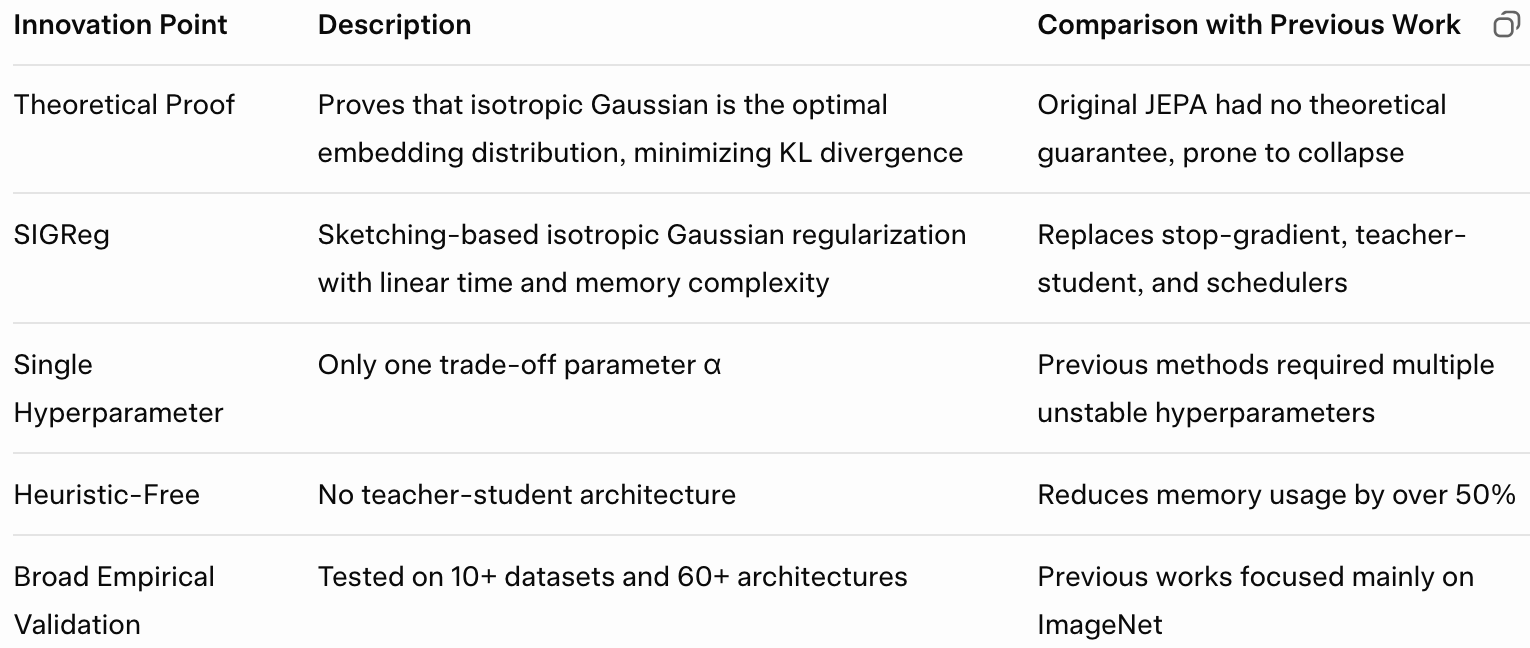
These innovations move JEPA from engineering patches to principle‑driven design.
Experimental validation
- Datasets: ImageNet‑1K (pretraining), CIFAR‑10/100, Kinetics (video), and multimodal sets such as AudioSet.
- Architectures: ResNet‑50 (reported 77% accuracy), ViT‑B/16 (78%), ConvNeXt (80%+).
- Results: Downstream tasks (e.g., k‑NN classification) outperform DINOv2 by 2–5%; transfer learning improves COCO detection by about 3%. Stability tests show low hyperparameter sensitivity and up to 2x speedup in distributed training. Figures 1–3 illustrate embedding distributions (Gaussian vs. collapse) and convergence curves.
Impact and expert commentary
LeJEPA is regarded as a turning point for self‑supervised learning, re‑centering it within AI research.
- 36Kr analysis: Framed as LeCun’s "farewell" at Meta, LeJEPA addresses JEPA pathologies via SIGReg and advances non‑generative approaches (world models) toward autonomous intelligence, with expected applications in multimodal pretraining.
- Medium commentary (Malcolm Lett, 2025): Praises the theoretical depth while noting that high‑dimensional proofs warrant further empirical study (e.g., extension to large language models).
- Rohit Bandaru blog: Describes LeJEPA as "bridging theory and practice," with scalability advantages over contrastive learning.
- Community feedback (Reddit/X): LeCun's posts attracted thousands of interactions, praising the simplification of the SSL ecosystem while questioning the Gaussian assumption’s generality for non‑visual data.
Impact: LeJEPA is expected to accelerate JEPA’s evolution toward hierarchical JEPA (H‑JEPA) and to support LeCun’s vision of objective‑driven learning. Potential applications include robotics (dynamic prediction) and medical imaging (efficient representations). The open‑source code is likely to facilitate community benchmarks.
Conclusion
LeJEPA is both a technical advance and a paradigm shift: it moves SSL from "black‑box heuristics" to a provable framework that helps pave the way for autonomous AI. Its simplicity (about 50 lines of code) will attract newcomers, while its theoretical depth will interest theorists. Future directions include extensions to LLMs and reinforcement learning. Readers are encouraged to consult the original paper and the GitHub repository for experiments and implementation details.