
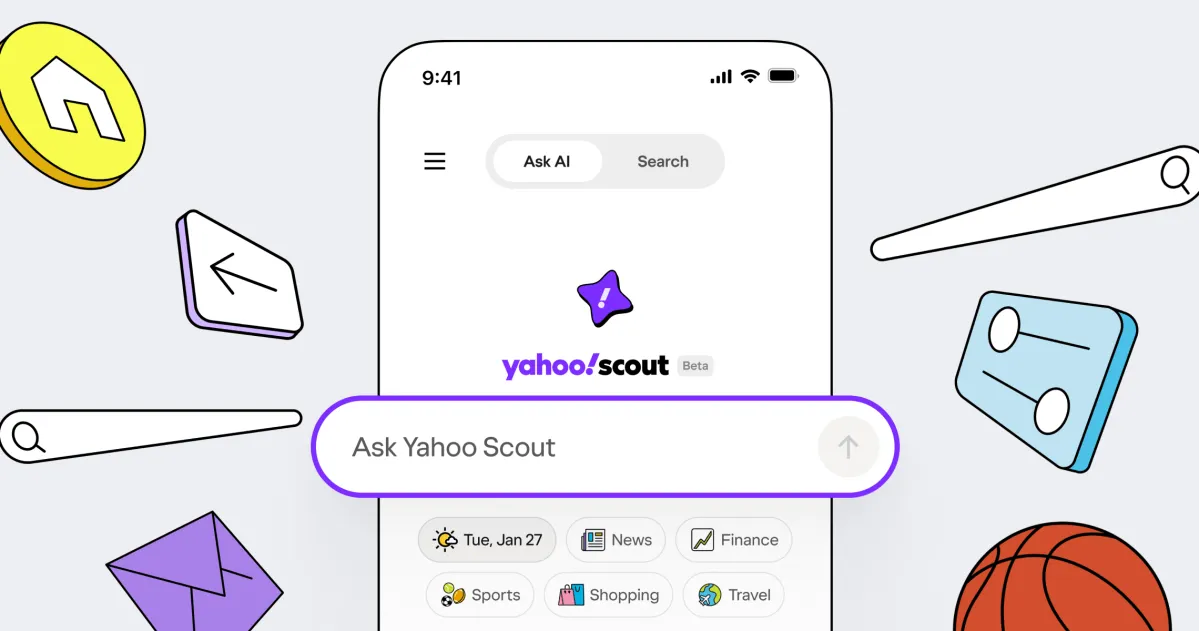
On January 26, 2026, The Verge published a detailed report on Yahoo's new product Scout. Yahoo describes Scout as an "answer engine"; the core idea is not to replace traditional search with chat‑style conversation, but to combine Yahoo's existing data, news editorial resources and general web retrieval to present concise answers while retaining clickable sources.
In the actual interface, Scout's results typically include three layers: a concise response generated by the model, a column listing clickable links to cited sources, and traditional search result cards. The Verge noted that this design is clearly intended to make AI output "verifiable." When the system provides facts or recommendations, users can jump directly to the original reports or webpages rather than seeing an untraceable block of text.
Another emphasized detail is Yahoo's integration of its own news and editorial content: Scout gives priority in answers to items written or reviewed by Yahoo's news team, while also listing links from other sites on the web. This approach both drives traffic to Yahoo's existing content and gives answers multiple supporting sources. The Verge judged that this distinguishes Scout from some "closed‑source generated" systems in terms of user trust and verifiability.
Positioned more as a "web‑centered AI search" than a pure chatbot, The Verge found that Scout, when handling complex questions, breaks long answers into key points and appends further‑reading links after paragraphs; users can see highlighted excerpts or quoted passages from the original text beneath answers. This preservation of "web cues" was described as "web‑friendly" because it encourages users to return to sources to verify details beyond the AI's conclusions.
Scout's interface and interactions also reflect Yahoo's attention to mobile and news scenarios: answer cards are compact for quick scanning in mobile browsers; editorial recommendations and video modules embed Yahoo's multimedia resources into the results stream. The Verge noted that Scout's rollout has been cautious and that Yahoo is positioning it as a supplement to the search experience rather than a complete replacement for traditional search engines.
In the competitive landscape, Scout is seen as a response to Google, Microsoft and independent AI search providers: it seeks a balance between instant AI answers and the verifiability of traditional webpages. The Verge concluded that users who care about source transparency and news context are more likely to accept Scout, while users seeking a purely conversational experience may still prefer chat‑style assistants.
Launched by Yahoo in 2026, Scout is not revolutionary but represents a careful tuning to mainstream user habits—placing AI convenience and web traceability in one interface so that "answers" are no longer isolated sentences but gateways to original reports and further information.
▶️ Like this article? Creating content is hard!
Follow our YouTube channel:
AI Rosetta
Your likes, subscriptions and shares are our greatest support! 🙏
More AI news at: https://www.airosetta.com