
On April 9, 2026, MiniMax developer Xiyun Technology officially fulfilled its earlier promise and fully open‑sourced its flagship model Minimax2.7, released in March. The model achieved leading results on programming benchmarks such as SWE‑Bench Pro and LiveCodeBench, with some metrics approaching or surpassing top international closed‑source models. Following the open‑sourcing of Zhipu AI's GLM‑5.1, this is another major domestic open‑source large model, signaling Chinese AI firms' continued alignment with international frontiers in coding ability and cost‑effectiveness and further accelerating open‑source ecosystem development.
Minimax2.7 uses a Mixture‑of‑Experts (MoE) architecture, with approximately 380 billion total parameters and about 52 billion activated parameters, combining efficient inference with strong coding capability. The open‑source release includes base model weights, instruction‑tuned models, full training and inference code, and accompanying toolchains and evaluation scripts, all under the Apache 2.0 license. Developers can download it for free via Hugging Face and ModelScope, and it supports local deployment on mainstream inference frameworks such as vLLM and SGLang, avoiding high API fees.
Coding Ability Matches International Leaders
The standout feature of Minimax2.7 is its engineering‑grade coding capability. On the software engineering benchmark SWE‑Bench Pro, Minimax2.7 scored 61.2, surpassing Claude Opus 4.6's 57.3 and GPT‑5.4's 57.7, making it the first open‑source model to outperform current mainstream closed‑source models on this benchmark. On LiveCodeBench (a real‑world programming competition problem set), Minimax2.7 also ranked first among open‑source models, with the overall score gap to top international closed‑source models narrowed to within 2–3 points.
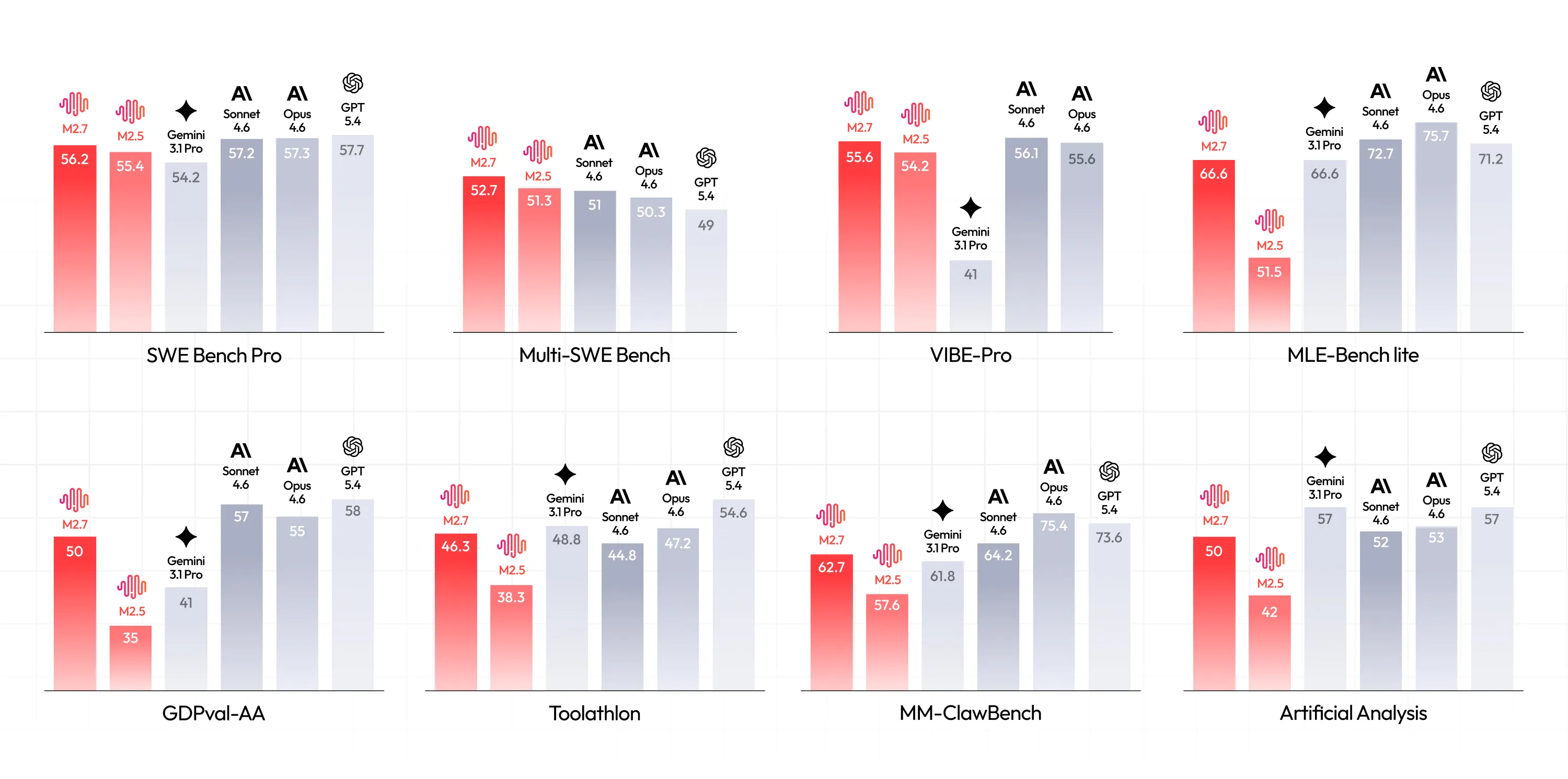
These results stem from Xiyun Technology’s large‑scale code data cleaning and reinforcement learning optimization during post‑training. The model has been especially strengthened in long‑context code understanding and multi‑file collaborative editing, supporting a 200K context length to process entire code repositories at once and enabling autonomous planning, debugging and refactoring in complex projects. Community tests show that in real software engineering tasks Minimax2.7’s code correctness and execution success rates are significantly higher than its predecessor Minimax2.5, reaching production‑level usability.
Compared with Zhipu AI’s GLM‑5.1, Minimax2.7 has advantages in programming‑specific capabilities, while GLM‑5.1 excels in general scientific reasoning and multimodal tasks. Together they form a twin‑peak landscape of domestic open‑source large models across different dimensions, broadening developers’ choices.
Cost‑effectiveness and Open‑Source Strategy: China’s 'Small Beats Big' Path
The open‑sourcing of Minimax2.7 is not just a technical release but a strategic move by Xiyun Technology. Compared to the high API fees of international closed‑source models, Minimax2.7 offers exceptional cost‑effectiveness. For local deployment, per‑inference costs are only about 1/8–1/10 of similar‑performance closed models, greatly lowering the barrier for SMEs and individual developers.
The CEO of Xiyun Technology said the open‑source release aims to "let more developers truly own their own high‑performance coding assistant." Since open‑sourcing, the community has quickly produced Agent framework integration projects based on Minimax2.7, including compatible versions for tools like OpenClaw and Cline, which are expected to further accelerate the adoption of AI coding tools.
Industry Impact: Domestic Open‑Source AI Enters a New Phase
The open‑sourcing of Minimax2.7 has multiple far‑reaching impacts on the global AI ecosystem:
- Breakthrough in coding ability: It demonstrates that with efficient MoE architectures and targeted post‑training, domestic open‑source models can match or even surpass top international closed‑source models on core engineering benchmarks, breaking the stereotype that 'open‑source models are always behind closed‑source ones.'
- Acceleration of open‑source ecosystem: With full open‑sourcing, developers can freely fine‑tune and vertically optimize the model, driving the creation of more agents, code assistants, and automation tools. A large number of Minimax2.7‑based derivative projects are expected to emerge in the short term, further enriching China’s open‑source AI ecosystem.
- Reshaping international competition: It puts pressure on closed‑source giants like Anthropic and OpenAI while offering global developers a cost‑effective alternative. Chinese AI firms' leading position in open‑source is further consolidated.
- Commercialization alongside inclusivity: Xiyun attracts developer traffic through open‑sourcing while retaining enterprise‑grade API services, forming a healthy 'open‑access plus commercial loop' model.
This event also offers an industry lesson: in a context of relatively limited compute resources, achieving 'small beats big' through architectural innovation and data optimization is a viable path for Chinese AI firms. The success of Minimax2.7 further validates this strategy.
Challenges and Outlook
Despite its impressive results, as a newly open‑sourced model Minimax2.7 still has room for improvement in ultra‑long contexts, complex multilingual tasks, and long‑term stability. After open‑sourcing, balancing community contributions with commercialization paths and addressing potential safety risks will also be new challenges for Xiyun.
Xiyun says it will continue iterating the Minimax series, planning larger‑scale versions and strengthening cooperation with the open‑source community. The successive open‑sourcing of GLM‑5.1 and Minimax2.7 together mark the start of a 'high‑performance open‑source era' for domestic large models in 2026. As more companies follow suit, this trend is expected to help Chinese AI take a more prominent position on the global stage.
From the mysterious model HappyHorse‑1.0 to the formal open‑sourcing of Minimax2.7, Chinese AI companies are putting 'open‑source promises' into practice, offering global developers more high‑performance options. With continued improvements in AI coding ability and cost‑effectiveness, the release of Minimax2.7 is not only a technical milestone but also a concentrated expression of confidence and strength in domestic open‑source AI. It suggests that future AI competition will depend increasingly on who can better balance openness, innovation, and practicality.
The wave of open‑sourcing domestic large models is moving from 'following' to 'running alongside' and even 'leading.' The debut of Minimax2.7 adds new momentum to this wave.
▶️ Like this article? Creating it takes a lot of work!
Subscribe to our YouTube channel:
AI Rosetta
Your likes, subscriptions and shares are our greatest support! 🙏
For more AI news visit: https://www.airosetta.com