
On September 21, 2026, xAI (released under the SpaceXAI name) officially launched Grok 4.7 and simultaneously introduced an accelerated variant, Grok 4.7 Fast. The company positions these models as primary offerings for coding, agent tasks and knowledge work: they are designed to operate longer on more difficult, longer‑running tasks with greater emphasis on self‑verification, while maintaining the same base pricing and speed tiers as Grok 4.6. The Fast variant runs the same model on faster infrastructure, roughly doubling output speed but charging about twice the standard rate; it is currently available only in Cursor and Grok Build and is not exposed via the public xAI API.
Details
Grok 4.7 is built on a larger new base than 4.6 and underwent extended reinforcement learning training, with a task mix skewed toward problems that can require hours to complete. The company emphasizes improvements in self‑validation and long‑context management, and notes native adaptation for the Grok Bot agent framework, yielding more robustness in conversation, document and demonstration‑style knowledge work.
Key specifications:
- Context window: 500,000 tokens
- Input: text and images; Output: text (no explicit output length cap)
- Knowledge cutoff: around May 2026
- Inference tiers: low / medium / high (default) / xhigh
- API identifier: grok‑4.7
Pricing (standard tier, prompts under 200,000 tokens):
- Input: $2 / million tokens
- Cached input: $0.50 / million tokens
- Output: $6 / million tokens
- After 200,000 tokens, input/cached/output rise to $4 / $1 / $12 per million tokens respectively. xAI has held this pricing across versions 4.5 to 4.7, signaling a clear cost‑performance strategy.
Grok 4.7 Fast uses the same model weights through a faster inference channel; its price is roughly double the standard tier. It targets workflows that require lower latency in coding interactions but is not offered through the public API.
Official benchmark results
In xAI's comparison table (Grok 4.7 xhigh vs Grok 4.6 high, GPT‑5.6 Sol max, Fable 5.1 max):
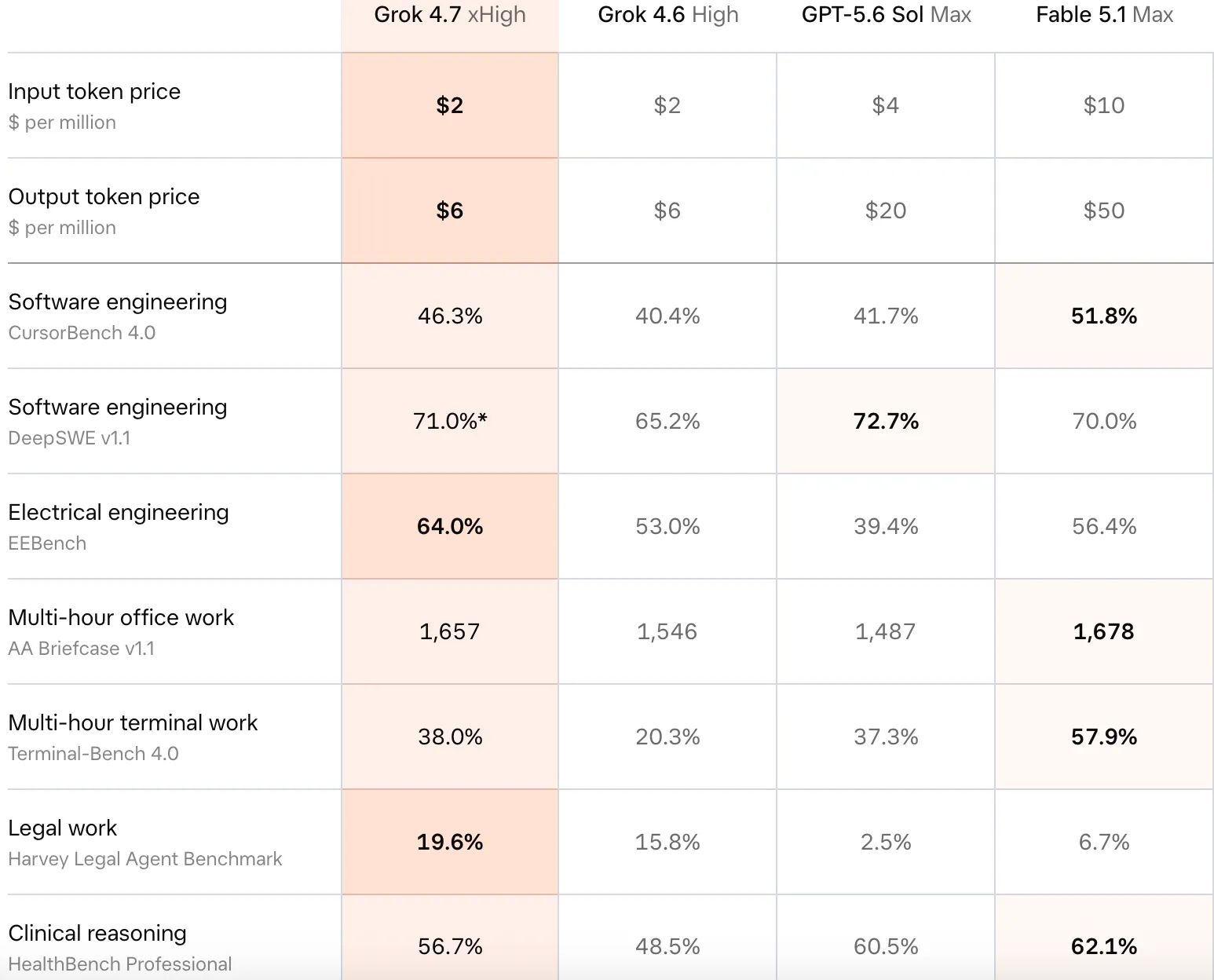
* high effort
- CursorBench 4.0: 46.3% (4.6: 40.4%)
- DeepSWE v1.1: 71.0% (high effort; 4.6: 65.2%)
- Terminal‑Bench 4.0: 38.0% (4.6: 20.3%; the largest single‑generation gain)
- EEBench: 64.0%
- AA Briefcase v1.1: 1657
- Harvey Legal Agent: 19.6%
- HealthBench Professional: 56.7%
Overall, Grok 4.7 shows comprehensive gains over 4.6; it leads or approaches GPT‑5.6 Sol on several measures and has mixed results versus Fable 5.1 — outperforming in some electrical engineering and legal agent tasks while still lagging on certain coding and long‑task dimensions. Its price point remains materially lower. Independent reviewers note that 4.7 reaches leading territory for agent knowledge work at higher inference tiers, though xhigh consumes more output tokens. The figures above are largely vendor‑reported or preliminary third‑party results; full independent reproduction is ongoing.
On safety, xAI states that Grok's refusal behavior and jailbreak resistance are the strongest in the series to date, while maintaining a relatively low false‑refusal rate for legitimate security research and defensive uses.
Potential impacts
1. Increased competition in coding toolchains.
Grok 4.7 is immediately available in Cursor and Grok Build and can be invoked via the API and gateways such as OpenRouter. For developers, that means running longer agent loops at similar latency for a lower unit price. The Fast variant preserves a “pay more, be faster” option inside IDEs, suited to interactive coding.
2. Price anchoring further cemented.
By holding the $2/$6 pricing across three generations, xAI may push the market to treat “cost‑effective coding models” as a distinct category rather than focusing solely on top benchmark rankings.
3. Long‑task and self‑verification as selling points.
The industry is shifting from one‑off Q&A to agent workflows lasting tens of minutes to hours. 4.7’s training emphasis on long‑running tasks and self‑checks reflects that trend; however, higher inference tiers will raise token bills, so enterprises will still need cost controls.
4. Limitations and risks.
The Fast variant is not exposed via the public API, leaving coverage incomplete; some benchmarks are self‑reported; independent evaluations show that composite indices do not uniformly beat the prior generation across all dimensions. Details such as parameter counts were not fully disclosed on the release page, so third‑party claims should not be treated as definitive.
Conclusion
Grok 4.7 is not a cosmetic rename but a substantive shift that, while maintaining price and baseline speed, reorients capability toward long‑running coding and knowledge work and offers a Fast channel for low‑latency scenarios. For developers it provides a cheaper option for long tasks; for the industry it continues to apply pressure on competitors through frequent iterations and frozen pricing. What will ultimately determine its standing are third‑party reproductions and stability in real‑world workflows, not single‑day scores.
▶️ Enjoy this article? Creating content is hard!
Follow our YouTube channel:
AI Rosetta
Your likes, subscriptions and shares are our greatest support! 🙏
More AI news at: https://www.airosetta.com