
On March 12, 2026, xAI officially launched Grok 4.20 Beta, the latest flagship model in the Grok series. Official and third‑party benchmarks show the model achieved a 78% non‑hallucination rate on the AA‑Omniscience benchmark, a new record among publicly tested models, making it the lowest‑hallucination large language model in the industry. This release marks xAI's strategic shift from “pursuing intelligence ceilings” to “pursuing real‑world reliability.” Grok 4.20 not only performs well in inference speed, cost efficiency and instruction following, but also employs a native 4‑Agent multi‑agent architecture to enable collaborative handling of complex tasks, particularly suited for enterprise‑grade agentic AI applications.
xAI founder Elon Musk said on X: "Grok 4.20 is the most honest AI currently; it won't fabricate answers to please people." The model is available via xAI's official API and platforms such as OpenRouter, priced at input $2 per million tokens and output $6 per million tokens, offering strong cost‑effectiveness. Within 24 hours of release, downloads on Hugging Face and in developer communities surged, quickly topping hybrid open‑source/closed‑source model popularity charts.
Core new features: low hallucination rate + native multi‑agent architecture
Grok 4.20's biggest breakthroughs are the record reduction in hallucinations combined with a native multi‑agent architecture. Traditional large models are often criticized for "confidently fabricating facts," whereas Grok 4.20 is designed to “say what it knows and admit what it doesn't,” achieving high honesty.
- Industry‑lowest hallucination rate (78% non‑hallucination on AA‑Omniscience) In the Artificial Analysis AA‑Omniscience benchmark, Grok 4.20 reached a 78% non‑hallucination rate, outperforming competitors such as Claude Haiku 4.5, Gemini 3.1 Pro Preview and GPT‑5.4. This means when the model is uncertain it is more likely to explicitly state "I don't know" or provide limited information rather than confidently invent an answer. xAI attributes this result to rigorous factual alignment and strengthened refusal mechanisms during training, where the model will proactively call search tools or acknowledge its limits when faced with unknown questions.
- Native 4‑Agent multi‑agent architecture Grok 4.20 includes a built‑in 4‑Agent collaboration system (Grok Coordinator + Harper the Researcher + Benjamin the Logician + Lucas the Creator), enabling real‑time debate and task division without additional frameworks. For complex tasks, the four agents work in parallel:
- The Grok Coordinator handles overall planning and final decisions.
- Harper the Researcher focuses on information retrieval and fact‑checking.
- Benjamin the Logician is responsible for rigorous reasoning and logical verification.
- Lucas the Creator provides creative ideas and multi‑perspective analysis.
- This architecture enables Grok 4.20 to excel at multi‑step planning and complex problem solving. Users can call it directly via the model name "multi‑agent‑beta‑0309," and Heavy mode supports scaling up to 16 agents for deep research and enterprise workflows.
- Extra‑long context and efficient inference Supports a 2M token context window (API version), far exceeding most competitors, allowing single‑pass processing of entire books, full codebases, or very long conversation histories. Combined with the MTP (Multi‑Token Prediction) mechanism, inference speed reaches 265+ tokens/s, significantly faster than previous Grok 4 versions.
- Strict instruction adherence and low‑cost design The model scores very high on instruction following, rarely "slacking" or deviating from user requests, while maintaining xAI's characteristic cost advantages—suitable for high‑frequency use cases like real‑time support, code assistance and automated agent workflows.
- Enhanced multimodality and tool calling Native support for image/video understanding, real‑time web search and a code interpreter tool. Developers can easily build cross‑modal agent applications.
Performance benchmarks and comparisons
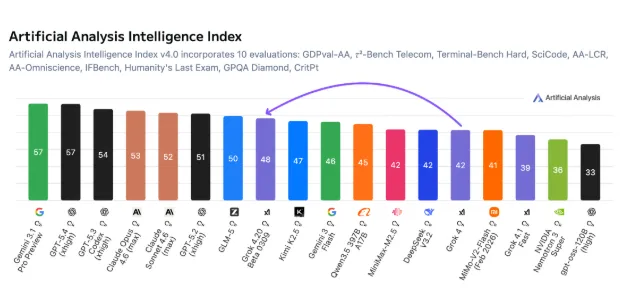
According to third‑party tests by Artificial Analysis and OpenRouter:
- Intelligence Index (in reasoning mode): 48 points, 6 points higher than Grok 4, but still behind Gemini 3.1 Pro Preview and GPT‑5.4 at 57 points.
- Non‑hallucination rate: 78% (industry highest).
- Instruction following and factuality: leading most competitors.
- Speed and cost: clear advantages in output speed and per‑token cost, suitable for production deployments.
xAI emphasizes that Grok 4.20 is not pursuing "maximum intelligence" but rather "maximum reliability + best value," aiming to become the preferred foundation for enterprise‑grade agentic AI.
Industry significance: a shift from "smart" to "trustworthy"
The release of Grok 4.20 has important demonstrative significance for the AI industry. Previously, large‑model competition focused on parameter counts and benchmark scores, while hallucinations remained the biggest barrier to enterprise adoption. Grok 4.20 demonstrates with a very low hallucination rate that through architectural innovation and alignment training, AI can become more honest, which has revolutionary value for high‑risk sectors such as finance, healthcare and law.
For developers, the combination of low cost, high reliability and native multi‑agent support will greatly lower the barrier to building reliable agent systems. Platforms like OpenRouter have already gone live, and many enterprise applications based on Grok 4.20 are expected to appear in 2026.
At the same time, this release reflects xAI's strategic positioning: not blindly pursuing parameter leadership but focusing on the "pursuit of truth" and practical reliability, consistent with Elon Musk's longstanding emphasis on pursuing maximum truth.
Conclusion: Grok 4.20 ushers in an "honesty era" for AI
xAI Grok 4.20 sets a new reliability benchmark for large models with a record‑low hallucination rate and a native multi‑agent architecture. It shows that AI can be not only smarter but also more honest and more reliable.
As AI moves from the lab to large‑scale commercial use in 2026, Grok 4.20 may mark the turning point from "pursuing intelligence ceilings" to "pursuing trustworthy deployment." Whoever truly solves the hallucination problem will take the lead in the enterprise AI market.
▶️ Enjoy this article? Creating content is hard!
Follow our YouTube channel:
AI Rosetta
Your likes, subscriptions and shares are our greatest support! 🙏
More AI news at:
https://www.airosetta.com