
On or around March 26, 2026, the English Wikipedia formally updated its editing policy, explicitly prohibiting editors from using large language models (LLMs, such as ChatGPT, Google Gemini, etc.) to generate or rewrite article content. The policy has been described by media as a "notice to AI" and aims to preserve the platform's reliability and neutrality.
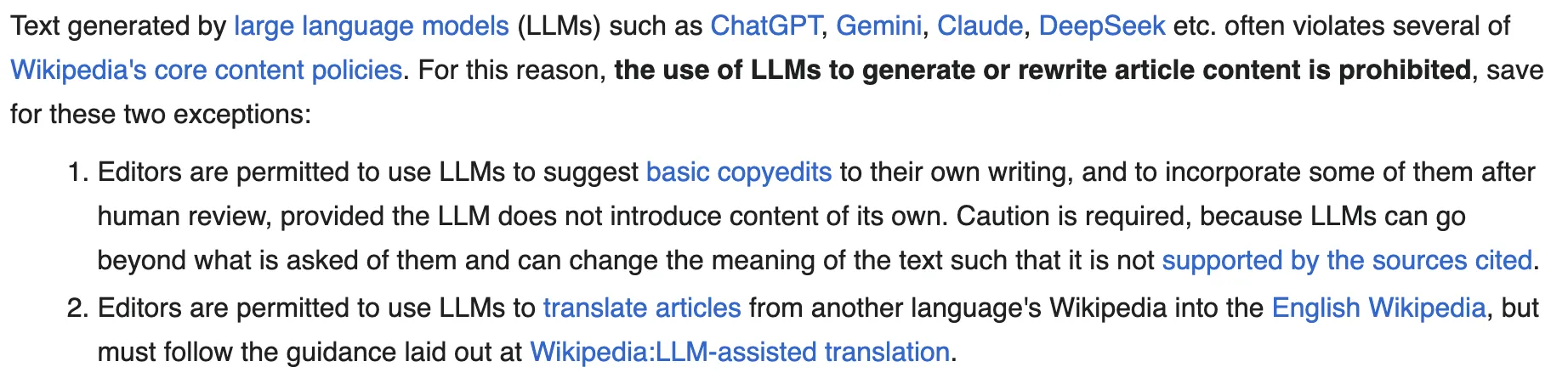
According to Wikipedia's official page 'Writing articles with large language models', the core statement of the new rule is: "Text generated by large language models often violates multiple core content policies of Wikipedia. Therefore, using LLMs to generate or rewrite article content is prohibited, except in the following cases." The policy was approved by the community Request for Comment (RfC) vote on March 20, 2026, by an overwhelming margin (about 40–44 in favor, 2 against) and was quickly incorporated into the official guidelines.
Policy background: AI content surge left community overwhelmed
Since the launch of ChatGPT at the end of 2022, Wikipedia has faced an increasing number of AI‑assisted or fully AI‑generated articles. Such content often contains "hallucinations" (fabricated facts), lacks reliable source citations, and violates core policies such as Verifiability and No Original Research. Editors have had to spend large amounts of time verifying and cleaning up, leading to a spike in administrative reports and overburdening the volunteer community.
Previous policy was vague, only advising that "LLMs should not be used to write new articles from scratch." In early 2026, an incident in which an AI bot "TomWikiAssist" made a large number of edits became the trigger, and the community decided to tighten rules. Wikipedia also established the "WikiProject AI Cleanup" to identify and clean suspected AI content, and added a category "Articles with suspected AI‑generated content since March 2026."
Strict restrictions and two exceptions
The new policy is not a total ban on AI, but draws clear lines:
- Basic Copyediting: Editors may use LLMs to suggest grammar, wording, or formatting improvements to text they wrote themselves, but must review manually, and the AI must not introduce any new content or change the original meaning. The policy warns: "LLMs may go beyond your request and change the meaning of text without your knowledge so that it is no longer supported by sources."
- LLM‑assisted Translation: Permitted to use LLMs to translate articles from other language Wikipedias into English, but editors must have sufficient knowledge of the source language to verify and must follow existing "LLM‑assisted translation" guidelines.
Other than these exceptions, generating new content, rewriting existing articles, or large‑scale rewording is prohibited. Violators may face warnings, editing restrictions, or bans, depending on severity.
The policy emphasizes that writing style alone cannot be used to determine whether content is AI‑generated, since some human editors may write in styles similar to AI; judgments must be based on whether content complies with core policies.
Analysis: defending the nature of a human knowledge base
As the world's largest volunteer collaborative encyclopedia, Wikipedia's core values are neutral, verifiable content supported by reliable sources. LLM training characteristics make them prone to producing fluent but unverified text, which conflicts with Wikipedia's principle that all content must be verifiable. Furthermore, the proliferation of AI content dilutes volunteers' contributions, raises maintenance costs, and threatens the platform's long‑term sustainability.
This decision also reflects a wider industry trend: many knowledge platforms are distinguishing between "AI‑assisted tools" and "AI authorship" (AI as an author). Wikipedia chose to keep human editors in the lead, not to make AI the main content producer.
Impact and outlook
- For the editing community: Short‑term it may increase manual review workload, but long‑term it should help improve content quality and reduce cleanup. Some editors welcome the clearer boundary, seeing it as protection for volunteer contributions.
- For AI tools: ChatGPT, Gemini and others are explicitly cited as examples, reinforcing debates about labeling AI‑generated content. AI can still be used behind the scenes as inspiration or assistance, provided human editors remain in control.
- For other language versions: The policy currently applies mainly to the English Wikipedia. The German Wikipedia adopted similar restrictions in February 2026; other language editions may follow or set their own rules.
- Broader impact: The move may affect search engines' trust in Wikipedia content and provide a reference for AI content policies in academia and publishing. Advertisers may benefit from higher‑quality human‑created content.
Wikipedia emphasizes this policy is the result of community consensus, not a top‑down decision by the Wikimedia Foundation, reflecting its decentralized governance model.
Wikipedia's "notice to AI" is not anti‑AI but clarifies AI's role — it can serve as a tool to assist humans, but must not replace humans as content creators. In the rapidly evolving AI landscape of 2026, this is a significant benchmark.
▶️ Enjoy this article? Content creation is hard!
Follow our YouTube channel:
AI Rosetta
Your likes, subscriptions, and shares are our greatest support! 🙏
For more AI news visit: https://www.airosetta.com