
Recently, many who follow tech news, especially AI, have often encountered a term: major companies partnering to build 1GW or multi‑GW compute centers, investing tens of billions or even hundreds of billions of dollars. So, what does "1GW of compute" actually mean? This article attempts to explain in plain language.
In the fields of artificial intelligence (AI) and data centers, "1GW of compute" does not directly refer to computational performance (such as FLOPS, floating‑point operations per second), but to the power capacity unit — gigawatt (GW), used to measure the scale of power supply required by a data center. This is an "indirect compute" metric because modern AI training and inference rely heavily on high‑performance compute hardware (such as GPUs or TPUs), and these devices consume large amounts of power, which directly determines a data center's electricity needs.
Specifically:
- 1GW = 1,000MW = 1,000,000kW, roughly equivalent to the total power load of a medium‑sized city and capable of supplying power to about 750,000 to 1,000,000 U.S. households.
- In an AI context, 1GW of power can support tens of thousands of high‑end GPUs such as the NVIDIA H100. For example, training a large language model on the scale of GPT‑5 may require thousands of gigawatt‑hours of cumulative electricity, while continuous operation demands GW‑level continuous power.
- This is not a "pure compute" metric but a reflection of infrastructure bottlenecks: AI "compute" is increasingly constrained by power and cooling systems. Data centers are like "AI factories," and GW‑level power is their "fuel." Global data center power capacity grew from 26GW in 2015 to 81GW in 2024, with AI as a primary driver.
A simple analogy: if CPUs/GPUs are the "engines," GW is the "fuel tank" — without sufficient power, even the most powerful compute cannot run at full load.
Why are major companies now frequently collaborating on projects of multiple GW?
Explosive growth in the AI industry has driven compute demand from terabyte‑scale to exabyte‑scale (10^18). Training a leading‑edge model can require millions of GPU hours, which translates directly into a hunger for GW‑level power. Tech giants (such as Meta, OpenAI, Google, Microsoft) find it difficult to go it alone, and thus often partner with energy companies, chip makers, and infrastructure providers on projects targeting several GW or even 10GW.
Main reasons:
- Scale of demand: Model parameters have grown from hundreds of millions to trillions, and energy consumption increases exponentially. Deloitte forecasts that by 2035 U.S. AI data center power demand could reach 123GW (an increase of more than 30 times), with a global median scenario growing at 33% annually. Building a single 1GW data center is already near the limit for one company; multiple GW projects require cross‑industry collaboration.
- Cost and resource sharing: Building GW‑scale data centers requires tens of billions of dollars in investment (land, grid upgrades, cooling systems). Partnerships share risk. For example, OpenAI's "Stargate" project reportedly teamed with Oracle and SoftBank to invest $300 billion to expand 4.5GW and create 25,000 jobs. NVIDIA and ABB are developing 800VDC power systems to optimize GW‑scale AI factory efficiency.
- Infrastructure bottlenecks: Aging grids and power shortages are pain points. U.S. utilities must cooperate with tech firms to upgrade substations and transmission lines, or AI projects will be delayed. For example, Amazon partnered with Dominion Energy to build a 1GW data center to ease power pressure in Virginia.
- Economies of scale: GW‑scale clusters lower the unit cost of compute and promote AI democratization. McKinsey estimates that hundreds of GW of additional AI capacity will be needed by 2030, representing a $7 trillion opportunity.
The table below briefly compares recent GW‑scale collaboration projects by major companies:
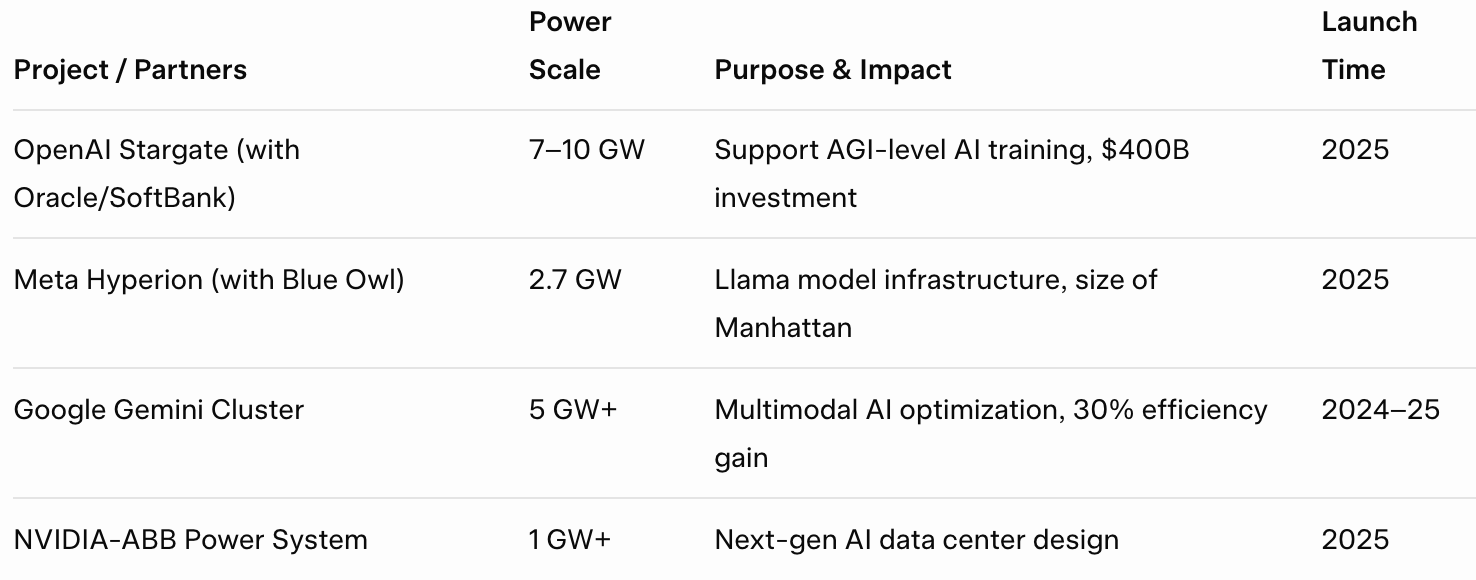
These collaborations, often at the multi‑GW level, are essentially an infrastructure race within the AI "arms race" — whoever secures power first gains an advantage.
Is this reasonable?
Reasonable in the short term, but requires sustainable transformation in the long term. GW‑scale AI data centers are an indispensable "engine" of the AI economy, but their energy use and environmental impact raise concerns. NPR has reported that the U.S. AI industry faces "major energy and environmental risks," and data centers could account for up to 8% of national electricity use by 2030 (up from 3% in 2022).
The reasonable side:
- Economic necessity: AI drives GDP growth, and infrastructure investment can close grid gaps, supporting jobs and innovation. Deloitte research shows that by 2030 leading AI labs will require "city‑scale" power or risk falling behind.
- Efficiency improvements: Models such as Google's Gemini have achieved per‑query energy optimizations and reduced carbon footprints. McKinsey suggests that "smart design" can accelerate projects and cut costs.
- Sustainable potential: Shifting to renewables (such as solar plus storage) offers the potential to offset training and inference emissions with green power, according to Generation Investment estimates.
The unreasonable side:
- Environmental pressure: High water consumption (cooling may require hundreds of millions of gallons) and carbon emissions have been called "crazy and unsustainable" by some engineers. CNET warns that AI data centers are "competing for land, water, and power," exacerbating climate change.
- Grid risks: U.S. infrastructure may not keep up; Yahoo Finance notes rising consumer electricity prices and increased reliance on natural gas.
- Ethical considerations: The benefits of AI (such as in healthcare and finance) must be balanced against costs; experts at HiveMQ emphasize that data centers should be "AI‑native and sustainable."
Overall, GW‑scale collaboration in 2025 is a practical necessity, but without regulation and green investment (such as McKinsey's "energy‑AI coordination"), it will be unsustainable. In the future, nuclear power and small modular reactors (SMRs) could become potential remedies.
Related:
What Can 1GW of Compute Actually Do? Revealing the Power–Compute Trade‑offs Behind AI (Part II)