
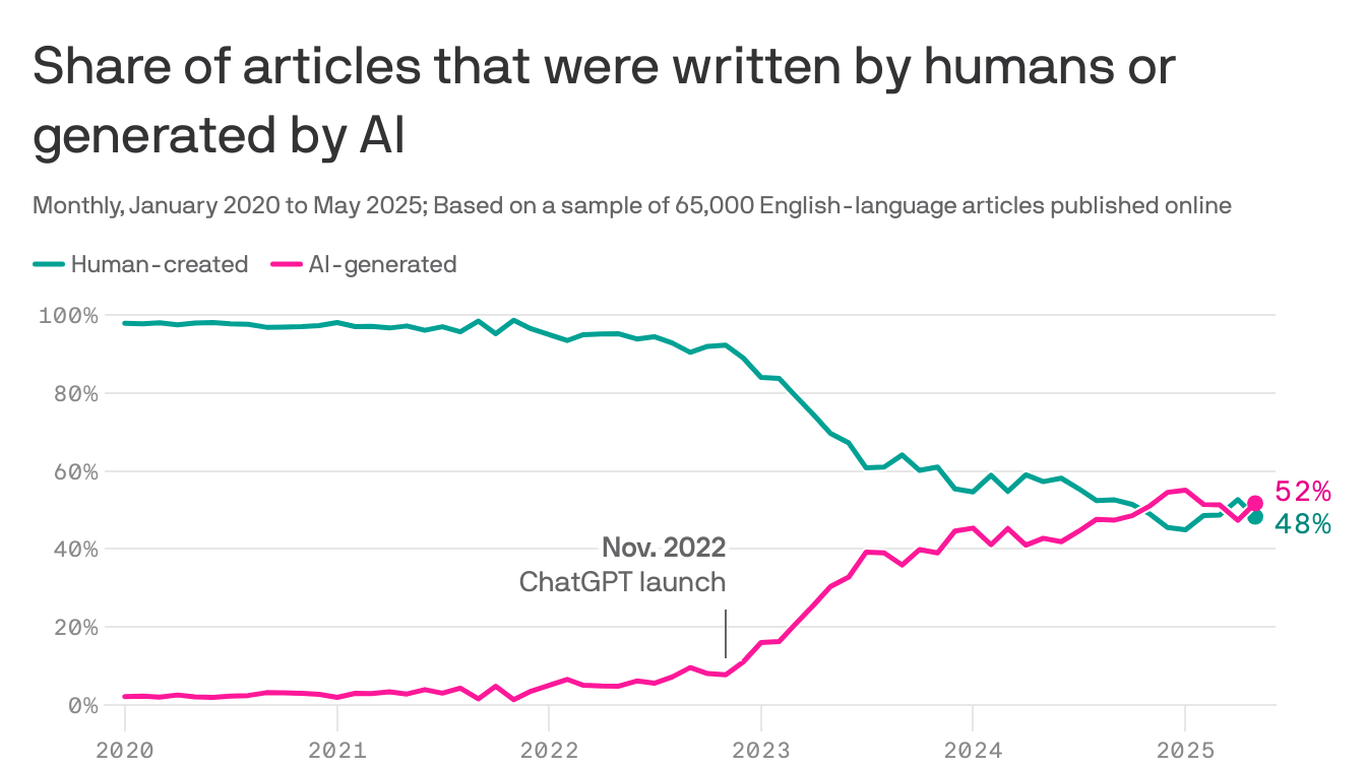
On October 14, 2025, an Axios exclusive published a study showing that although generative AI tools are widely used in creation workflows, pages that are "purely AI‑written" remain a minority on the open web. The research team used three parallel technical approaches to validate findings: adversarially trained text detectors, comparison with corpora of known AI model outputs, and scraping page metadata (publish dates, edit histories, bylines) to assess content origins.
The study analyzed hundreds of millions of web pages across news sites, blogs, forums and e‑commerce product pages. Several findings merit attention. First, the overall share of AI‑generated content, after rapid early growth, began to slow in mid‑2024 — researchers estimate it has not exceeded the one‑quarter mark. Second, many pages labeled as "AI‑generated" were in fact edited and polished by humans; instances of model outputs being posted verbatim with a single click remain relatively rare. Third, AI‑written content performs worse in search engines: for the same topics, pages detected as AI‑produced were more likely to experience ranking declines or algorithmic de‑prioritization, a conclusion reached through historical ranking tracking and traffic comparisons.
The report also lists granular evidence: many AI drafts are used as "first drafts" and later supplemented by reporters or editors with fact‑checking, sourcing and localization; some pages with sudden traffic spikes exhibit telltale AI repetition and lack of exclusive information, and these pages have weaker organic traffic compared with in‑depth human reporting after Google and other search systems updated their algorithms. The report notes that platforms adjusted policies and handling of generated content multiple times between 2024 and 2025, directly affecting the visibility of AI‑produced pages.
For publishers and creators, the study offers two practical takeaways: continue to emphasize the unique value of fact‑checking and on‑the‑ground reporting, and be transparent about the use of generative tools and record editorial chains to avoid penalties in search visibility and reader trust. Researchers emphasize that the technology is evolving and detection methods will be challenged by model improvements, but the current web‑text ecosystem is dominated by a human+AI hybrid model — with AI acting as an accelerator rather than a full replacement.
The report supplies verifiable chains of evidence for media organizations, SEO practitioners and platform regulators. Researchers recommend continued public release of data and detection methods to promote a more transparent system for identifying content origins; they also urge readers to pay attention to bylines and edit histories, since these micro‑level cues determine long‑term advantages in search results and audience trust.