
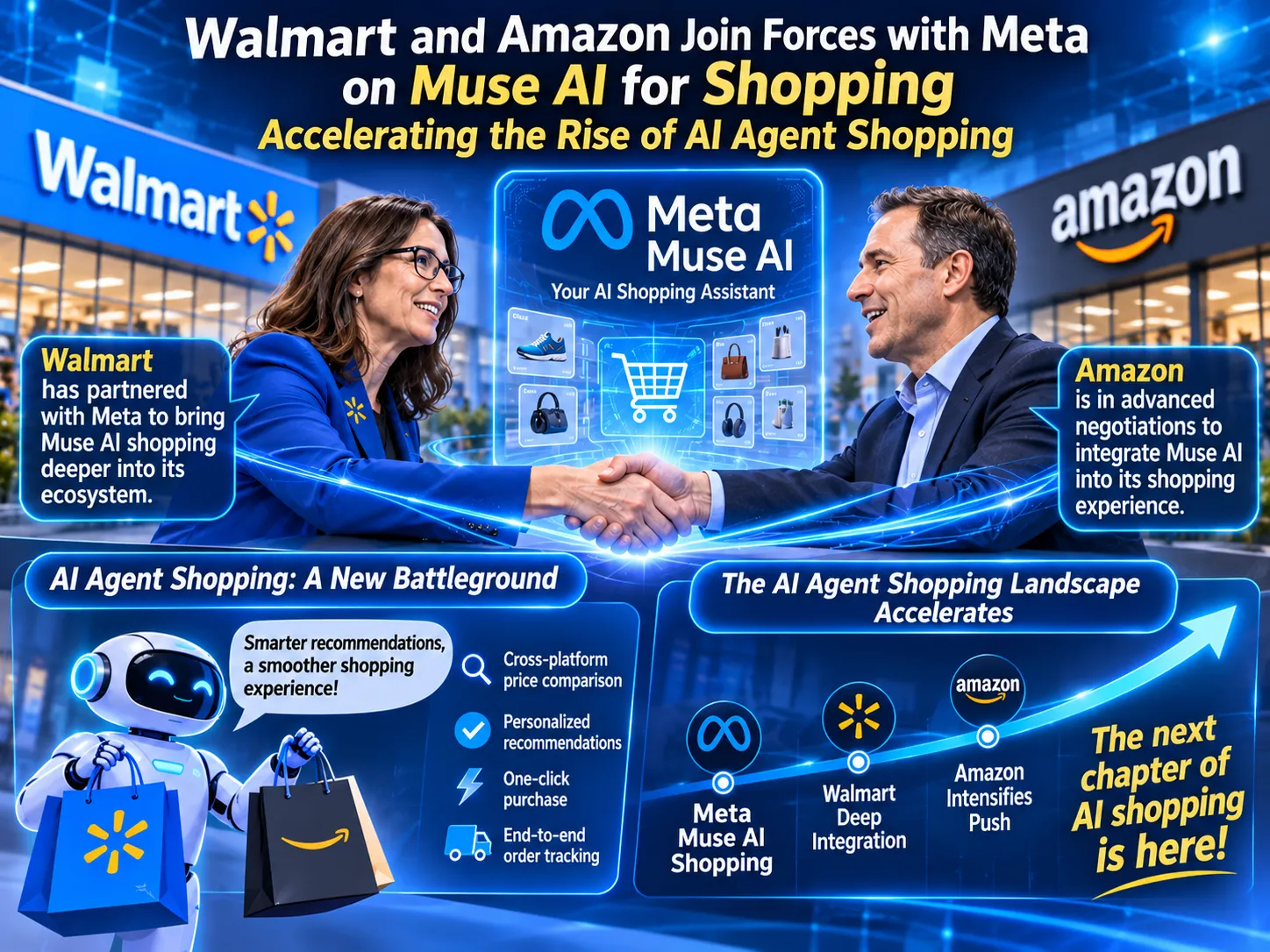
In late November 2026, the U.S. retail and technology sectors witnessed sharply contrasting developments around the shopping capabilities of Meta's personal AI agent, Muse. On November 24 Walmart officially announced it would allow users to select Black Friday promotional items via Muse and complete ordering and payment. At the same time, Amazon has engaged in multi‑round negotiations with Meta over restoring Muse's access to its platform. These events highlight the different strategic choices large retailers are making in response to AI‑agent shopping and mark a key moment as agentic commerce moves from experiments toward scaled application.
Walmart Opens a Gateway: Controlled Access Becomes a New Paradigm
Walmart's cooperation is based on its self‑built "Agent Gateway" technology. Users simply issue shopping instructions to Muse (for example, "find a TV under $500" or "help me pick Black Friday toys"), and Muse passes the request to Walmart's systems. Walmart matches products, builds the shopping cart, and returns results. Users can set an "Agent Profile" in their Walmart account, including spending limits, per‑order approval permissions, and a record of orders completed by the agent. Payment uses methods already stored in the user's Walmart account; Muse itself cannot access full credit card information or historical purchase data.
Walmart emphasizes that purchases made via agents receive the same prices, promotions, and membership benefits (such as free shipping) as on the website, and the same return policies apply. This arrangement is seen in the industry as an example of a retailer proactively controlling AI‑agent access: opening a new traffic channel while retaining core control over product ranking, user data, and transaction processes. Walmart had previously announced the Agent Gateway plan and is advancing related standards with partners including Shopify; the Muse integration is an important practical deployment during Black Friday.
Amazon's Block and Negotiations: Ads and Customer Relationships Are the Focus
By contrast, Amazon imposed a block on Muse in September 2026. At that time, Amazon, citing violations of its user agreement, prevented third‑party AI agents from accessing its platform and asked Meta to remove Amazon from Muse's default search scope. Meta said Muse does not obtain user passwords or payment credentials, and the two sides have expressed differing positions. Since then, Muse's shopping directives have defaulted to avoid Amazon and have prioritized platforms such as Walmart, Target, and Best Buy.
According to media reports on November 25, Amazon and Meta have recently held several rounds of discussions about restoring Muse access. Negotiations have focused on how product search results are presented, advertising delivery mechanisms, and technical integration details. Amazon's core concern is that external AI agents might circumvent its high‑margin advertising system (which generates tens of billions of dollars in annual ad revenue), weaken the platform's direct control over customers' shopping journeys, and affect its direct relationship with customers. No agreement has been reached so far, and any final arrangement is expected to require approval at the CEO level. Amazon is also advancing its own AI shopping capabilities and remains cautious about external agents.
Muse's Positioning and Market Context
Muse is a personal AI agent launched by Meta in September 2026 that supports tasks including shopping, travel planning, and email processing. Meta disclosed that within weeks of launch, U.S. and Canadian users exceeded 10 million, with shopping among the primary use cases and some users averaging about $200 per purchase. Meta plans to commercialize through transaction commissions rather than charging users directly. Retailers including Walmart, Best Buy, and Sephora have already established integrations, with some platforms connecting via controlled interfaces or open protocols.
This trend reflects the evolution of AI agents from "recommendation assistants" to "executing agents." Users no longer need to browse pages themselves; an AI can discover, compare, and place orders. For retailers, this represents a new source of traffic but also raises challenges to advertising revenue, brand exposure, and control over customer data. Walmart chose a "conditional open" approach, using a self‑built gateway to retain leadership; Amazon prioritized protecting its existing business model until acceptable terms can be negotiated.
Industry Impact and Future Trajectory
From a broader perspective, the divergent paths of Walmart and Amazon could shape future standards for intelligent shopping. Retailers that enable controlled access may attract incremental customers brought by AI agents—particularly younger consumers and those who value convenience—while platforms that block or strictly limit access will need to accelerate their own AI capabilities to maintain user engagement. The restructuring of advertising models is especially critical: when shopping entry points shift from search result pages to conversational agents, sponsored products, ranking algorithms, and attribution mechanisms will all need adjustment.
Privacy and security remain central concerns. Walmart's approach reduces risk by limiting data sharing and requiring user approvals, while part of Amazon's earlier blocking stemmed from worries about credential capture and unauthorized access. Regulators in the U.S. and other markets are still developing rules on AI‑agent transparency, liability, and consumer protection.
As of now, Walmart's integration went live during Black Friday, while Amazon's negotiations with Meta continue and the outcome is uncertain. Regardless of the final direction, the moves by these two retail giants will deeply influence the AI‑driven e‑commerce landscape. Intelligent agent shopping is moving from proof of concept to commercial contest, and the balance of interests among retailers, tech platforms, and consumers will determine whether this model can scale. Ongoing developments merit close attention.
▶️ Enjoyed this article? Creating great content takes effort!
Subscribe to our YouTube channel:
AI Rosetta
Your likes, subscriptions and shares mean the world to us! 🙏
For more AI news, visit:
https://www.airosetta.com