
As artificial intelligence (AI) advances rapidly, energy efficiency has become a bottleneck for further progress. The human brain performs complex learning and decision‑making using roughly 20 watts of power, while today’s supercomputers require megawatts to handle comparable tasks. This vast gap is being gradually narrowed by neuromorphic computing techniques.
November 2, 2025, SciTechDaily reported that researchers at the USC Viterbi School of Engineering and the Institute for Advanced Computational Science disclosed a new hardware neuron design: the Integrated Spiking Artificial Neuron (ISAN). Rather than emulating spiking behavior in software on general‑purpose chips, the team directly realizes spike, integration and leak dynamics in physical device structures, producing electronic responses that closely resemble those of biological neurons.
The paper details ISAN’s operating principle: by integrating spike generation, membrane‑potential integration and spontaneous leakage within a single stacked device, the researchers achieved electrical responses analogous to a biological cell membrane. When input current accumulates to a threshold the device emits a short spike; after discharge the membrane potential decays back to baseline over time — a sequence that closely mirrors the integrate–leak–fire behavior of biological neurons in both form and time scale.
Neuromorphic computing aims to mimic the brain’s structure and function. The brain contains roughly 86 billion neurons that communicate electrochemically across synapses via ions such as sodium, potassium and calcium, enabling highly efficient parallel processing. Conventional computers use electron flow and largely serial computation, leading to enormous energy consumption during AI training. For example, some large‑scale model training phases have consumed millions of kilowatt‑hours. By contrast, the brain can learn from very few examples — a child can recognize digits 0–9 from only a handful of handwritten samples, while machines often need thousands. The USC team targets this gap by emulating ionic dynamics at the hardware level to build more brain‑faithful systems.
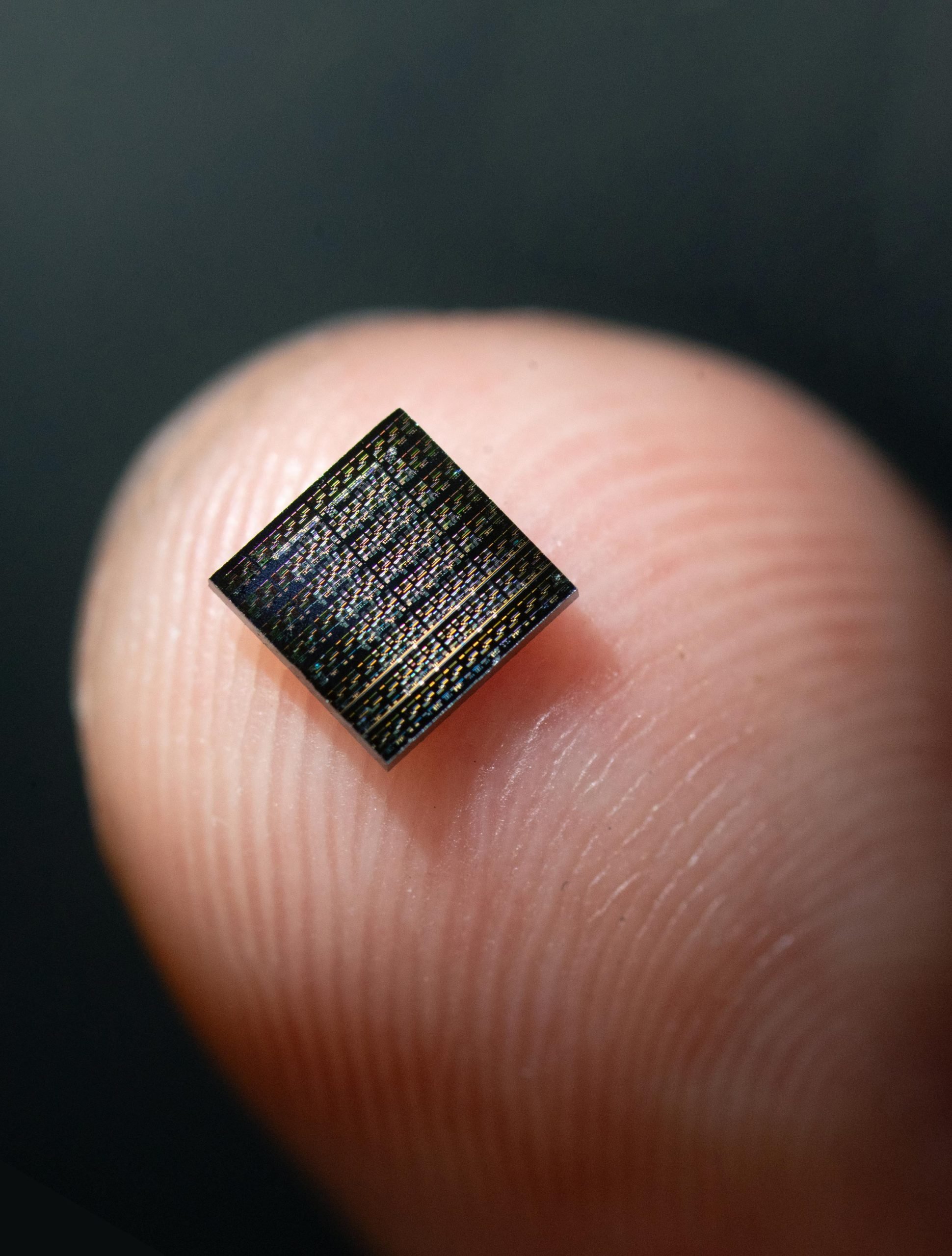
The artificial neuron’s design is remarkably simple yet effective: a stacked structure of a diffusive memristor, a transistor and a resistor occupying only about 4 μm² — orders of magnitude smaller than designs requiring dozens or hundreds of transistors. Memristors are emerging storage elements that retain resistance‑state changes and can emulate synaptic weight adjustments. The researchers use silver ions in an oxide as mobile carriers; these ions diffuse and drift to generate electrical spikes that closely replicate biological action potentials. As J. Joshua Yang, USC professor of computer and electrical engineering and director of the Center for Neuromorphic Computing Excellence, said: “Although the ions are not identical to those in biology, the physical principles of ion motion and dynamics are highly analogous to the brain. Silver ions diffuse readily, providing the necessary dynamics to emulate biological systems, and a simple structure can realize neuron functions.”
In experiments, the device successfully reproduced key brain processes: electrical signals converted to chemical‑like signals at a synapse and then back to electrical signals in the next neuron. This ion‑driven mechanism differs from electron‑based “software learning” and implements hardware‑level adaptive learning akin to the brain’s wetware. The team fabricated chip arrays in the university cleanroom that exhibited rich neuron functions, including motion, learning and planning behaviors. Energy consumption was several orders of magnitude lower than conventional AI chips, addressing the current AI “energy sink.” Yang emphasized: “Existing systems are not power‑starved but inefficient. They were never designed to handle massive data or to learn autonomously from few samples. Borrowing brain principles can improve both energy and learning efficiency.”
The researchers reported experimental details: they paired these artificial neurons with tunable artificial synapses to build small‑scale network prototypes, validating spike‑timing coding and event‑driven computation; on‑chip tests showed ISAN could autonomously complete spike generation and decay cycles without external digital controllers, significantly simplifying peripheral circuitry.
This result is part of broader advances in 2025. A Nature Communications study reported artificial neurons with functional parameters that integrate analog signals and produce continuous voltage spikes resembling action potentials. An August paper described “artificial transneurons” that mimic activity across different brain regions and even capture stochastic dynamics — the brain’s essential “noise.” Nature recently commented that such artificial neurons will help build compact, efficient brain‑inspired computers likely to appear first in edge devices like wearable AI. The University of Texas at Dallas disclosed a brain‑inspired prototype computer optimized for AI tasks with substantial energy‑efficiency gains, and Los Alamos National Laboratory predicted neuromorphic computing could become the next AI paradigm: smaller, faster and brain‑comparable in efficiency.
From a commercial perspective, the 2025 neuromorphic roadmap shows hardware readiness levels lag behind software but nearing practicality. The Netherlands’ Topsector ICT report notes that hardware such as Intel Loihi, IBM TrueNorth and SpiNNaker is transitioning from labs to market. A Nature Communications article discussed commercial pathways by simplifying deployment tools so applications run faster and more easily on neuromorphic hardware. AI News Hub analysis suggested neuromorphic tech could be deployed in smart homes and robotic vision by late 2025. An arXiv review further argued that brain‑inspired AI (BIAI) is converging neuroscience, AGI research and neuromorphic hardware into a unified frontier.
The deeper significance lies in bridging AI and neuroscience. Traditional AI relies on massive data and compute while overlooking the brain’s few‑shot learning and hardware adaptability. Ion‑based rather than electron‑based computing addresses this divide. The Yang team’s device demonstrates that ionic dynamics can deliver evolutionary advantages: “The human brain is the evolutionary winner — the most efficient engine of intelligence. We chose ionic dynamics because that is how the brain operates.” Integrating millions of such neurons could approach brain‑like efficiency, aid understanding of brain–machine interfaces and potentially accelerate AGI development. The Open Neuromorphic community’s hardware guides show current chips already support advanced neural processing.
Challenges remain. The randomness of ion diffusion can mimic brain noise but may also introduce instability; large‑scale integration faces fabrication‑precision hurdles. An arXiv paper on “physical AI” warns that biological principles, while inspirational, require balancing stability and adaptability. Ethical concerns also arise: if brain‑like systems become too realistic, debates over privacy and autonomy will intensify.
Looking beyond 2025, neuromorphic computing could reshape the AI landscape. USC’s innovation marks a shift from an "electronic era" to an "ionic era," as Yang envisions: “We have demonstrated the effectiveness of compact building blocks; the next step is large‑scale integration to test replication of brain efficiency. Even more exciting, brain‑faithful systems may reveal new mysteries about the brain itself.” Under global climate pressure, this efficient path is not only a technological revolution but a necessary move toward sustainable intelligence. Researchers are accelerating iterations, hoping brain‑inspired AI will illuminate the future of human neural networks.