
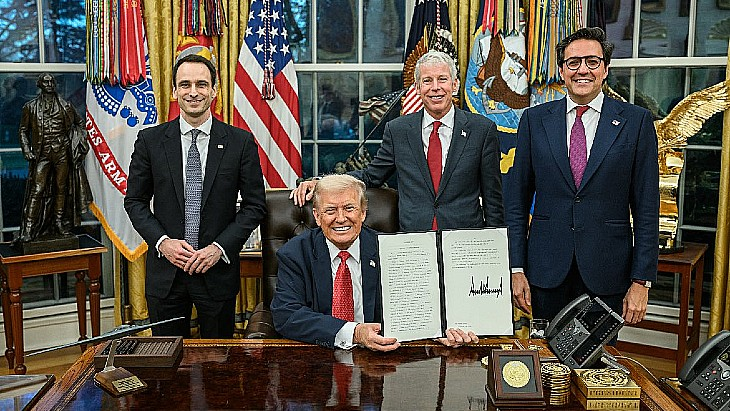
As artificial intelligence (AI) becomes the core of global strategic competition, the U.S. government has rapidly launched a national program hailed as an "AI version of the Manhattan Project" — the "Genesis Mission." On Nov. 24, 2025, President Trump signed an executive order formally inaugurating the ambitious initiative. Led by the Department of Energy (DOE), the effort aims to integrate the nation's supercomputing resources, federal scientific datasets and AI technologies to fundamentally reshape the scientific research paradigm and roughly double AI‑driven productivity. The move marks a national‑scale mobilization in AI and is seen as a countermeasure to technological challenges from China and Russia, with urgency and scale compared to the World War II‑era Manhattan Project and the Apollo program. Experts predict the program will build a closed AI research loop within nine months and drive breakthroughs in nuclear fusion, chip design and biotechnology.
The Genesis Mission stems from deep U.S. anxiety over global AI competition. As early as 2024, the U.S.‑China Economic and Security Review Commission (USCC) recommended a Manhattan Project–style effort focused on artificial general intelligence (AGI) to safeguard national security and economic leadership. After the Trump administration took office, that recommendation moved quickly toward implementation. The White House said the United States owns the world's largest collection of federal scientific datasets, but those data have long been fragmented and underused, preventing AI from reaching its full potential. The executive order directs the DOE to rapidly create the "American Science and Security Platform," a digital‑twin integrated AI system. That platform will seamlessly connect federal datasets with the nation's top supercomputers (such as the Frontier system at Oak Ridge National Laboratory), use generative AI to propose scientific hypotheses and design experiments, and automate data analysis and model validation. Energy Secretary Jennifer Granholm said at the announcement: "This is not a simple technology upgrade but a revolution in the scientific paradigm. We will turn AI from an assistant into a 'chief scientist,' shrinking discovery cycles from years to months."
The program's core objectives focus on three areas: energy security, advanced manufacturing and biohealth. In energy, Genesis will prioritize solving the challenge of nuclear fusion. By using AI to simulate billions of plasma reaction pathways, the project expects to produce a controllable fusion prototype within two years, aiming to break dependence on fossil fuels. In chips and advanced manufacturing, AI will optimize semiconductor design processes; facing China's supply‑chain advantages, the U.S. plans to coordinate resources across firms such as Intel and TSMC to develop "AI chip scientist" models that accelerate iterations from design to mass production. In biotechnology, the project will mine massive genomic datasets with AI to develop personalized therapies for cancer and infectious diseases, and support robotic laboratories to advance automation in surgery and drug discovery. Michael Kratsios, director of the White House Office of Science and Technology Policy, stressed: "We will mine the 'gold mine' of federal datasets and use AI to run more experiments and shorten the time to discovery." The plan is estimated to invest more than $50 billion in its first year, covering hardware upgrades, talent recruitment and cross‑agency collaboration.
Resource integration is key to the Genesis Mission's success. The U.S. government will bind federal agencies, tech giants, universities and national laboratories into a national AI team. The DOE will lead in partnership with the National Science Foundation (NSF) and the Defense Advanced Research Projects Agency (DARPA) to build unified data pipelines. The private sector will participate deeply: Google, Microsoft and OpenAI are expected to provide AI models and compute capacity, while NVIDIA's GPU clusters will be prioritized for platform access. At the university level, Stanford and MIT will focus on algorithm optimization and ethics oversight to ensure transparency in AI decision‑making. National laboratories such as Los Alamos and Lawrence Livermore will contribute experimental facilities, forming a theory‑to‑application loop. The executive order also establishes a network of "AI Centers of Scientific Excellence" across all 50 states, with priority support for talent mobility in the Midwest and rural areas. President Trump described the all‑of‑government, whole‑of‑society model as a "revival of the American spirit," aiming to seize the scientific high ground through national effort.
From a global perspective, the Genesis Mission will reshape the AI competitive landscape. China, the U.S.'s primary rival, has built an autonomous AI ecosystem through the "New Generation Artificial Intelligence Development Plan" and projects such as "East Data West Computing." The EU's AI Act emphasizes regulation first, while the U.S. move stresses speed and scale, likely widening gaps with China and Europe. The International Atomic Energy Agency (IAEA) has noted that a fusion breakthrough could redraw the energy geopolitics map and trigger a "green cold war." Developing countries may benefit from shared open datasets but also risk a widening digital divide. The World Economic Forum (WEF) warns that without international cooperation, an AI‑driven scientific revolution could spark a new arms race.
Despite its promise, the Genesis Mission faces multiple challenges. First are ethical and security risks: autonomous AI decision‑making could amplify bias or expose sensitive data. The executive order calls for independent audit mechanisms, but experts worry oversight may lag. Second, talent shortages are acute. While the U.S. retains Silicon Valley advantages, the outflow of top AI scientists to the Middle East and Asia continues. The program plans H‑1B visa reforms to attract global talent. Finally, budget execution faces pressure: Congress must approve large appropriations, and partisan differences could delay implementation. MIT professor Erik Brynjolfsson warned: "An AI Manhattan Project must balance innovation and inclusion, or it will exacerbate social inequality."
The Genesis Mission's launch marks a shift in U.S. AI strategy from defense to offense, echoing the post–World War II reshaping of the world by the Manhattan Project. It will not only accelerate scientific discovery but also help define technological hegemony in the 21st century. In a changing world, the U.S. move may trigger a cascade of responses: allies following suit, rivals countering, and humanity's welfare hanging in the balance. In the future, AI will no longer be merely a tool but a partner — the key will be who can master its power to achieve broad benefit rather than monopoly.