
On December 23, 2025, the Tsinghua University Intelligent Systems and Artificial Intelligence Laboratory (TSAIL) and ShengShu Technology jointly released the open‑source TurboDiffusion framework in Beijing. Designed for AI video‑generation models, the framework combines multiple innovations to deliver 100–200× end‑to‑end acceleration with negligible quality loss, marking the arrival of real‑time AI video generation. According to ShengShu's announcement, the framework is available on GitHub and supports various open video models, including those at the 1.3B and 14B T2V parameter scales, and has reduced generation time for an 8s 1080p video on ShengShu's self‑developed Vidu model from ~900s to 8s. Reports from authoritative outlets such as OSChina and Pacific Technology note that this release not only improves AI video efficiency but also injects new momentum into the open‑source community, advancing real‑time applications from text‑to‑video (T2V) and image‑to‑video (I2V). This special report is based on ShengShu's official release and related technical documents, analyzing TurboDiffusion's core mechanisms, performance gains and industry impact to ensure factual accuracy.
TurboDiffusion Technical Architecture: A Multi‑layered Acceleration Blend
TurboDiffusion is not a brand‑new model but an open‑source acceleration framework for existing AI video diffusion models. It integrates four core techniques to optimize attention computation, sampling steps and linear layers in diffusion models, enabling efficient inference. First, low‑bit attention acceleration (SageAttention): attention computation is executed on low‑bit Tensor Cores to achieve multiple‑fold, lossless speedups. This technique has been integrated into platforms such as NVIDIA TensorRT, Huawei Ascend and MooreThread S6000, and adopted by companies including Tencent, ByteDance and Alibaba.
Second, Sparse‑Linear Attention (SLA): a trainable sparse linear attention mechanism that further sparsifies computation and provides an additional 17–20× speedup on top of SageAttention. Third, sampling‑step distillation (rCM): using rCM distillation to compress high‑step samplers to 3–4 steps while maintaining video quality; this technique originates from NVIDIA's open projects and ensures an efficient and reliable generation process. Finally, linear‑layer acceleration: weight and activation 8‑bit quantization (W8A8) speeds up linear layers and reduces VRAM usage.
These techniques were developed by Tsinghua TSAIL and ShengShu Technology, and the overall framework is compatible with a single RTX 5090 GPU, providing end‑to‑end optimizations from model loading to video generation. Compared with traditional diffusion models, TurboDiffusion emphasizes "near‑lossless" acceleration to avoid quality tradeoffs, making it particularly suitable for real‑time interactive scenarios. The framework code is available on GitHub and includes SageAttention, SLA and rCM components for easy integration into existing T2V models.
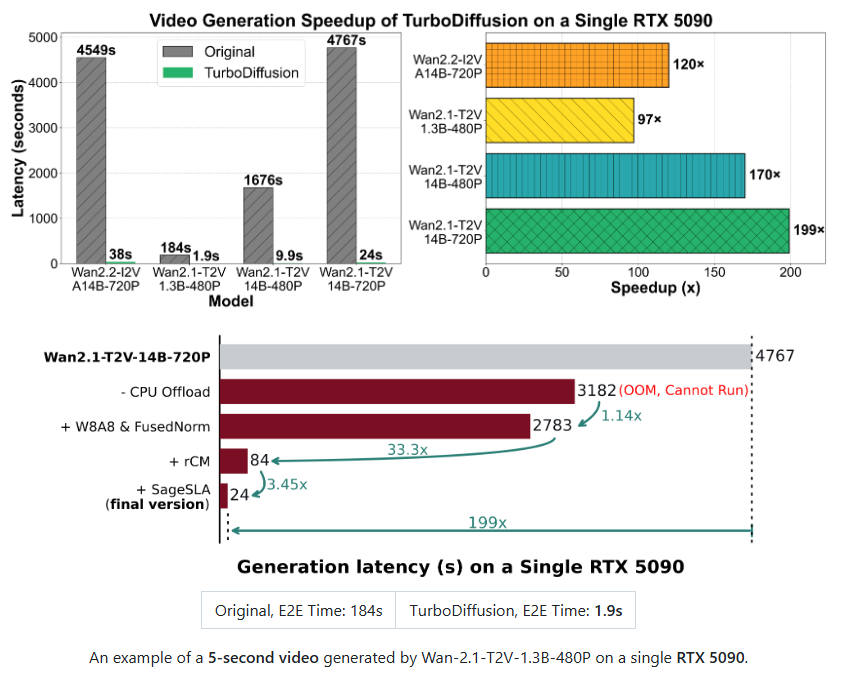
Performance Breakthrough: From Minutes to Seconds
TurboDiffusion's performance gains are striking. On open video generation models at the 1.3B and 14B T2V scales, the framework achieves 100× to peak 200× end‑to‑end acceleration using a single RTX 5090 GPU. For ShengShu's Vidu model, generation time for an 8‑second 1080p video was reduced from about 900 seconds to 8 seconds, roughly a 112× speedup. This enables real‑time video generation on consumer‑grade hardware, far exceeding the minute‑level latencies of traditional methods.
Benchmarking shows the framework achieves almost lossless acceleration while maintaining visual stability, consistency and quality. Compared with other acceleration techniques, TurboDiffusion's multi‑layer fusion is more comprehensive: SageAttention provides baseline speedup, SLA and rCM further compress computation paths, and linear quantization optimizes resource usage. OSChina reported that TurboDiffusion notably reduces VRAM usage on the same hardware, supporting deployment of larger models. Pacific Technology emphasized that this performance leap helps move AI video from the lab to practical use cases such as short‑form content creation, virtual reality and educational content generation.
In comparisons with other open frameworks, TurboDiffusion stands out. For example, versus Stable Diffusion acceleration variants, it is specifically optimized for video and better preserves temporal consistency. PixelDojo reported that the framework achieves industry‑leading energy efficiency for high‑resolution video generation.
Open‑source Strategy and Ecosystem Impact
Open‑sourcing TurboDiffusion is a major highlight. The complete framework code, model weights and technical components are freely available on GitHub, including SageAttention (https://github.com/thu‑ml/SageAttention?referrer=grok.com), SLA (https://github.com/thu‑ml/SLA) and rCM (https://github.com/NVlabs/rcm). This move aligns with TSAIL's open‑source tradition and encourages global community collaboration and innovation. ShengShu says the open‑source release will accelerate adoption and benefit SMEs and independent developers.
The ecosystem impact is far‑reaching. TurboDiffusion addresses an efficiency gap in AI video generation and advances real‑time applications from T2V to I2V. 36Kr noted the framework can be integrated into existing toolchains to boost platforms like Midjourney or Runway. Within China's AI ecosystem, it reinforces Tsinghua's leadership in generative AI and complements other projects such as the GLM series. Globally, the open release may prompt vendors like NVIDIA to further optimize TensorRT, lowering the barrier for AI video.
Challenges remain: the framework favors high‑end hardware (recommended RTX 5090), and while the code is free, optimization requires expertise. Ethically, real‑time generation could amplify deepfake risks and will require accompanying regulation.
Background and Outlook
TurboDiffusion's release comes amid rapid advances in AI video. In 2025, generative AI expanded from text to video, driving strong demand but exposing efficiency bottlenecks. The collaboration between Tsinghua TSAIL and ShengShu stems from their respective strengths in diffusion research: academic innovation from Tsinghua and commercialization focus from ShengShu.
Looking ahead, the framework could usher in a real‑time AI video era. AIBase projected that by 2026 similar technologies will be widely adopted by short‑video platforms and the metaverse. As an open project, TurboDiffusion may spur more derivative innovations and drive adoption from consumer to enterprise scenarios.
The open release of TurboDiffusion is a significant milestone for AI video technology. Centered on up to 200× acceleration, it reshapes generation efficiency while raising questions about responsible use. Going forward, the framework is poised to drive substantial change across the AI video landscape.
▶️ Enjoy this article? Content creation is hard!
Subscribe to our YouTube channel:
AI Rosetta
Your likes, subscriptions and shares are our greatest support! 🙏
More AI news at: https://www.airosetta.com