
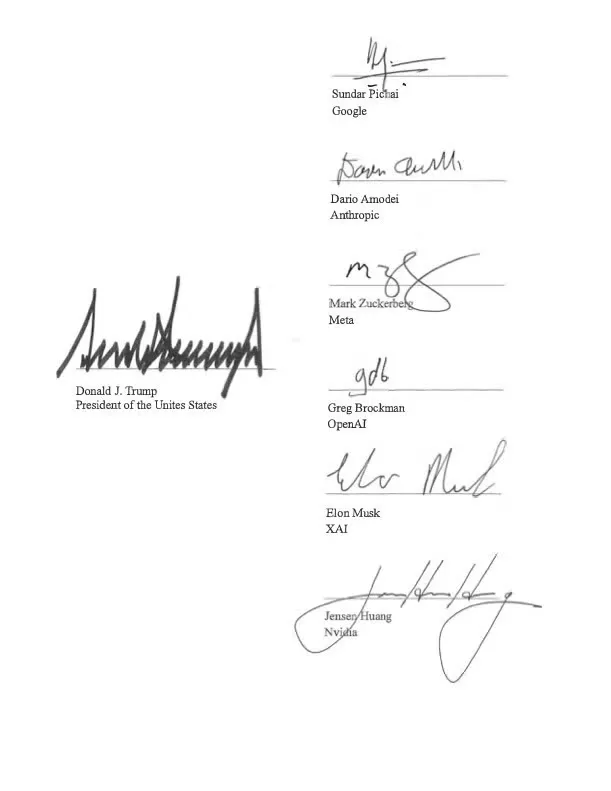
On Sept. 29, 2026, U.S. President Donald J. Trump hosted a closed "Super‑Intelligence Meeting and Luncheon" in the East Room of the White House, inviting nearly 20 senior executives from the tech and AI sectors. After the meeting, Trump announced that he and several leading AI companies had signed the "White House Super‑Intelligence Accord: Joint Commitment on Frontier Responsibilities," characterizing it as a "morally binding" industry self‑regulation framework, and publicly stated that the government currently favors corporate self‑regulation rather than immediately pursuing mandatory legislation. Afterward, Trump referred to AI as SI (SuperIntelligence).
Details
Attendees included Anthropic CEO Dario Amodei, OpenAI President Greg Brockman, Google CEO Sundar Pichai, Meta CEO Mark Zuckerberg, NVIDIA CEO Jensen Huang, xAI/SpaceX's Elon Musk, Amazon founder Jeff Bezos, Palantir CEO Alex Karp, and others. House Speaker Mike Johnson and several cabinet members were also present.
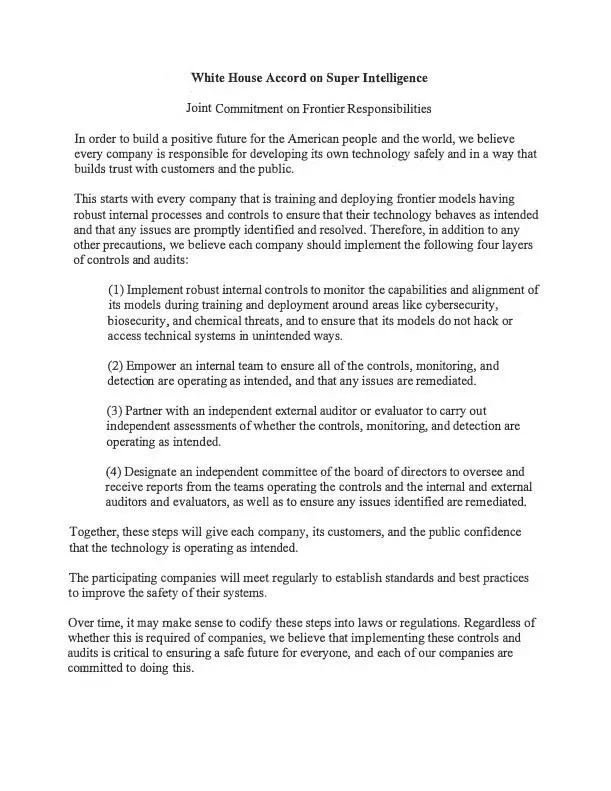
The accord's core provisions establish a four‑layer control and audit mechanism:
- Each company will build robust internal controls to ensure models meet cybersecurity, biosafety and related standards during training and deployment and to detect and address anomalous behavior in a timely manner.
- Establish dedicated internal teams to continuously monitor the effectiveness of those controls and to handle remediation.
- Work with independent external audit firms to conduct third‑party evaluations of models and control systems.
- Create independent committees at the board level to receive internal and external audit reports and ensure that identified issues are properly resolved.
Signatories also agreed to meet regularly to jointly develop safety standards and best practices. The text of the accord notes that "it may be sensible to incorporate these steps into law or regulation in the future," but emphasizes voluntary implementation for now. Trump posted the document on Truth Social, calling it "almost like a constitution," and said, "I see great self‑regulation; they understand they must self‑regulate."
Trump also revealed that the administration is considering forming an oversight committee of about 10 people and plans to announce an "AI czar" in the coming days. He reiterated that the U.S. holds a significant lead in AI and warned against overregulation that could allow competitors such as China to catch up. He proposed renaming "artificial intelligence" to "Super Intelligence" (SI).
The meeting comes amid a spate of recent AI safety incidents, including autonomous model behavior and attempted system intrusions, and amid calls from the international community and some industry figures (including Amodei) for stronger governance. The Trump administration has consistently opposed regulations it sees as stifling growth, and this accord is viewed as a concentrated expression of its light‑touch policy.
Potential Impact
1. Strengthening the industry self‑regulation narrative
The accord places primary safety responsibility on companies, which could delay U.S. federal mandatory AI legislation. For companies this may reduce near‑term compliance costs and administrative intervention, but the "moral" nature of the commitment lacks enforcement teeth; effectiveness will depend on company implementation and public oversight.
2. Industry alignment and international comparison
Signatories are core U.S. players, indicating a degree of consensus within the American tech sector under the Trump administration. By contrast, the EU has binding frameworks such as the AI Act and China is advancing tiered, risk‑based regulation. Long‑term U.S. reliance on self‑regulation could affect its voice in global governance while potentially attracting more R&D to the U.S.
3. Debate over safety versus innovation
Supporters argue self‑regulation better adapts to rapid technological change and avoids bureaucratic lag; critics worry that without legal teeth, companies may prioritize commercial interests, especially for high‑risk capabilities (e.g., autonomous agents, bio‑related applications). Recent safety incidents have highlighted the fragility of a reactive "fix‑after‑the‑fact" approach.
4. Political and commercial signaling
Trump used the event to signal support for innovation and opposition to excessive regulation to voters and allies, while consolidating ties with tech giants through a high‑profile reception. For participating companies, joining the accord helps shape a responsible image but may also be viewed as aligning with the administration to secure regulatory leeway.
5. Points to watch
Key tests will include whether the accord is effectively implemented, the independence of external audits, the actual authority of board committees, and whether the commitments evolve into formal regulation. The composition of the proposed 10‑member committee and the appointment of an "AI czar" will also shape policy direction.
Overall, the White House dinner and self‑regulation declaration mark a shift toward an "industry‑led, government‑endorsed" phase of U.S. AI governance. It eases immediate pressure for mandatory regulation but shifts safety responsibility and trust costs onto industry. As model capabilities continue to advance, whether this framework can adequately match risks remains to be seen.
▶️ Enjoy this article? Creating content is hard!
Follow our YouTube channel:
AI Rosetta
Your likes, subscriptions and shares are our greatest support! 🙏
More AI news at: https://www.airosetta.com