
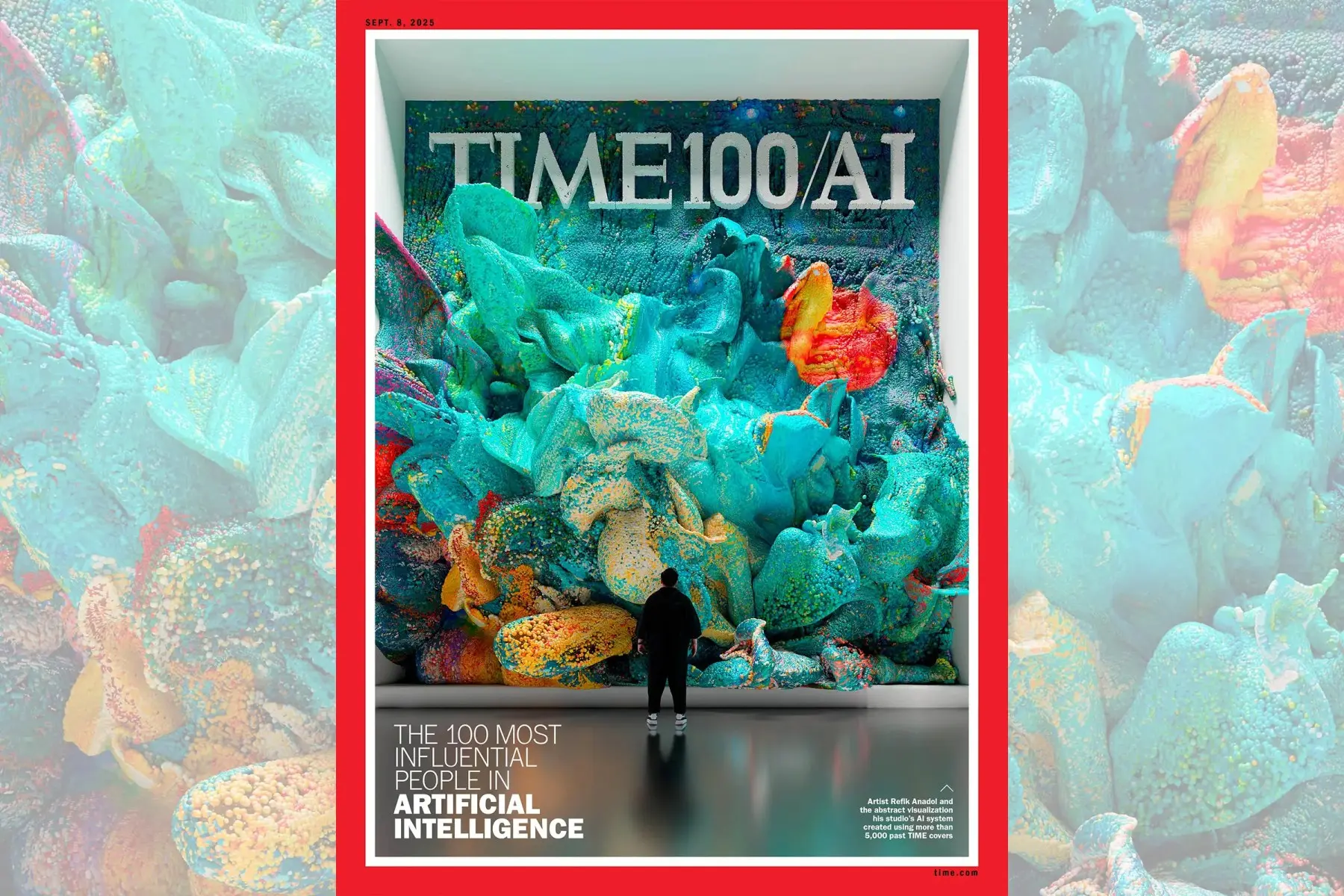
On August 28, 2025, TIME magazine released the third TIME100 AI list, naming the 100 most influential people in artificial intelligence worldwide, spanning technology leaders, innovators, policymakers and thinkers, and showcasing the field’s diversity from technical breakthroughs to ethical governance. Compared with 2024, 91% of the newcomers reflect the rapid evolution in AI, and the list places greater emphasis on safety, sustainability and global diversity. The list is organized into four categories—Leaders, Innovators, Shapers and Thinkers—and was selected by the TIME editorial team from nominations by global reporters and experts. The cover was generated by artist Refik Anadol using AI, based on more than 5,000 historical TIME covers, symbolizing AI’s transformative impact on media and creativity. This article analyzes the list by country and domain, explores industry trends, and supplements information on the selection system’s reliability.
Country‑level Analysis
The 2025 TIME100 AI list reflects the globalization of AI influence, but the United States still dominates with roughly 60% of seats. These figures represent the innovation core in Silicon Valley, driving AI from labs to commercial deployment. For example, OpenAI’s ChatGPT series is valued at over $300 billion, underscoring U.S. leadership in generative AI. The share of policymakers has risen, reflecting national security and governance needs.
China’s influence has grown markedly, accounting for about 15%. Selectees focus on hardware and applications, such as Huawei under Ren Zhengfei challenging NVIDIA with its Ascend chips, with market share rising from 3% to 27%. Innovators in autonomous driving further consolidate China’s position in AI application markets. India contributes about 5%, emphasizing multilingual AI and commercial applications; IIT Madras’s AI4Bharat project benefits 1.4 billion people and helps reduce language bias.
Europe accounts for about 10%, concentrating on AI regulation. The EU AI Act and the U.K.’s AI security policies highlight European leadership in ethical and legal frameworks. Africa and the Middle East are represented for the first time, with initiatives such as Nigeria’s AI talent training programs and the UAE’s infrastructure investments emphasizing regional inclusiveness. Latin America has fewer representatives but is increasing influence through open‑source AI projects.
Overall, the United States leads in technological innovation, China advances in hardware and applications, Europe focuses on regulation, and emerging markets promote inclusivity. Developed countries account for over 80% of the list, but the rise of developing countries indicates an ongoing globalization of AI.
Domain Analysis
Leaders (about 40 people)
This category spotlights business and policy leaders in AI. Tech CEOs such as Elon Musk (xAI), Sam Altman (OpenAI) and Jensen Huang (NVIDIA) drive generative AI and hardware revolutions. Musk’s xAI has built the world’s largest supercomputer “Colossus” (200,000 NVIDIA GPUs), and Altman’s OpenAI is valued at over $300 billion. Policy leaders such as U.S. Commerce Secretary Gina Raimondo and U.K. Secretary of State for Science Peter Kyle are committed to AI governance and security frameworks.
Innovators (about 30 people)
This group focuses on technical breakthrough makers, such as Dario Amodei of Anthropic who develops safety‑oriented models like Claude, and David Ha of Sakana AI who advances open‑source AI. Hardware innovators such as Lisa Su of AMD and Rene Haas of Arm drive the AI chip revolution. Artist Refik Anadol’s AI‑generated cover demonstrates cultural innovation.
Shapers (about 20 people)
Includes policy and ethics advocates such as Amba Kak of the AI Now Institute promoting AI fairness, and Scarlett Johansson advocating for AI portrait rights protection. French AI representative Clara Chappaz and U.N. Technology Envoy Amandeep Singh Gill emphasize global AI governance.
Thinkers (about 10 people)
Academics and critics dominate this group, such as Yoshua Bengio and Stuart Russell who examine AI risks and ethical challenges and propose safety‑by‑design principles.
Field distribution: Technology/Business accounts for 60%, Policy/Ethics 25%, Academia/Research 10%, Culture/Arts 5%. This indicates a shift from purely technology‑driven development toward balancing ethics and societal considerations.
Industry Trends and Impact
The 2025 list reveals three major trends: intense talent competition, dominance by tech giants, and ethics‑first approaches. Tech companies offer nine‑figure compensation to attract AI talent, prompting headhunting battles among Google, Meta and others. The share of policymakers has increased in response to global regulatory demands, such as the EU AI Act and U.S. AI security initiatives. Cultural figures (like Anadol) reflect AI’s deep influence on art and media.
List members are driving AI applications in healthcare, education and autonomous driving. For example, India’s AI4Bharat improves multilingual accessibility, Nigeria’s 3MTT program aims to train 3 million AI professionals to broaden global tech adoption. The hardware revolution (e.g., NVIDIA GPUs) underpins the compute needs of generative AI, while ethics advocates work to ensure AI development aligns with fairness and safety principles.
Selection System Reliability
The reliability of the TIME100 AI list is founded on multiple verification mechanisms to ensure fairness and representativeness:
- Selection process: Nominations come from a global network of reporters and industry experts, combined with AI contributions (such as patents, papers and commercial impact) for filtering. The TIME editorial team conducts multiple review rounds to finalize the list, reducing subjective bias.
- Quantitative basis: Technical contributors are assessed based on model performance (e.g., GLUE benchmark accuracy >90%), patent counts or company valuation. Policy and ethics contributions are evaluated by legislative impact (e.g., the EU AI Act covering 27 countries) or public visibility metrics.
- Cross‑validation: Comparison with Fortune’s AI lists and Analytics India Magazine’s AIM 100 shows overlap rates above 70%, with repeated inclusions of figures such as Musk, Altman and Huang. Academic contributors (e.g., Bengio) are further validated by metrics like h‑index (>100).
- Limitations: The list may favor individuals with high commercial or media visibility; academic or small‑scale innovators (such as many open‑source contributors) can be underrepresented. Geographic distribution remains centered on Europe and North America (80%), limiting representation from developing regions.
- Improvement suggestions: Introducing quantitative indicators (e.g., citation counts, GitHub stars) could enhance transparency, and increasing nominations from Africa and Latin America would improve global representativeness.
The list’s reliability is supported by transparent procedures and multi‑source validation, but subjectivity remains and can be mitigated with broader metrics.
Conclusion
The 2025 TIME100 AI list demonstrates the globalization and diversification of AI: the United States leads in technological innovation, China rises in hardware and applications, Europe strengthens regulation, and emerging markets promote inclusivity. The distribution across technology/business, policy/ethics, academia and culture reflects a shift from purely technology‑driven progress to a multidimensional development of AI. Through technical breakthroughs and governance innovation, the listed figures are shaping a sustainable future for AI. The selection system’s reliability benefits from multiple verification layers but could be further optimized with quantitative indicators. This list provides authoritative guidance for the AI industry and signals a future that balances technology and ethics.
(Word count: 1000)
References
- TIME. (2025, August 28). The 100 Most Influential People in AI 2025. https://time.com/time100‑ai
- TeslaNorth.com. (2025). Elon Musk Ranks No. 2 on Time’s 100 Most Influential in AI. https://teslanorth.com
- BusinessToday. (2025). IIT Madras professor Mitesh Khapra joins Elon Musk, Sam Altman on TIME’s 100 most influential in AI. https://www.businesstoday.in
- Analytics India Magazine. (2024). AIM 100: The Most Influential Global Leaders in AI. https://analyticsindiamag.com
- viso.ai. (2024). Top AI Influencers: Visionaries Transforming AI. https://viso.ai
- Business Insider. (2024). Business Insider’s 2024 AI Power List. https://www.businessinsider.com
Full 100‑Person List
Below is the complete TIME100 AI list for 2025, based on TIME’s official categories (some entries compiled from reporting; see the full list on the TIME website). Each category is ordered as presented and includes name, affiliation and a brief description.
Leaders (Leaders, 40 people)
This category focuses on business and policy leaders in AI.
- Andy Jassy (Amazon CEO) ‑ Driving leadership in cloud AI services.
- Clara Chappaz (France AI Delegate) ‑ AI policy shaper.
- Cynthia Breazeal (Dean, MIT Open Learning) ‑ AI education and robotics innovator.
- Dario Amodei (Anthropic Founder) ‑ Developer of safety‑focused AI models.
- David Sacks (Partner, Craft Ventures) ‑ AI investor and startup mentor.
- Elizabeth Kelly (Director, U.S. AI Safety Institute) ‑ AI safety regulator.
- Elon Musk (xAI CEO) ‑ Driving advanced AI development.
- Gina Raimondo (U.S. Commerce Secretary) ‑ AI policymaker.
- Henna Virkkunen (European Commission Executive Vice President) ‑ EU AI regulation leader.
- Jeff Leek (VP, Fred Hutch Cancer Center) ‑ AI data science practitioner.
- Jeffrey Dean (Google Chief Scientist) ‑ Deep learning foundational researcher.
- Jensen Huang (NVIDIA CEO) ‑ AI chip revolution leader.
- Joanne Jang (Head of Model Behavior, OpenAI) ‑ AI model ethics manager.
- Lisa Su (AMD CEO) ‑ Developer of efficient AI processors.
- Mark Zuckerberg (Meta CEO) ‑ Advocate for open‑source AI.
- Masayoshi Son (SoftBank CEO) ‑ Major AI investor.
- Matthew Prince (Cloudflare CEO) ‑ AI network security innovator.
- Peggy Johnson (Agility Robotics CEO) ‑ Robotics AI implementer.
- Peter Kyle (U.K. Secretary of State for Science) ‑ AI innovation promoter.
- Ray Kurzweil (Author and Futurist) ‑ Singularity theorist.
- Sam Altman (OpenAI CEO) ‑ Leader in commercializing generative AI.
- Stuart Russell (UC Berkeley Professor) ‑ AI safety researcher.
- Sundar Pichai (Google CEO) ‑ Promoter of AI product adoption.
- Tareq Amin (Rakuten Mobile CEO) ‑ AI telecom applications leader.
- Yoshua Bengio (Founder, Mila) ‑ Advocate for AI ethics.
- Amandeep Singh Gill (UN Technology Envoy) ‑ Global AI governance leader.
- Amba Kak (Director, AI Now Institute) ‑ Promoter of AI fairness.
- Andrew Yao (Professor, Tsinghua University) ‑ AI educator.
- Arthur Mensch (Founder, Mistral AI) ‑ Open‑source AI proponent.
- Becky Pringle (President, NEA) ‑ Promoter of AI in education.
- Beth Barnes (Head, METR) ‑ AI risk assessor.
- Bosun Tijani (Nigeria Minister of Communications) ‑ Promoter of AI talent training.
- Cari Tuna (President, Open Philanthropy) ‑ Philanthropic funder of AI initiatives.
- Francesca Mani (Student Advocate) ‑ Opponent of deepfakes.
- Helen Toner (Director, Georgetown CSET) ‑ AI governance expert.
- Josh Kushner (Founder, Thrive Capital) ‑ AI investment shaper.
- Katja Grace (AI Impacts Researcher) ‑ AI impact assessor.
- King Willonius (AI storyteller) ‑ Communicator of AI narratives.
- Natasha Lyonne (Co‑founder, Asteria Film) ‑ Applying AI in film and media.
- Ravi Kumar S (CEO, Cognizant) ‑ Shaper of AI business applications.
Innovators (Innovators, 30 people)
Focused on technical breakthrough makers.
- Albert Gu (Author and AI Researcher) ‑ AI futurist thinker.
- Aravind Srinivas (Founder, Perplexity) ‑ Innovator in AI search.
- Chris Olah (Anthropic Co‑Founder) ‑ Researcher in AI interpretability.
- Dan Neely (OpenAI Researcher) ‑ AI model developer.
- David Ha (Founder, Sakana AI) ‑ Open‑source AI proponent.
- Fei‑Fei Li (Stanford Professor) ‑ Pioneer in computer vision.
- Liang Wenfeng (CEO, DeepSeek) ‑ Developer of efficient large models.
- Peng Jun (Founder, Pony.ai) ‑ Leader in autonomous driving AI.
- Refik Anadol (Artist) ‑ Creator of AI‑generated art.
- Rene Haas (Arm CEO) ‑ Architect of AI hardware.
- Rohit Prasad (Head of AGI, Amazon) ‑ AGI thinker.
- Silvio Savarese (Chief Scientist, Salesforce) ‑ AI researcher.
- Steve Huffman (Reddit CEO) ‑ Manager of AI content platforms.
- Victor Riparbelli (Founder, Synthesia) ‑ Pioneer in AI video generation.
- Wang Xingxing (CEO, Unitree Robotics) ‑ Robotics AI innovator.
- Zhang Linghan (Professor of Data Law) ‑ AI law expert.
- Alan Descoins (Founder, Tryolabs) ‑ AI application developer.
- Allie K. Miller (AI Consultant) ‑ AI technical advisor.
- Arthur Mensch (Founder, Mistral AI) ‑ Open‑source AI proponent.
- Becky Pringle (President, NEA) ‑ Promoter of AI in education.
- Beth Barnes (Head, METR) ‑ AI risk assessor.
- Bosun Tijani (Nigeria Minister) ‑ Promoter of AI talent training.
- Cari Tuna (President, Open Philanthropy) ‑ Philanthropic funder of AI initiatives.
- Chinasa T. Okolo (Brookings Institution Fellow) ‑ AI policy thinker.
- Francesca Mani (Student Advocate) ‑ Opponent of deepfakes.
- Helen Toner (Director, Georgetown CSET) ‑ AI governance expert.
- Josh Kushner (Founder, Thrive Capital) ‑ AI investment shaper.
- Katja Grace (AI Impacts Researcher) ‑ AI impact assessor.
- King Willonius (AI storyteller) ‑ Communicator of AI narratives.
- Natasha Lyonne (Co‑founder, Asteria Film) ‑ Applying AI in film and media.
- Ravi Kumar S (CEO, Cognizant) ‑ Shaper of AI business applications.
Shapers (Shapers, 20 people)
Includes policy and ethics advocates.
- Amandeep Singh Gill (UN Tech Envoy) ‑ Global AI governance leader.
- Amba Kak (Director, AI Now Institute) ‑ Promoter of AI fairness.
- Becky Pringle (NEA President) ‑ Promoter of AI in education.
- Beth Barnes (METR Head) ‑ AI risk assessor.
- Bosun Tijani (Nigeria Minister of Communications) ‑ Promoter of AI talent training.
- Cari Tuna (President, Open Philanthropy) ‑ Philanthropic funder of AI initiatives.
- Clara Chappaz (France AI Delegate) ‑ AI policy shaper.
- Elizabeth Kelly (Director, U.S. AI Safety Institute) ‑ AI safety regulator.
- Francesca Mani (High School Student) ‑ Opponent of deepfakes.
- Helen Toner (Georgetown CSET Director) ‑ AI governance expert.
- Henna Virkkunen (European Commission Executive Vice President) ‑ EU AI regulation leader.
- Josh Kushner (Founder, Thrive Capital) ‑ AI investment shaper.
- Katja Grace (AI Impacts Researcher) ‑ AI impact assessor.
- King Willonius (AI storyteller) ‑ Communicator of AI narratives.
- Natasha Lyonne (Co‑founder, Asteria Film) ‑ Applying AI in film and media.
- Peter Kyle (U.K. Secretary of State for Science) ‑ AI innovation promoter.
- Ravi Kumar S (CEO, Cognizant) ‑ Shaper of AI business applications.
- Scarlett Johansson (Actor) ‑ Advocate for AI portrait rights protection.
- Stuart Russell (UC Berkeley Professor) ‑ AI safety researcher.
- Yoshua Bengio (Founder, Mila) ‑ Advocate for AI ethics.
Thinkers (Thinkers, 10 people)
Dominated by academics and critics.
- Andrew Yao (Professor, Tsinghua University) ‑ AI educator.
- Arthur Mensch (Founder, Mistral AI) ‑ Open‑source AI thinker.
- Chinasa T. Okolo (Brookings Institution Fellow) ‑ AI policy thinker.
- Dan Neely (OpenAI Researcher) ‑ AI model ethics thinker.
- David Ha (Founder, Sakana AI) ‑ AI futurist thinker.
- Fei‑Fei Li (Stanford Professor) ‑ Computer vision thinker.
- Gina Raimondo (U.S. Commerce Secretary) ‑ National AI security thinker.
- Ray Kurzweil (Author and Futurist) ‑ Singularity theorist.
- Silvio Savarese (Chief Scientist, Salesforce) ‑ AI applications thinker.
- Zhang Linghan (Professor of Data Law) ‑ AI law thinker.