
On April 29, 2026, Tencent's Hunyuan team officially open‑sourced the Hy‑MT1.5‑1.8B‑1.25bit translation model. The model compresses translation capabilities for 33 languages (including 5 minority languages/dialects) into just 440MB, enabling fully offline real‑time translation on consumer devices such as smartphones, and its translation quality surpasses mainstream commercial APIs like Google Translate on multiple benchmarks. This open‑source achievement quickly drew industry attention and is regarded as an important breakthrough in AI model "lightweighting + localization", providing practical solutions for privacy protection, offline scenarios and AI translation on low‑resource devices.
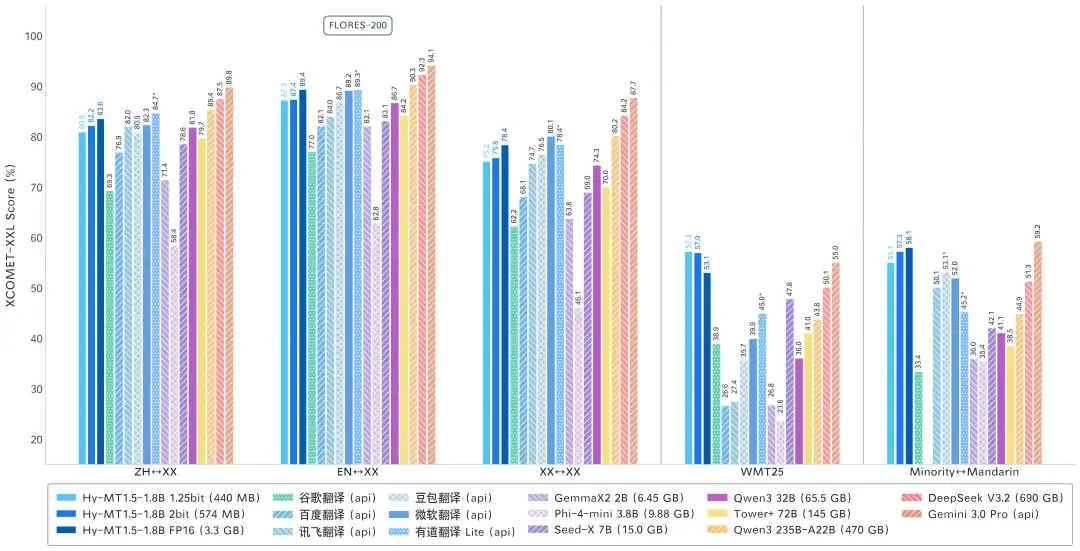
Hy‑MT1.5: Small Model, Big Capabilities
The Hy‑MT1.5 series includes a 1.8B lightweight version and a 7B full version. The quantized 1.8B variant is only 440MB; after extreme quantization, it runs smoothly on mid‑ to low‑end devices such as Snapdragon 865 with 8GB RAM, enabling real‑time offline translation. Tencent's Hunyuan team stated that under strict evaluation benchmarks, translation quality not only surpasses commercial APIs like Google Translate and Microsoft Translator, but also reaches or approaches the performance of 235B‑class very large models, and it performed well in international machine translation competitions such as WMT.
Technical highlights include:
- Multilingual coverage: Supports mutual translation among 33 international languages, covering major pairs such as Chinese↔English, French↔German, Japanese↔Korean, as well as 5 Chinese dialects/minority languages, with 1,056 translation directions.
- Advanced features: Supports terminology control, context‑aware translation, format preservation and other professional capabilities, suitable for documents, real‑time conversations and various scenarios.
- Local deployment: Fully offline operation with no data uploaded, significantly improving privacy and security.
- Efficient quantization: Uses extreme compression techniques such as 1.25‑bit quantization to greatly reduce model size and memory usage while maintaining high performance.
Compared with traditional cloud‑based translation services, Hy‑MT1.5's biggest advantage is no network required. In remote areas with poor signal, during international travel, studying abroad or in network‑constrained environments, users can still obtain high‑quality translation support. This has practical value for cross‑border communication, emergency rescue and personal learning scenarios.
Far‑reaching Impact on the AI Translation Industry and Users
1. Privacy protection and data security upgrade
Traditional online translation services require user text to be uploaded to servers, which carries a risk of data leakage. Hy‑MT1.5 runs entirely locally, fundamentally addressing this pain point. Especially in scenarios involving sensitive information, trade secrets or personal privacy, localized translation will become the preferred choice. This also aligns with increasingly strict global data privacy regulations (such as GDPR and China’s Personal Information Protection Law), offering compliant solutions for enterprise applications.
2. Empowering offline scenarios and inclusive value
A 440MB footprint brings high‑end translation capabilities to ordinary smartphones, including mid‑ and low‑end devices. This greatly expands the application scope of AI translation: in developing countries, regions with weak network infrastructure, or in aviation and remote‑tourism scenarios, users can access high‑quality translation without relying on expensive data plans or stable networks. Tencent’s move significantly lowers the barrier to AI technology, allowing more ordinary users to benefit and advancing AI inclusivity.
3. Challenging cloud‑based translation business models
Mainstream services like Google Translate and DeepL rely heavily on cloud compute. The emergence of open‑source local models such as Hy‑MT1.5 will challenge that model. Users may shift to free, offline, localized alternatives, forcing cloud services to further differentiate (for example, via real‑time multi‑turn dialogue or proprietary domain knowledge). At the same time, this accelerates the trend toward edge computing for AI models, prompting the industry to evolve from "cloud‑centered" to "cloud‑edge‑end collaboration".
4. Open‑source ecosystem and accelerated innovation
Tencent has fully open‑sourced the model weights, code and technical report (supporting an Android demo experience, with plans to extend to iOS and other platforms), providing developers, researchers and SMEs with a high‑performance base translation model. This will spur more localized AI application innovations, such as integration into translation apps, educational tools, cross‑border e‑commerce and smart hardware. Open source also fosters global collaboration in the AI community, advancing the "small model, big capability" technical path.
5. Sustainability and cost optimization
Local operation significantly reduces dependence on cloud servers, lowering energy consumption and carbon emissions and aligning with green AI trends. For enterprises, deployment costs drop substantially without the need for continuous API call payments. This is particularly beneficial for SMEs and developers, helping AI translation penetrate more vertical domains.
Challenges and Future Outlook
Despite its strong performance, Hy‑MT1.5 still faces challenges: extreme quantization may incur some accuracy loss on very complex long texts or rare languages; mobile real‑time performance depends on hardware optimizations; future integration of multimodal (speech, image) translation remains a key direction.
Tencent's Hunyuan open‑source release not only demonstrates domestic AI strength in the translation field but also offers a Chinese solution for global AI lightweighting. As more similar open‑source models emerge, AI translation will become smarter, more convenient and more inclusive. The deployment of Hy‑MT1.5 may be just the beginning of AI's journey from small models to large‑scale application.
▶️ Enjoy this article? Creating it was hard work!
Follow our YouTube channel:
AI Rosetta
Your likes, subscriptions and shares are our greatest support! 🙏
More AI news at: https://www.airosetta.com