
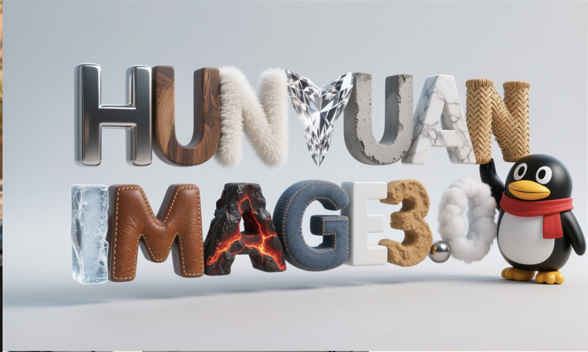
In September 2025, Tencent’s Hunyuan foundational models team in Shenzhen published a paper on arXiv (arXiv:2509.23951v1) officially introducing the HunyuanImage 3.0 model. This largest and most powerful open‑source image generation AI marks a significant breakthrough for China in the multimodal field. HunyuanImage 3.0 is a native multimodal model that can both "understand" images for analysis and generate high‑quality images, supporting a wide range of creation from photographic realism to artistic styles. According to Tencent News, the model is based on a language model with more than 80 billion parameters (13 billion activated) and features chain‑of‑thought reasoning capabilities, fundamentally unifying image generation and understanding. Wired emphasized that the open‑source release democratizes AI imaging technology, giving developers free access to top‑tier performance and likely accelerating applications in the creative industries.
Since 2023 the Hunyuan team has focused on large model R&D; the prior HunyuanImage 2.1 already showed strong generative ability, but version 3.0 achieves a qualitative leap in multimodal fusion. Hugging Face repository data show downloads quickly surpassing 500,000. An X user @TencentHunyuan posted: "HunyuanImage 3.0: one model that understands and generates images—open source empowers global creativity." The post received thousands of likes and community feedback highlighted the model’s "all‑round" design as a standout. This release not only consolidates Tencent’s leadership in open‑source AI but also injects new momentum into education, design and research.
Data preparation: building a high‑quality dataset
The success of HunyuanImage 3.0 stems from rigorous data preparation. Starting from 10 billion raw images, the team used a three‑stage filtering process: first technical filtering to remove low‑resolution, damaged or duplicate images; second objective plus subjective filtering to remove watermarks and AI‑generated fakes and to evaluate color, lighting and composition with aesthetic scoring models; finally deduplication by feature‑vector clustering to remove 0.5% similar content. The process retained nearly 5 billion high‑quality images (under 45% of the original). They supplemented with specialized datasets including video snippet mining: extracting high‑value frames from videos via shot detection, motion classification, object detection and blur detection.
This process ensured data diversity and quality. Tencent News noted the team constructed a dataset of 100 million image pairs by clustering images to generate paired descriptions that simulate editing instructions, supporting image‑to‑image understanding and generation. Compared with Llama 3.1’s open datasets, Hunyuan’s filtering placed greater emphasis on aesthetics and semantic integrity to avoid introducing low‑quality noise.
Image description generation and inference dataset construction
The model’s key is a hierarchical bilingual description architecture that generates four levels of descriptions: from brief semantics to ultra‑long detail, covering semantic fields, style attributes and factual entities. Compositional data augmentation samples fields to produce 30–1000‑word descriptions to ensure diversity. Integrated OCR agents extract text and named‑entity agents recognize entities, with bidirectional verification to ensure accuracy. For paired images, a difference‑description generator simulates editing instructions to deepen the model’s understanding.
The inference dataset is designed to simulate human chain‑of‑thought: from prompt comprehension to refined reasoning and then image generation. It covers photographic, artistic, UI design and knowledge‑query scenarios, uses aesthetic metrics to filter images, and annotates reasoning traces. This design endows the model with "thinking" capabilities and reduces the randomness of traditional generative models. Hugging Face community feedback indicates this approach outperforms Seedream 4.0 on complex prompt handling.
Model design and key techniques
HunyuanImage 3.0 is based on Hunyuan‑A13B (80 billion parameters, 64 expert modules, 8 experts activated per pass + shared MLP, with 13 billion parameters actually activated). Text processing uses an extended vocabulary; image encoding employs a dual encoder: a VAE (32‑dim latent space, 16× downsampling) and a visual encoder connecting features. Projectors include timestep‑modulated residual blocks for VAE features and a two‑layer MLP for visual features, supporting interleaved multimodal interaction.
The generalized causal attention mechanism is an innovation that integrates causal (text autoregressive) attention and full attention (global image). Image tokens may attend to later tokens within the same patch, and training introduces a dilated mask; during inference standard causal masking is used. Positional encoding adopts generalized 2D rotary positional encodings (trigonometric functions of x,y coordinates), with text retaining 1D compatibility to ensure consistency. Automatic resolution adjustment extends the vocabulary with size anchors and aspect‑ratio tokens (1:4 to 4:1); the model predicts sizes from context while allowing user specification (e.g., "3:4"). This enables flexible handling of different resolution inputs and represents a leading innovation.
Training and post‑training optimization
Pretraining proceeded in four stages: 1. Transformer backbone + low resolution (text‑to‑image generation, language modeling, multimodal understanding); 2. visual encoder fine‑tuning; 3. joint training + higher resolution + interleaved data; 4. high‑resolution subset (short side ≥1024 pixels) + inference data. Subsequent instruction fine‑tuning used template‑formatted data to ensure prompt compliance.
Post‑training optimizations include supervised fine‑tuning (high‑quality image categories), direct preference optimization using labeled good/bad pairs to suppress distortions, MixGRPO (reinforcement learning to optimize aesthetics and reduce artifacts), SRPO (gradient‑guided noise injection to improve realism) and ReDA (reward distribution alignment to mimic high‑quality image distributions). These methods substantially improved generation quality and stability. Compared with Llama 3.1, Hunyuan’s optimizations emphasize multimodal consistency.
Performance evaluation and expert activation analysis
On the SSAE metric (500 prompts, 3,500 points, 12‑field classification, multimodal LLM scoring 0–1 match), HunyuanImage 3.0 leads across all fields. In the GSB evaluation (1,000 prompts, 100+ evaluators) its relative win rates vs. HunyuanImage 2.1 were 14.10%; vs. Seedream 4.0 1.17%; vs. Nano Banana 2.64%; and vs. GPT‑Image 5.00%.
Expert activation analysis shows a heatmap for 1,000 prompts indicating expert specialization (image/text KL divergence increases with depth) and emergent division of labor that enhances multimodal capability. These results demonstrate the model’s SOTA position in image understanding and generation.
Community reaction and industry impact
After the release of HunyuanImage 3.0, community response was enthusiastic. Hugging Face downloads exceeded 500,000 and developers called its "all‑round" design revolutionary. An X user @TencentHunyuan shared: "A new benchmark for open‑source image AI." Bloomberg reported that Hunyuan challenges U.S. tech incumbents’ dominance and propels the open‑source ecosystem.
The impact is far‑reaching. Info‑Tech assessed that Hunyuan lowers the barrier for multimodal work and supports creativity, education and research. Compared with proprietary alternatives, its open‑source nature accelerates community fine‑tuning, though geopolitical risks remain and U.S. restrictions could affect collaboration. Tencent plans subsequent versions to expand image‑to‑image capabilities.
Conclusion: the open‑source beacon of HunyuanImage 3.0
Tencent Hunyuan’s HunyuanImage 3.0, with its 80‑billion‑parameter multimodal innovations, reshapes the open‑source image AI landscape. From data curation to post‑training optimization, the model not only leads benchmarks but also provides free tools for global developers, advancing AI accessibility. Going forward, Hunyuan could spark many applications but will need to address ethical and regulatory challenges.