
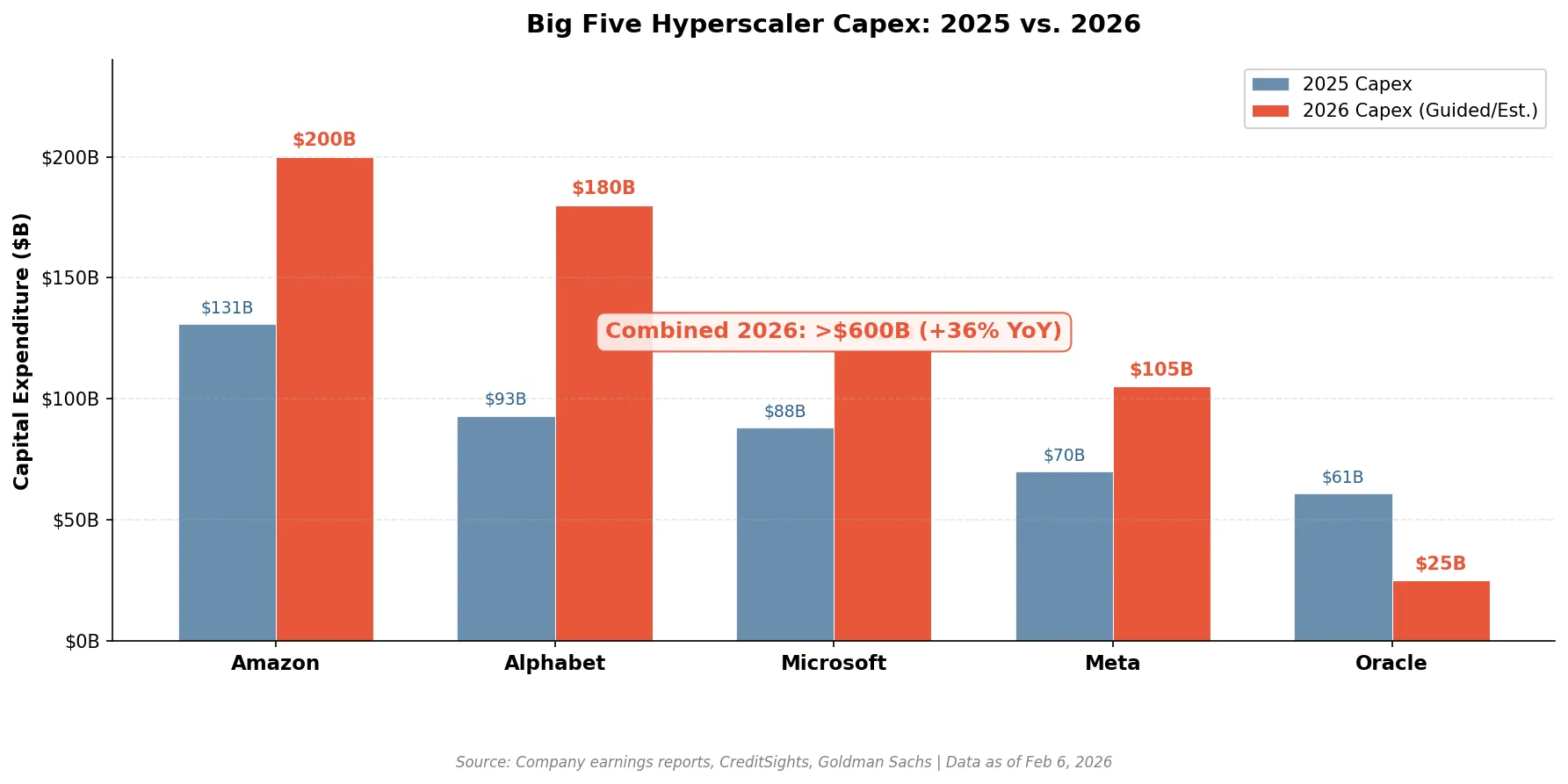
As the wave of artificial intelligence (AI) sweeps the globe, Big Tech is placing unprecedented bets on the technology's future. According to forecasts from several authoritative institutions, Amazon, Alphabet (Google's parent company), Microsoft, Meta and Oracle will together push total capital expenditure above $600 billion in 2026, with the vast majority directed at AI infrastructure. That figure is more than four times the annual investment of the U.S. energy sector, prompting widespread concern on Wall Street and among investors: can such massive spending be converted into timely returns, or will it turn into a high‑risk cash‑burning race? This issue not only concerns the future of the tech industry but may also reshape the global economic landscape. Let's take a closer look.
AI investment boom: from forecasts to reality
Looking back over recent years, the pace of AI investment growth has been staggering. As early as 2025, the four big tech companies (Amazon, Alphabet, Microsoft and Meta) spent $381 billion in total, while 2026 forecasts jump to $635–$665 billion, an increase of about 67%. Adding players such as Oracle pushes the total well past the $700 billion mark. In a year‑end 2025 report, Goldman Sachs noted that this scale of investment already accounts for 0.8% of global GDP and could climb to $700 billion in 2026, matching peak levels seen in past tech booms, such as the telecom investment surge in the 1990s.
By company, Amazon leads the "arms race." The company’s 2026 capital expenditure plan reaches $200 billion, far exceeding its 2025 budget and surpassing the U.S. energy sector's annual investment. Alphabet's spending is expected between $175 billion and $185 billion, Microsoft’s fiscal‑year spending will exceed its 2025 level of $88.2 billion, and Meta’s budget is notably higher than 2025’s $70 billion. Oracle, as a key cloud player, has been included among the five hyperscalers, helping push total investment above $600 billion.
Where is the money going? CreditSights estimates about 75% of spending—roughly $450 billion—will be allocated to AI infrastructure, including graphics processors (GPUs), servers, networking equipment and data center construction. For example, AWS has reached $142 billion in annualized revenue, and its custom chips Trainium and Graviton have an annual revenue run rate of $10 billion. Google Cloud grew 48% and Azure grew 39%, indicating cloud computing is the core engine of AI investment. Early Wall Street forecasts were too conservative—projections of roughly 20% annual growth for 2024 and 2025 were exceeded by actual growth rates of over 50%, which has pushed 2026 estimates higher.
The investment boom is not unfounded. Rapid AI advances are driving corporate digital transformation, with applications ranging from chatbots to automated decision‑making. Bloomberg data show the four giants’ 2026 spending will exceed the total of the past three years and is equivalent to the $470 billion spent by 21 major U.S. industrial companies (such as ExxonMobil, Walmart and Intel). This "roughly $650 billion wager" is reshaping corporate financial strategies, turning tech stocks from growth stories into an infrastructure race.
Winners emerge: "gold diggers" on the supply chain
Despite concerns, the spending creates golden opportunities for supply‑chain companies. Analysts note the giants' outlays will generate multi‑year revenue tailwinds, especially for suppliers who "sell the shovels." In semiconductors, NVIDIA is the clear winner with a 90% share of the AI accelerator market; virtually every hyperscaler begins its procurement with GPUs. Goldman has a "buy" rating on NVIDIA with a $250 target price, implying 39% upside. Broadcom leads in custom silicon and networking equipment, designing ASICs for Apple, Meta, Alphabet and ByteDance, and is forecast to see fiscal‑2026 revenue grow 52% to $133 billion. TSMC, the world's leading contract chipmaker with a 68% market share, manufactures chips for NVIDIA, AMD, Broadcom and Qualcomm, and its demand pipeline is deepening amid a 36% surge in capital spending.
The power‑supply sector also stands to benefit. AI data centers’ electricity demand is rising sharply; Microsoft expects its power needs to jump more than 600% by 2030. Vistra signed a power purchase agreement with Meta for the Comanche Peak nuclear plant, and Goldman regards Vistra as a top AI power pick with a $205 target. GE Vernova supplies gas turbines, grid solutions and electrification products, and its share price rose more than 40% over the past year. These stocks climbed after Amazon’s spending announcement—NVIDIA rose 7.87% and Broadcom rose 7.22%—highlighting the market’s favor toward infrastructure suppliers.
From a broader perspective, this wave will stimulate global supply‑chain realignment. Nuclear power is being revisited as a preferred energy source for data centers, and tech‑related debt issuance is expected to reach $1.5 trillion, spurring financial‑market innovation. Unlike the internet bubble era, today's AI demand is driven by real customers and profitable cloud services rather than pure speculation.
Market concerns: from share gyrations to systemic risk
However, optimism is layered with concerns. After Amazon announced $200 billion in spending, its stock plunged 9% to $210.32 despite fourth‑quarter revenue of $213.4 billion and 24% growth in AWS. Alphabet CEO Sundar Pichai acknowledged some "irrational" elements to the pace of spending. Reuters reported that the $600 billion spending is intensifying investor anxiety about profitability and the "survival threat" to software companies. European data‑analytics companies saw stock pressure, and global software stocks lost hundreds of billions in market value.
The core issue is returns. Currently AI services generate only $25 billion in direct revenue—about 4% of infrastructure spending. If monetization is delayed, the massive outlays could lead to historic write‑downs. The hyperscalers’ capital spending has consumed 94% of operating cash flow (after dividends and buybacks), forcing them to lean on the debt market—$108 billion of bonds were issued in 2025. In addition, power shortages and policy uncertainty (such as nuclear approvals) amplify risks. Microsoft's surging power demand underscores this bottleneck, while climate change and geopolitics may further raise costs.
Deeper concerns involve a valuation bubble. SanJac Alpha CIO Andrew Wells said the AI build‑out trade is "priced too high," pulling future potential returns forward while understating risks. Over the past week, Big Tech’s market value has evaporated by more than $1 trillion; though the S&P 500 and Nasdaq have partially rebounded, weekly closes remain down. Reddit discussions suggest the roughly $660 billion investment has made investors cautious, triggering widespread selling.
Outlook: balancing innovation with caution
Despite risks, AI investment is still seen as an engine of technological progress. Goldman expects analyst consensus on 2026 capital spending to have risen from $465 billion to $527 billion, signaling strong momentum. NVIDIA's February 25 earnings, if reflective of this wave, will further lift infrastructure stocks. For investors, the focus should be on supply‑chain beneficiaries rather than pure spenders.
Overall, 2026’s $600 billion AI investment marks a pivotal step toward an intelligent era. It will accelerate technological innovation and may help tackle global challenges in healthcare and the environment. But amid the excitement, markets must beware the trap of "overcommitment." As with the internet revolution, eventual winners will be those who balance spending with returns. The question of which companies will monetize AI first—and thus dominate the next decade—deserves close attention from every tech observer.
▶️ Like this piece? Creating content is hard work!
Follow our YouTube channel:
AI Rosetta
Your likes, subscriptions and shares are our greatest support! 🙏
More AI news at: https://www.airosetta.com