
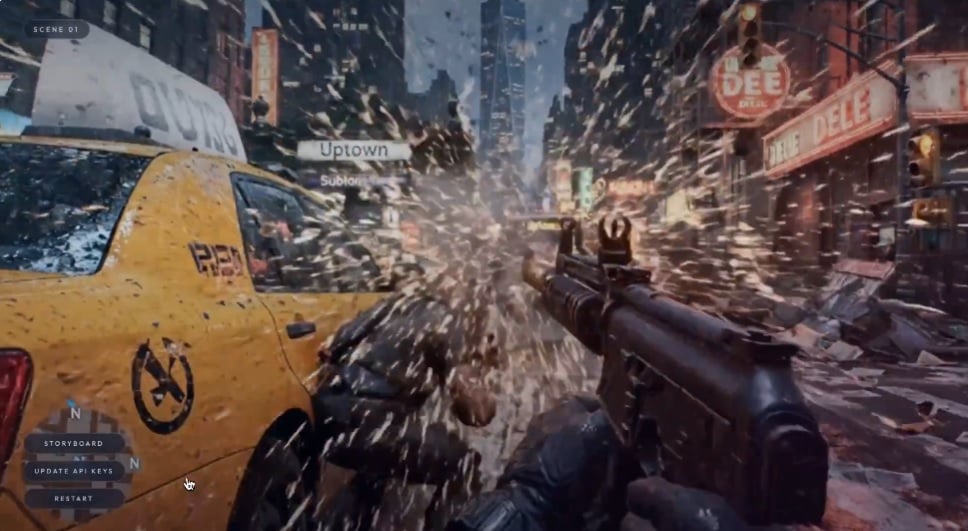
October 22, 2025, Kotaku published an article describing a project that looked "experimental" but was highly unprofessional: a developer self‑described as a "tech bro" used the generative AI tool HyperWrite to rapidly compose an FPS (first‑person shooter) demo video, which Kotaku called "this is some of the worst Tom Clancy shovelware I've ever seen".
The video runs only a minute or two, but its details are enough to make viewers wince. Soldier models have faces stretched into mask‑like distortions, with eyes floating outside helmet seams; muzzles don't align with hands, bullet tracers and muzzle flashes are offset, and shell casings appear to eject from characters' midsections. Map textures repeat heavily: the same building's windows are copy‑pasted within five seconds, and the ground shows low‑resolution repeating texture bands, making the player perspective feel like moving across a looping stage. (video link)
Audio is seriously out of sync as well: firing sounds loop endlessly, distant explosions have a reverb that sounds like a studio effect, and NPC lines often cut off mid‑phrase or are replaced with text placeholders. Kotaku noted that the HUD even displays unreplaced template fields, such as "{player_name} has been eliminated", exposing the automated pipeline stitching behind the piece.
More notable is the obvious borrowing of a "Tom Clancy" military aesthetic: tactical jackets, close‑up night‑vision shots, and counterterrorism jargon. Those elements are clumsily patched together and lack logical coherence, as if an IP style were being used as free素材. Kotaku classified the work as "shovelware," highlighting that rapid, low‑cost generation is a typical problem when generative AI is misused.
Social media reaction has been mainly ridicule: users turned distorted textures into emojis and made GIFs from misaligned‑weapon screenshots. Broader discussion shifted to two more serious issues: first, whether generative AI's ability to quickly assemble elements that "look like" a known IP without rights checks could infringe on the original; and second, how a flood of quickly produced, nonprofessional works might affect industry expectations for quality and creative workflow.
The article also cited technical observations: tools like HyperWrite excel at creating static images or very short animated clips, but stitching multiple AI outputs into a playable, coherent game experience still requires extensive manual fixes, animation rigging, and physics tuning. Without those traditional development steps, the result is often a noise product that only resembles the original in form, not in spirit.
Whether viewed as entertainment or a critique of tool capabilities, the incident has sparked discussion among young developers: generative AI can greatly lower creation barriers, but it can also enable rapid spread of low‑quality content that undermines original IP and blurs responsibility. Kotaku presented the clip as a cautionary example, reminding industry and regulators that "automatic generation" cannot replace careful creation and legal review.
There is no sign this project was intended for commercial release or platform distribution, but after its exposure on October 22, 2025, it quickly became a case used to debate the boundaries of generative AI in games. For players and practitioners alike, the central question is: when tools can convincingly mimic a popular IP's style, who is responsible for policing quality and copyright?