
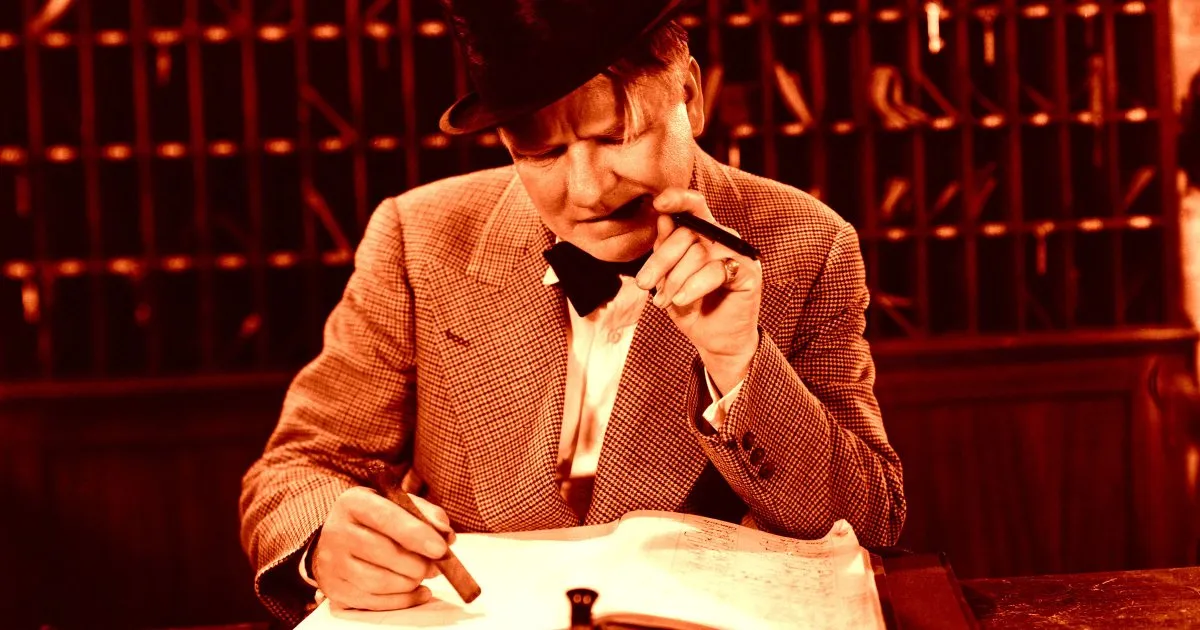
In late April 2026, University of Toronto computer science associate professor David Duvenaud and collaborators Alec Radford, status_effects and others published the open‑source historical large language model Talkie. This 13‑billion‑parameter model was trained and fine‑tuned exclusively on books, newspapers and other texts published before 1930, making it the largest known "retro" large language model to date. It can converse in a characteristic early‑20th‑century Mid‑Atlantic accent and elaborate prose, as if an old‑fashioned gentleman "trapped in the past." The project quickly attracted attention from the AI community not only for its distinctive linguistic style but also because it provides a unique experimental platform for studying large language models' (LLMs) knowledge boundaries, temporal generalization and scientific discovery potential.
Talkie has no system prompt; researchers observed that it is "basically" unaware that its training data are limited to pre‑1930 sources and does not introspect well about its knowledge cutoff. This gives its outputs a strong period flavor: formal diction, long sentences, and archaic expressions such as "we do declare," while it displays naive or speculative views of modern matters.
Talkie’s core principle: pure historical data training and temporal isolation
Talkie’s training approach builds on contemporary Transformer architectures and standard LLM pretraining paradigms but enforces strict temporal isolation. The team carefully curated a new dataset containing only texts from before 1930, including literary classics, news reports, scientific papers and everyday reading, avoiding any contamination from post‑1930 material.
Pretraining: The model learned the statistical patterns, grammatical structures and cultural contexts of vast historical texts through self‑supervised next‑token prediction. This enabled it to naturally acquire early‑20th‑century English styles, including formal vocabulary, period‑specific expressions and contemporary social common sense.
Fine‑tuning: Instruction tuning targeted conversational ability to improve usability as a chatbot, while still strictly preserving data purity.
The key idea is knowledge cutoffs and distribution shift. Modern LLMs are typically trained on vast contemporary corpora and tend toward neutral or "therapy‑speak" tones. By imposing a hard temporal cutoff, Talkie creates a pronounced temporal embedding that makes its outputs highly consistent with historical contexts.
Interestingly, the model still exhibits "temporal leakage," occasionally referencing events after 1933. This reflects an inherent property of large models to generalize associative patterns from data—so even with a cutoff, they may infer hindsight‑like "knowledge."
Echoes of early AI ideas: from mechanical automata to language simulation
Talkie did not arise in a vacuum; conceptually it links to AI’s long prehistory. Since antiquity humans have pursued intelligence via automata. Mythic constructs such as Hephaestus’ golden automata, Hero’s devices and medieval alchemical notions of a "homunculus" all embody the ancient desire to endow the inanimate with intelligence.
The 18th and 19th centuries saw mechanical automata peak: Jacques de Vaucanson’s digesting duck, Pierre Jaquet‑Droz’s writing automata and Charles Babbage’s Analytical Engine. Ada Lovelace speculated in her notes that Babbage’s machine might "weave algebraic patterns," hinting at the idea of a thinking machine. Twentieth‑century logicians such as George Boole and Gottfried Leibniz laid foundations for symbolic reasoning, and Alan Turing’s 1936 universal Turing machine formally demonstrated that any computable process could be mechanically simulated.
Talkie is a modern continuation of this long evolution: rather than simulating a physical automaton, it models linguistic intelligence through statistical learning on large amounts of text. Unlike early rule‑based symbolic AI, Talkie relies on data‑driven connectionist methods, using parameter optimization to capture the "statistical essence" of historical language.
Significance for AI research and scientific discovery
1. Testing knowledge boundaries and generalization
Talkie provides a "clean" temporal slice for experiments. Researchers can ask: could a model trained only on pre‑1911 data independently derive Einstein’s 1915 general theory of relativity? Early tests show Talkie can generate simple single‑line code but remains far from making substantive scientific discoveries. This offers a new paradigm for assessing LLMs’ discovery potential and underscores how training cutoff dates shape a model’s world model.
2. Temporal generalization and prediction
In tests, Talkie shows higher "surprise" for post‑cutoff events and produces intriguing predictions (for example, speculating about another world war in 1936 or widespread aircraft use). This reveals the model’s extrapolation mechanism: it infers future patterns from historical trends but, limited by its training distribution, can produce results that are both plausible and absurd (such as predicting the sun would stop shining in 1999). Studying this helps trace sources of hallucination and robustness issues.
3. Cultural and linguistic preservation
Talkie functions like a "time capsule," recreating pre‑1930 language, culture and modes of thought. For historians, linguists and digital humanities scholars it is a powerful tool for simulating historical dialogues, analyzing period ideas or for educational purposes.
4. Open source and community impact
Released as an open‑weight model, Talkie encourages global developers to experiment with domain‑ or time‑specific models. This could stimulate more vertical historical AIs, push AI toward greater specialization, and set new standards for dataset curation and training purity.
Limitations and future directions
Talkie is not without flaws. It shows clear weaknesses in complex reasoning, modern knowledge and consistency, and temporal leakage demonstrates the difficulty of perfectly isolating historical data. Researchers acknowledge its programming and scientific discovery capabilities remain at an early stage.
Nevertheless, the project opens intriguing avenues: could we train models restricted to "pre‑1900" or "pre‑1850" corpora? Or combine multimodal historical data to build richer "historical simulators"? As model scale and training techniques advance, such experiments will further illuminate LLM mechanisms, creativity boundaries and differences from human cognition.
Talkie reminds us that AI is not only a technology of the future but also a mirror for reinterpreting past and future alike. By strictly limiting the temporal window of training data, researchers have both created a chatbot that speaks "old‑fashioned English" and injected a historical dimension into AI principles research. In the quest for more powerful general artificial intelligence, such "retro experiments" may prove a revealing step toward understanding fundamentals.
▶️ Enjoy this article? Creating content is hard work!
Follow our YouTube channel:
AI Rosetta
Your likes, subscriptions and shares are our greatest support! 🙏
More AI news at: https://www.airosetta.com