
Introduction
The rapid progress in artificial intelligence builds on a body of classic papers. OpenAI co‑founder Ilya Sutskever reportedly recommended roughly 30 foundational papers to computer scientist John Carmack and asserted, "If you truly understand these, you will grasp 90% of what matters in today’s AI." This idea has circulated widely in the AI community and has been compiled into lists by authoritative sources such as Aman.ai and several GitHub repositories. However, these papers are often dense with mathematical notation, and converting them into runnable code can be challenging for beginners. A recent GitHub project named "Sutskever‑30‑implementations" addresses this gap by reimplementing the papers from scratch in pure NumPy, providing interactive Jupyter Notebooks and synthetic datasets so the examples can be executed directly. The project not only bridges theory and practice but also covers the architectural evolution from RNNs to Transformers as well as theoretical foundations like Kolmogorov complexity and AIXI.
Project Overview
The "Sutskever‑30‑implementations" project was initiated by user pageman, inspired by papercode.vercel.app, and aims to reproduce the 30 papers recommended by Sutskever through code. The project reports completing all implementations on 2025‑12‑10 and currently shows 1.1k stars and 121 forks, indicating community recognition. Each paper is represented by a Jupyter Notebook that builds the model using pure NumPy without depending on frameworks like PyTorch or TensorFlow. This approach keeps the code close to the underlying mathematical operations and makes the algorithmic essentials easier to understand.
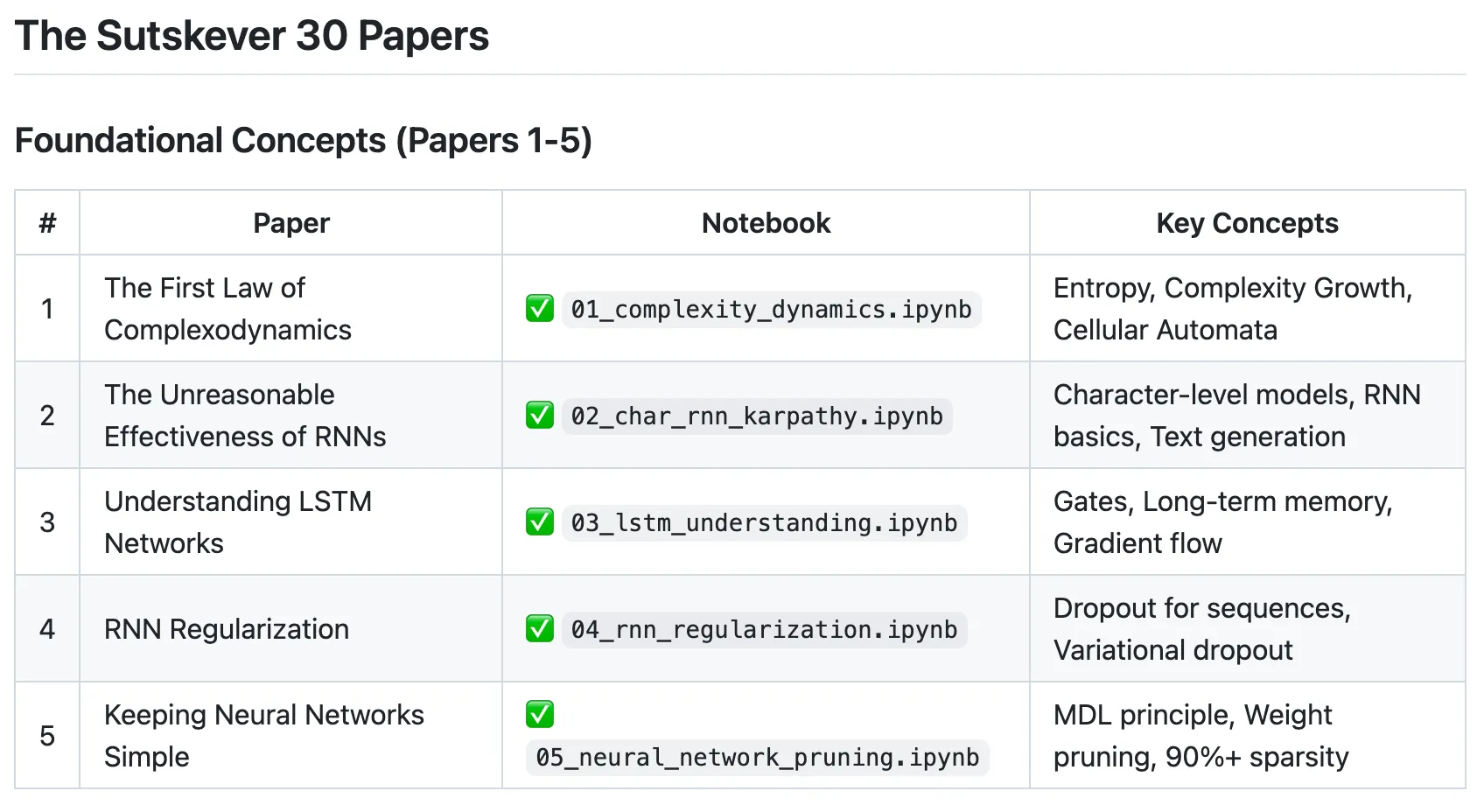
The project’s coverage is comprehensive and includes:
- The First Law of Complexodynamics: Explores entropy and complexity growth using cellular automata simulations.
- The Unreasonable Effectiveness of RNNs: Character‑level RNN text generation.
- Understanding LSTM Networks: LSTM gate mechanisms and gradient flow.
- RNN Regularization: Sequence‑wise dropout.
- Keeping Neural Networks Simple: Network pruning and the MDL principle.
- Pointer Networks: Attention as pointers to solve combinatorial problems.
- ImageNet/AlexNet: CNN convolutions and data augmentation. aman.ai
- Order Matters: Seq2Seq for Sets: Set encoding and permutation invariance.
- GPipe: Pipeline parallelism and micro‑batching.
- Deep Residual Learning (ResNet): Skip connections as gradient highways.
- Dilated Convolutions: Dilated convolutions and multi‑scale processing.
- Neural Message Passing (GNNs): Message passing in graph neural networks.
- Attention Is All You Need: Transformer and multi‑head self‑attention.
- Neural Machine Translation: Seq2Seq and Bahdanau attention.
- Identity Mappings in ResNet: Pre‑activation and gradient flow.
- Relational Reasoning: Relation networks and pairwise functions.
- Variational Lossy Autoencoder: VAE, ELBO and reparameterization.
- Relational RNNs: Relational memory and multi‑head self‑attention with manual backprop (about 1,100 lines of code).
- The Coffee Automaton: Irreversibility, entropy and Landauer’s principle.
- Neural Turing Machines: External memory and differentiable addressing.
- Deep Speech 2 (CTC): CTC loss and speech recognition.
- Scaling Laws: Power laws and compute‑optimal training.
- MDL Principle: Minimum description length and model selection.
- Machine Super Intelligence: General AI, AIXI and Solomonoff induction.
- Kolmogorov Complexity: Compression and algorithmic randomness.
- CS231n: CNNs for Visual Recognition: Vision pipeline, backpropagation and optimization.
- Multi‑token Prediction: Multi‑token prediction and sample efficiency.
- Dense Passage Retrieval: Dual encoders and in‑batch negatives.
- Retrieval‑Augmented Generation (RAG): RAG‑sequence and RAG‑token.
- Lost in the Middle: Positional bias, long contexts and U‑shaped performance curves.
These implementations span neural architecture evolution (RNN/LSTM to Transformer and ResNet), key techniques (attention mechanisms, residual connections, graph neural networks), advanced topics (VAE, Neural Turing Machines, CTC loss) and theoretical foundations (Kolmogorov complexity, MDL, AIXI). The project also includes modern applications such as RAG and long‑context analysis.
Each Notebook generates synthetic data (e.g., character sequences, simple images, toy graphs) so external datasets are unnecessary. The code emphasizes visualization—plotting gate activations, attention weights and gradient flow—to help users form an intuitive understanding.
Implementation Analysis
The core of the project is building models from scratch in pure NumPy to expose the low‑level mechanics of algorithms. NumPy provides efficient array operations but lacks built‑in automatic differentiation and optimizers, so the author implements forward passes, backward passes and gradient updates manually. This mirrors the mathematical formulas in the papers—for example, manually computing multi‑head attention in the Transformer:  . This approach avoids the "black‑box" nature of frameworks and helps learners understand issues like vanishing and exploding gradients while manually constructing LSTM forget and input gates.
In the Relational RNN implementation, the project even includes about 1,100 lines of manual backpropagation with gradient checks, reinforcing mastery of the chain rule. The interactivity of Jupyter Notebooks allows users to change parameters and visualize intermediate results, promoting experimental learning. Synthetic data simplifies onboarding—for example, using random sequences to train an RNN for text generation rather than large corpora.
Compared with similar efforts such as deepbiolab/ilya30u30‑paper‑research (which also reproduces the Sutskever list but may rely on frameworks), this project emphasizes educational purity. The Tensor Labbet blog summary of the Sutskever list highlights that implementing from scratch helps trace AI’s evolution. Manning’s book "Sutskever's List" similarly notes that such hands‑on practice cultivates the ability to anticipate modern AI trends.
However, pure NumPy implementations have limitations: they are computationally inefficient and unsuitable for large‑scale training. That said, this shortcoming aligns with the project’s educational goals rather than production use.
Factual Accuracy and Sources
Sutskever’s remark originated from his interactions with Carmack around 2019 and spread via Hacker News and Twitter. The list is not an official publication but Aman.ai has compiled it from reliable sources and includes widely recognized classics such as AlexNet and the Transformer. Reddit discussions confirm the list’s continued relevance, with papers like "Understanding LSTM Networks" and "GPipe" cited as foundational to large language model development.
The project’s claims are verifiable: the GitHub page indicates 100% completion and the code is open for inspection. While mainstream media coverage is limited, comparable reimplementations such as AnupBhat30/ilya‑sutskever‑ai‑reading‑list underscore the educational value. LinkedIn and Facebook posts treat the list as an AI learning "cheat sheet." Primary sources are arXiv papers, GitHub repositories and expert blogs; the community has cross‑checked these sources and found no major contradictions.
Applications and Educational Value
This project is suitable for AI beginners, researchers and practitioners. By reproducing the papers, learners can master deep learning mechanisms from the ground up rather than merely calling APIs. For example, the RAG implementation manually builds dual encoders to illustrate retrieval‑augmented generation. The codebase can be extended to practical uses by adding PyTorch acceleration or adapting examples to custom tasks.
Combined with other resources—such as Karpathy’s RNN blog (with accompanying GitHub code)—this project can deepen understanding. Medium’s series "Ilya Sutskever’s 30 Foundational Papers of AI, Explained" offers concise explanations, and YouTube videos like "The List That Changed AI Forever" discuss the list’s impact.
In education, the project can supplement courses—Stanford’s CS231n includes similar hands‑on material. For practitioners, it aids diagnosis of model issues such as gradient flow.
Conclusion
The "Sutskever‑30‑implementations" project reimplements AI foundational papers in pure NumPy, bridging theory and code and helping learners absorb what Sutskever described as 90% of AI essentials. Its approach emphasizes exposing low‑level mechanics and its factual basis rests on verifiable sources like GitHub and Aman.ai. In the AI era, such open‑source resources help more users become true practitioners and are worth bookmarking and experimenting with.
▶️ Enjoyed this article? Creating great content takes effort!
Subscribe to our YouTube channel:
AI Rosetta
Your likes, subscriptions and shares mean the world to us! 🙏
For more AI news, visit:
https://www.airosetta.com