
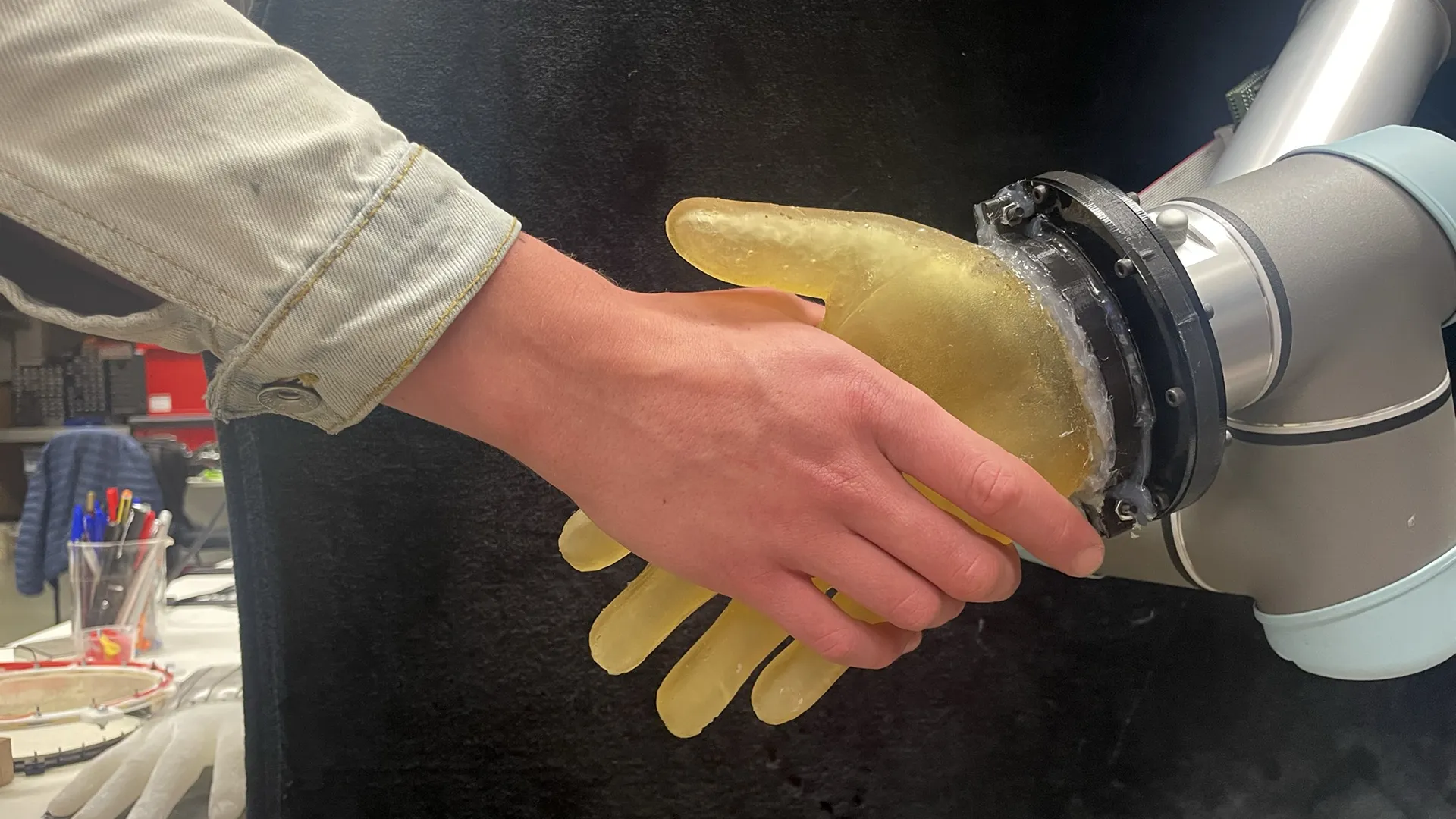
Amid rapid advances in human–machine interaction, a Stanford University research team on 2025‑06‑16 announced a breakthrough: a low‑cost, durable, highly sensitive robotic "skin" that can sense pressure, heat, pain and subtle sliding much like human skin, marking a major leap in tactile simulation. The skin is made from flexible electronic materials and can cover a robot hand like a glove, supporting real‑time feedback with a response time below 1 millisecond. ScienceDaily reports that this innovation not only brings AI robots closer to human tactile ability but also opens new paths for surgical robotics, industrial assembly and prosthetics, with the market expected to exceed $50 billion by 2030. At a key moment when AI robots are shifting from "rigid tools" to "flexible partners," this result is seen as a milestone of a "tactile revolution," drawing interest from giants such as DeepMind and Boston Dynamics.
Robotic tactile simulation has long been limited by rigid sensors and insufficient sensitivity. Traditional robots rely on cameras or force sensors and struggle to capture the multimodal feedback of human skin (such as temperature, texture and sliding). The Stanford team’s skin addresses this gap: it embeds a micro sensor array in flexible silicon‑based material and can detect fine changes from 0.1 N of pressure to 50°C of heat. Project lead Elliot Hawgood, a professor of bioengineering at Stanford, said, "Our goal is to let robots 'feel' the world, like a human finger sensing silk or hot coffee." The skin is only 0.5 mm thick, stretches up to 200%, endures 100,000 bends, and costs under $1 per square centimeter.
The core technology combines AI algorithms and nanomaterials. The skin contains a piezoelectric sensor array (1000 dpi resolution) that captures tactile signals in real time and feeds them to an edge AI processor based on TensorFlow Lite. For example, in a sliding‑detection task an AI model using convolutional neural networks (CNNs) analyzed sensor patterns to identify texture and motion direction with 98% accuracy. The team also integrated thermistors and fiber‑optic sensors to implement "pain simulation": the skin issues an alert when temperature exceeds 42°C, mimicking human pain reflexes. Compared with a similar Cambridge study on July 16 that focused on pressure, Stanford’s version is more comprehensive, supporting multimodal fusion (such as touch plus vision) and responding twice as fast.
The advance stems from Stanford’s "Physical AI" project, which has explored robotic perception since 2022 and has received over $100 million in cumulative investment. Early prototypes (such as a 2023 electronic skin) were limited to pressure detection with 80% accuracy; the new version was optimized with deep learning and models inspired by the human nervous system, boosting sensitivity to human‑skin levels (0.01 N pressure threshold). EurekAlert notes that the team published a paper in IEEE Robotics and Automation Letters (July 2) detailing the algorithms: reinforcement learning (RL) trains the skin to adapt to different environments, with a reward function based on "natural feedback" (such as sliding stability). In lab tests, robots wearing the skin could precisely pick up an egg without breaking it and identify object textures in the dark, achieving a 95% success rate.
The impact is far‑reaching: in medicine, tactile skin could be used in minimally invasive surgical robots to help surgeons "feel" tissue hardness, reducing complications by 20%. In industry, it can improve assembly‑line efficiency, for example detecting part defects in automotive manufacturing and saving 30% of labor. For people with disabilities, prosthetics integrated with this skin could restore a sense of touch and improve quality of life. TechXplore points out that combining this technology with AI vision (such as DenseTact sensors) could enable robots to achieve "full‑sensory" perception, with market potential exceeding $100 billion. Stanford plans to open‑source part of the code to encourage adoption.
Challenges remain: the skin’s water resistance and long‑term stability need improvement (current rating IP67, target IP68). In complex scenarios AI processing latency can reach 10 ms and needs further reduction. Hawgood acknowledged, "There is still engineering work to move from the lab to the factory." Ethical issues also arise: highly humanlike robotic skin could trigger an uncanny‑valley effect and affect public acceptance. The team is working with ethicists to ensure the technology serves people.
This innovation is not only a technical leap but also a symbol of AI robots drawing closer to humans. Stanford’s skin shows that tactile simulation is no longer science fiction but a practical tool. Hawgood said at a press briefing, "In the future robots will 'feel' our world, like partners rather than machines." With follow‑up efforts from DeepMind and Tesla Optimus, tactile AI could reshape manufacturing and healthcare and usher in a "sensory era." The tech community is witnessing robots evolve from "cold machines" into entities with humanlike sensing.
(Word count: 1012)
Sources:
- ScienceDaily: "Robots that feel heat, pain, and pressure? This new 'skin' makes it possible" (https://www.sciencedaily.com/releases/2025/06/250616040237.htm, 2025‑06‑17).
- TechXplore: "Scientists give robots a sense of touch with fabric that mimics human skin" (https://techxplore.com/news/2025‑08‑scientists‑robots‑fabric‑mimics‑human.html, 2025‑08‑01).
- EurekAlert: "Physical AI uses both sight and touch to manipulate objects like a human" (https://www.eurekalert.org/news‑releases/1096815, 2025‑09‑02).
- ISPR: "Robots that 'feel': Breakthrough robotic skin could revolutionize human‑robot interactions" (https://ispr.info/2025/07/16/robots‑that‑feel‑breakthrough‑robotic‑skin‑could‑revolutionize‑human‑robot‑interactions/, 2025‑07‑16).
- PMC: "Toward an AI Era: Advances in Electronic Skins" (https://pmc.ncbi.nlm.nih.gov/articles/PMC11397144/, 2025‑08‑29).
- Stanford TechFinder: "DenseTact: Optical Tactile Sensor" (https://techfinder.stanford.edu/technology/densetact‑optical‑tactile‑sensor, undated).