
In April 2026, Stanford University's Human‑Centered Artificial Intelligence Institute (Stanford HAI) published the widely watched 2026 AI Index report. This is the ninth edition, 423 pages in total, systematically tracking AI developments in 2025 across technical performance, research and development, economic impact, policy and governance, and public perception. It has been hailed as the "annual report card" for the field of AI. The report was compiled by Stanford HAI together with leading global scholars and industry experts, providing the most comprehensive and authoritative data portrait of AI development, intended to help policymakers, companies and the public understand AI's real trajectory and potential risks.
The report's core conclusion is stark: AI capabilities are accelerating breakthroughs, but society's preparedness in governance, measurement and management is severely insufficient. This "capability‑governance" gap has become the most notable characteristic of AI development in 2026. The report notes that AI has moved from the laboratory to large‑scale application, but the supporting regulatory frameworks, talent supply, transparency mechanisms and public trust have failed to keep pace, creating a clear "two‑speed world".
AI Capabilities Accelerate: Technical Performance Continues to Break Through
The report shows that AI technical performance has not plateaued but continues to rise rapidly. In 2025 the industry released more than 90% of the frontier models, and multiple models have reached or exceeded human benchmarks on high‑difficulty tasks such as PhD‑level scientific problems, multimodal reasoning and competitive mathematics. On the key coding benchmark SWE‑bench Verified, performance jumped from 60% to nearly 100% within a year. Organizational adoption reached 88%, and four out of five university students have used generative AI.
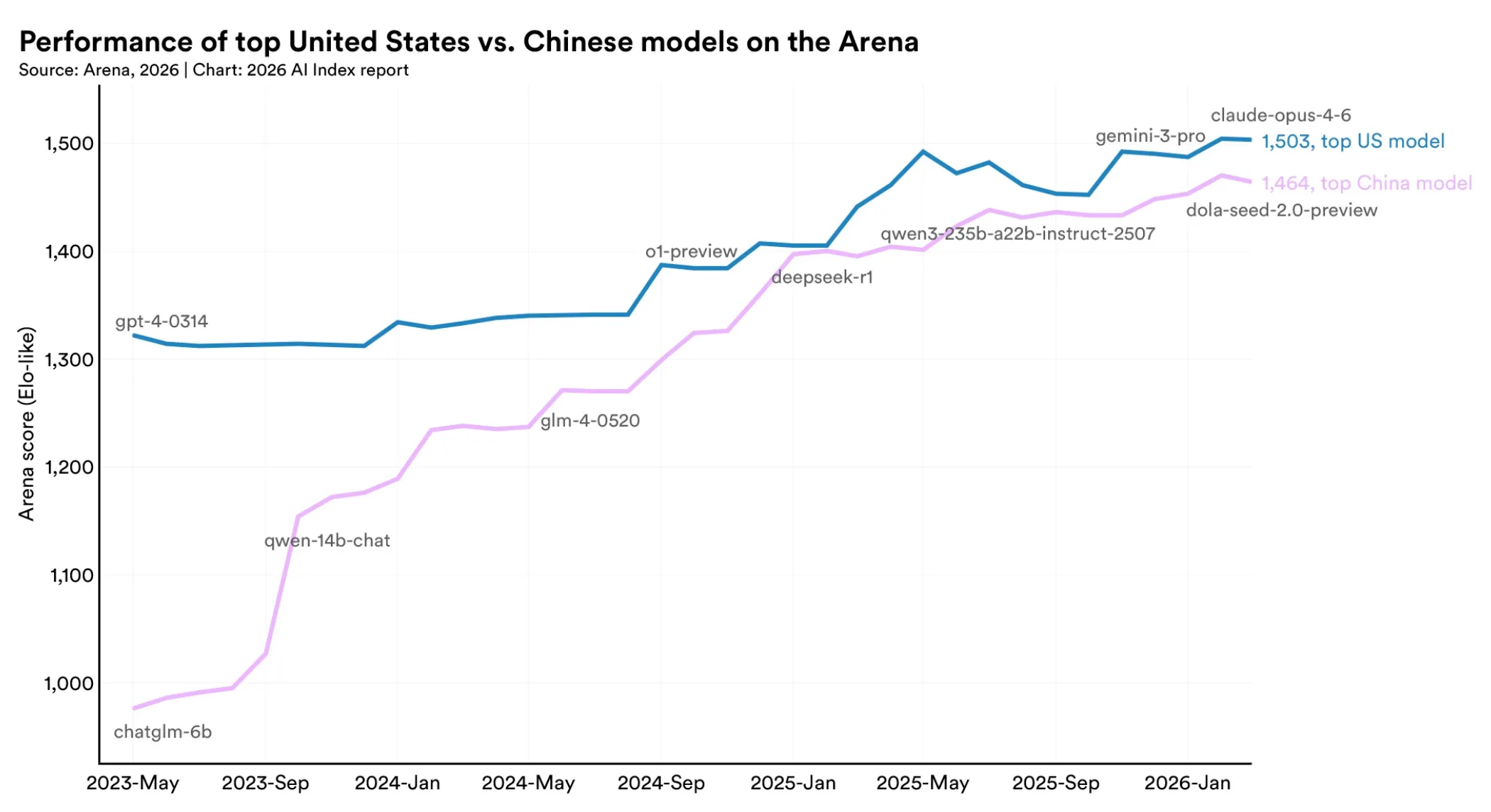
The performance gap between top US and Chinese models has largely disappeared. Since early 2025 leading US and Chinese models have alternated in leading positions. As of March 2026, Anthropic's strongest model led China's best model by only 2.7 percentage points. The United States still leads in the number of top models and high‑impact patents, while China holds advantages in paper output, citation volume, patent production and industrial robot installations. South Korea leads globally in per‑capita AI patent density.
Investment and Economic Impact: Explosive Growth Accompanied by Employment Disruption
Global corporate AI investment reached $581.7 billion in 2025, a year‑on‑year increase of 130%. Private investment grew 127.5% to $344.7 billion, of which US private AI investment was $285.9 billion—23 times that of China. Generative AI investment grew over 200% and accounted for nearly half of private investment. The number of newly founded AI companies rose 71%, and billion‑dollar funding events nearly doubled.
However, AI's impact on employment has shifted from prediction to reality. The report shows that young workers are the first to be affected: 20% of developer positions held by younger workers have been impacted by AI automation. AI agent capabilities have risen rapidly, achieving success rates of 66.3% and 74.3% on real computing tasks such as OSWorld and WebArena respectively, showing AI's transition from "chat tools" to "task executors".
Environment, Transparency and Trust Crisis
AI development also brings significant environmental pressure. In 2025 capital expenditures by the five major US cloud and AI infrastructure companies reached $660–690 billion, nearly double that of the previous year. Energy consumption for AI training and inference continues to climb, and the report warns that if left unchecked this will challenge global carbon emissions targets.
Transparency issues are similarly prominent. The share of frontier models publicly disclosing training details fell from 58% to 40% in 2025. The number of AI incidents rose from a notable increase in 2024 to 362 in 2025. Public trust in AI continues to decline, with optimism about AI lower in most countries compared with 2024.
Top Ten Points of Note
Stanford HAI summarizes 10 key observations in the report. Below are the most representative items:
- AI capabilities continue to accelerate Although the number of frontier models slightly decreased, performance improved substantially. In 2025 the industry released over 90% of the top models, and multiple models reached or exceeded human benchmarks on high‑difficulty tasks such as PhD‑level scientific problems, multimodal reasoning and competitive mathematics.
- The US‑China AI model performance gap has essentially disappeared Since early 2025 leading US and Chinese models have alternated in leadership. As of March 2026, Anthropic's strongest model led China's best model by only 2.7 percentage points. The US still leads in the number of top models and high‑impact patents, but China has advantages in paper publications, citation counts, patent output and industrial robot installations.
- AI agent capabilities have exploded AI agents' success rates on real computing tasks rose sharply: 66.3% on the OSWorld benchmark and 74.3% on WebArena. AI is rapidly shifting from "answering questions" to "completing tasks", and agent‑based workflows are becoming a new trend.
- Global AI investment shows explosive growth Global corporate AI investment reached $581.7 billion in 2025, up 130% year‑on‑year. Private investment rose 127.5% to $344.7 billion, of which US private AI investment was $285.9 billion—23 times China's. Generative AI investment grew over 200% and accounted for nearly half of private investment.
- AI's impact on employment has moved from prediction to reality Young workers are hardest hit; 20% of young developers' positions have been affected by AI automation. Rising agent capabilities are changing employment structures in software development, customer service and content creation.
- AI infrastructure capital expenditures have surged In 2025 capital spending by the five major US cloud and AI infrastructure companies reached $660–690 billion, nearly double the prior year. Energy use for AI training and inference continues to climb, challenging global emissions goals.
- AI model transparency continues to decline The share of frontier models publicly disclosing training details fell from 58% to 40% in 2025. Increasingly models are moving to closed or semi‑closed source, raising transparency concerns.
- The number of AI incidents has risen significantly 362 AI‑related incidents were recorded globally in 2025, a clear increase from 2024. Safety, ethical issues and misuse risks have become focal points.
- Public trust in AI continues to fall Optimism about AI in most countries is lower than in 2024, with growing public concern over job displacement, privacy breaches and ethical risks.
- The structural imbalance between governance and capability is intensifying AI technical capability is racing ahead, but regulatory frameworks, talent supply, transparency mechanisms and public trust have not kept up. This capability‑governance gap has become the most prominent feature of AI development in 2026 and represents the greatest future risk.
Deep Lessons for Global AI Governance
The greatest value of the 2026 AI Index report lies in its clear revelation of the structural imbalance between capability and governance. Rapid breakthroughs in AI capability are not being matched by progress in regulation, ethics, talent supply and public trust. This imbalance could amplify risks posed by AI, including employment shocks, environmental pressure, transparency shortfalls and safety hazards.
The report calls on governments, companies and academia worldwide to strengthen collaboration and build more robust AI governance frameworks, including raising transparency standards, strengthening education and talent development, promoting responsible AI practices, and crafting more forward‑looking regulatory policies. For companies, the report warns that while pursuing AI investment returns they must simultaneously build governance and trust mechanisms, or else face an "AI reckoning."
The director of Stanford HAI said, "The AI Index report is not meant to create panic but to provide objective data to help policymakers make informed choices." This 423‑page report is not only an annual summary of AI's progress but also a cautionary document for the future. It reminds the world that while embracing the AI revolution, governance systems and human‑centered care must be built in parallel.
Conclusion: The Double‑Edged Sword of AI Development
The 2026 AI Index report presents AI's astonishing progress with data and facts, and does not shy away from the challenges it brings. It shows that AI capability is accelerating, but societal preparedness is severely lagging. This capability‑governance gap will be the most important structural contradiction to watch in future AI development.
For China, the report's trend of a narrowing US‑China gap deserves attention. China has clear advantages in papers, patents and scale of application, but still needs to keep catching up in top models and high‑impact innovation. The rapid progress of domestic open‑source models such as GLM‑5.1 and Minimax2.7 is a positive response from China's AI sector in this race.
Looking ahead, the AI Index report reminds us: technological progress is not an end in itself. The real test is how to make AI genuinely serve human well‑being, balance innovation with safety, and ensure that the benefits of technology are broadly shared. The 2026 AI Index is not just an annual report but a mirror of global AI development. It reflects the brilliance, the gaps and the shared future we must face.
▶️ Like this piece? Creating it is hard work!
Follow our YouTube channel:
AI Rosetta
Your likes, subscriptions and shares are our greatest support! 🙏
More AI news at: https://www.airosetta.com