
On July 8, 2026, SpaceXAI (the entity formed after xAI and SpaceX merged) officially released Grok 4.5, the first major model iteration since the merger. The model demonstrates strong capabilities in coding, agentic tasks and knowledge work, and surpasses Anthropic's Opus 4.8 on some key performance metrics, drawing broad industry attention. The release of Grok 4.5 not only marks a technical breakthrough under xAI's vertical‑integration strategy, but also provides new options for AI coding tools and enterprise applications.
Background: Results of a Vertical Integration Strategy
The creation of Grok 4.5 is built on deep integration between xAI and SpaceX. After the SpaceX–xAI merger in February 2026, the two parties achieved synergies in compute, data and talent, and the Cursor acquisition further bolstered coding capabilities. Grok 4.5 was trained on a V9 base model with 1.5 trillion parameters and supplemented with developer interaction data from Cursor, closing the loop from base model to application optimization.
Elon Musk said the model was first privately tested within SpaceX and Tesla to validate its reliability in real engineering scenarios. Following the public release, Grok 4.5 is accessible via the SpaceXAI console, Grok Build and the Cursor app.
Key Performance Metrics: Leading in Coding and Agent Capabilities
According to official benchmarks and third‑party tests, Grok 4.5 performs strongly across several key areas:
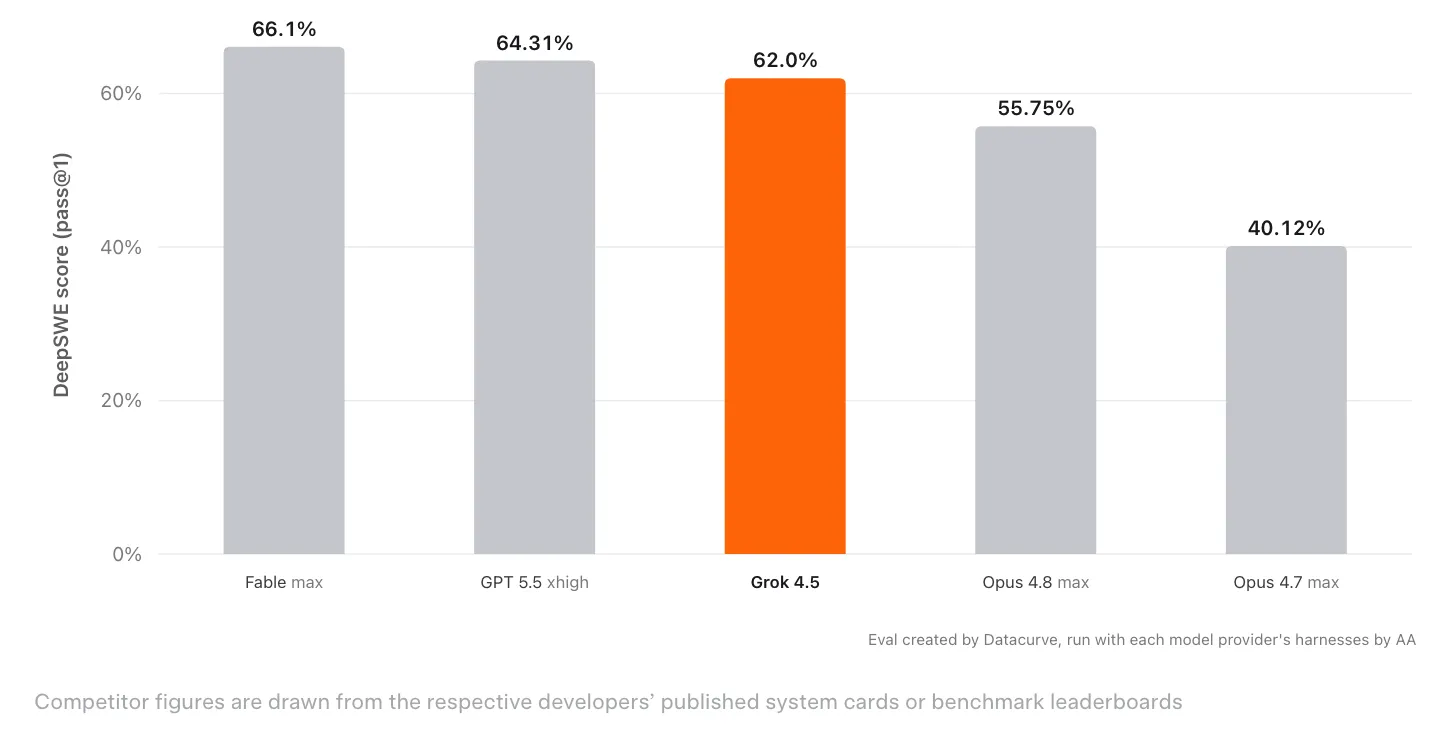
- Coding capabilities:
- SWE‑Bench Pro pass rate: 64.7% (Opus 4.8: 69.2%, though Grok 4.5 is more efficient)
- DeepSWE 1.0: 62.0% (ahead of Opus 4.8's 55.75%)
- Terminal‑Bench 2.1: 83.3% (comparable to Fable and GPT 5.5)
- Agentic tasks:
- Excels at multi‑step reasoning and tool calls, supporting autonomous planning for complex workflows.
- Demonstrates significant practical effectiveness in scenarios such as financial analysis, legal document handling and data science.
- Efficiency metrics:
- Token efficiency: average output for SWE‑Bench Pro tasks is about 15,954 tokens, roughly 1/4.2 of Opus 4.8.
- Response speed: p50 latency 0.81 seconds, throughput 94 tokens/s, comparable to or better than competitors.
- Context window: supports long‑context processing, suitable for large codebases and complex agent tasks.
- Pricing advantage:
- Input: $2 per million tokens
- Output: $6 per million tokens
- Significantly lower than Anthropic Opus 4.8 and OpenAI GPT‑5.5, offering strong cost‑effectiveness.
In real‑user tests, Grok 4.5 has been praised as a “workhorse for everyday tasks,” especially in coding and agent scenarios, validating its engineering practicality.
Strategic Significance: Vertical Integration and an Ecosystem Closed Loop
The release of Grok 4.5 highlights SpaceXAI's vertical‑integration advantages:
- Compute synergy: SpaceX provides massive compute support to accelerate model iterations.
- Data flywheel: Cursor developer data feeds back into training to create a positive loop.
- Application deployment: Directly serves internal needs at SpaceX and Tesla while opening access to developers, promoting wider adoption of AI coding tools.
This model reduces training and inference costs by closing the loop among compute, models and applications, strengthening long‑term competitiveness in AI.
Industry Impact: Reshaping the AI Coding and Agent Ecosystem
1. Impact on competitors
- Anthropic and OpenAI: Grok 4.5's pricing and advantages on some coding metrics may drain developer users and force competitors to adjust pricing or accelerate iterations.
- Overall market: It pushes AI models toward a “efficient + vertical” direction, lowering the barrier for enterprise adoption.
2. Impact on developers
- Productivity gains: Cheaper and faster coding agent tools could accelerate software development cycles.
- Ecosystem expansion: Deep integration between tools like Cursor and Grok creates a more complete AI development chain.
3. Impact on industry structure
- Vertical‑integration trend: More companies may emulate the SpaceXAI model and build their own AI stacks.
- Cost‑structure optimization: Lower inference costs will accelerate AI penetration across industries.
- Regulatory and safety considerations: The proliferation of high‑performance agent models will require strengthened safety alignment and ethical governance.
Outlook: Continued Iteration of the Grok Series
SpaceXAI plans to release new models monthly in 2026; Grok 4.5 is only the starting point. Future versions are expected to make further advances in multimodality, real‑time agents and enterprise‑grade security.
The release of Grok 4.5 is an important outcome of the xAI–SpaceX merger. It not only challenges leading models on performance but also explores new commercial approaches. Competition in the AI coding and agent era is entering a more intense new phase.
▶️ Enjoyed this article? Creating great content takes effort!
Subscribe to our YouTube channel:
AI Rosetta
Your likes, subscriptions and shares mean the world to us! 🙏
For more AI news, visit:
https://www.airosetta.com