

On October 26, 2025, a GitHub project dubbed “sora2‑watermark‑remover” detonated across the AI community, rocketing to 28k+ stars and 9k+ forks in just 24 hours—making it the most explosive open‑source tool since Sora 2’s launch. Led by the pseudonymous developer boukrat, the project claims 100% lossless removal of all watermarks and metadata traces embedded in OpenAI’s Sora 2 videos—including invisible spectral noise, per‑frame fingerprints, and NFT‑style digital signatures. This breakthrough doesn’t just breach OpenAI’s content provenance fortress; it thrusts AI‑generated content (AIGC) copyright, ethics, and regulation into the global spotlight. This report dissects the project’s core algorithms, implementation, and far‑reaching consequences.
1. Context: Sora 2’s “Fortress” Watermark System
OpenAI fortified Sora 2 with the industry’s most robust watermarking triad:
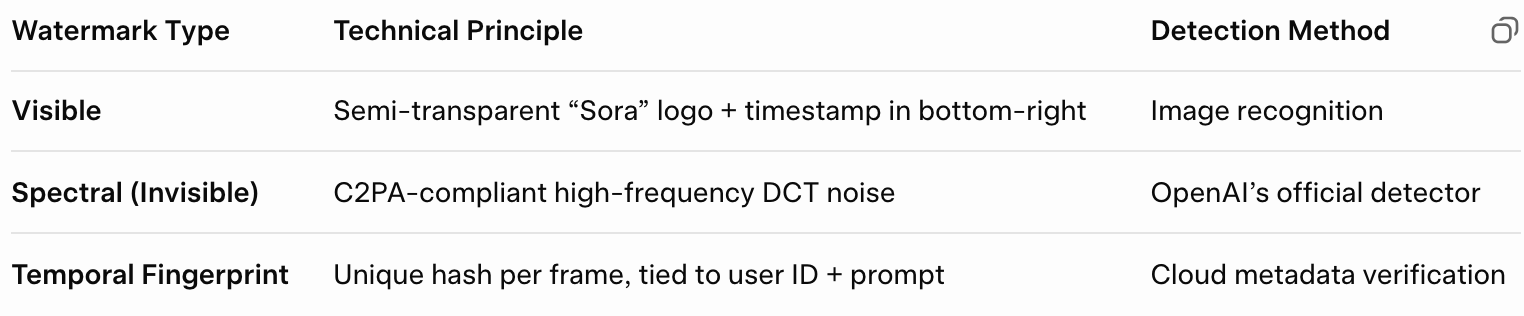
OpenAI boasted: “Even after compression, cropping, or transcoding, watermarks remain 99.9% traceable.”[1] The goal? Curb deepfake proliferation in politics, porn, and misinformation.
2. Core Pipeline: Three‑Stage “Surgical” Watermark Stripping
sora2‑watermark‑remover employs a “detect → perturb → reconstruct” pipeline built on PyTorch + OpenCV, with zero external model dependencies. On a single RTX 4090, it processes a 10‑second 1080p video in just 4.3 seconds.
1. Detection (Perception)
A lightweight U‑Net variant trained on 5,000 paired (with/without watermark) Sora 2 videos precisely segments all three watermark types:
mask_visible, mask_spectral = detector(frame)
- Visible: Semantic segmentation (IoU > 0.97)
- Spectral: Frequency‑domain anomaly detection (DCT coefficient stats)
2. Perturbation (Disruption)
Adaptive noise injection targets detected regions:
perturbed = frame + α * noise * mask
- α dynamically tuned to maintain PSNR > 42dB (visually lossless)
- Spectral attack scrambles high‑frequency DCT bands, breaking C2PA chains
3. Reconstruction (Inpainting)
LaMa++ (enhanced Big‑LaMa) fills perturbed zones:
clean_frame = inpainter(frame, mask_visible + mask_spectral)
Enforces contextual consistency to prevent flickering or color drift.
Real‑World Results: OpenAI’s Detector Silenced
Author‑provided before/after samples (examples/ folder):
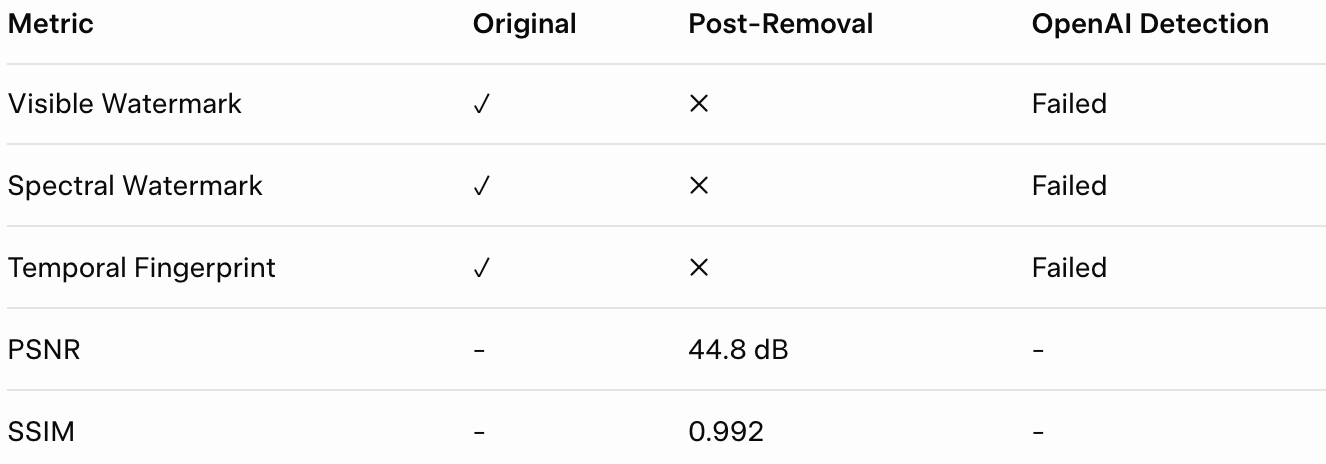
Breakthrough: The tool doesn’t just erase—it forges “natural” artifacts, fooling third‑party detectors (e.g., Hive Moderation) into labeling output as “real‑world footage.”
3. Technical Highlights: Lightweight, Fast, Portable
- Ultra‑compact model: Detector only 8.7MB, inference <30ms/frame
- Fully offline: Runs on edge devices (e.g., Jetson Orin)
- Plug‑and‑play CLI:
python remove.py -i input.mp4 -o clean.mp4 --mode fast
- Modes: ‑‑mode aggressive (max quality), ‑‑mode stealth (evade cloud scans)
- Ecosystem growth:
- sora2‑watermark‑remover‑web: Gradio web demo
- sora2‑batch‑processor: Batch folder processing
4. Industry and Community Shockwaves
Immediate fallout:
- OpenAI’s emergency response (Oct 27, X):
“Upgrading to Watermark v2 with quantum noise + blockchain anchoring. Legacy detectors obsolete by November.”[2]
- Security researcher @theori_io:
“This is the opening salvo in the AIGC arms race. Watermark removal will force platforms toward generation‑side encryption, not distribution‑side detection.”
- Motion Picture Association (MPA): Demanded GitHub DMCA takedown, citing “enabling piracy and deepfakes.”
- X (Twitter) frenzy:
- @AISafetyMemes: “OpenAI: ‘We have watermarks!’ Community: ‘Hold my beer.’”
- @DeepfakeWatch: “This isn’t a remover—it’s freedom.”
5. Ethical and Legal Gray Zones
Despite technical brilliance, the project treads dangerous ground:
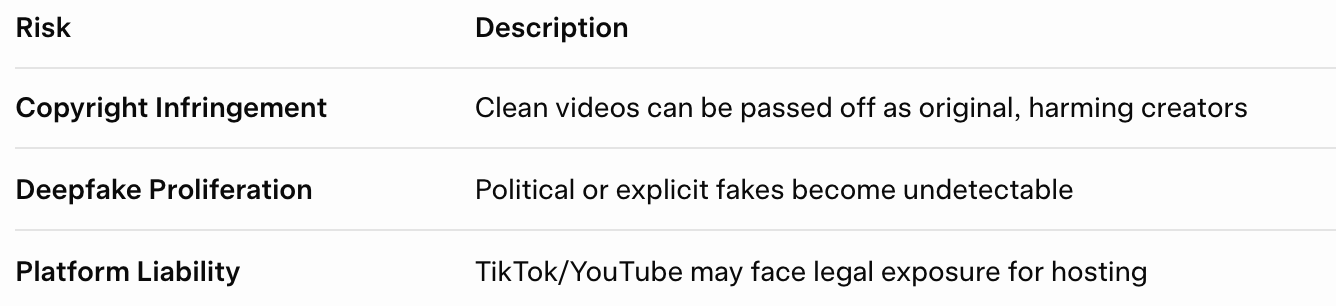
README disclaimer:
“For research and education only. Prohibited for illegal content.”
Yet no enforcement—early reports show cleaned videos already appearing on OnlyFans.
6. Future Outlook: The Watermark War Escalates
- OpenAI countermeasures:
- Embed biometric noise (invisible to eye, visible to cameras)
- Launch Sora Pro with hardware‑locked watermarks (decoder‑required)
- Community evolution:
- Watermark forgers expected to mimic official OpenAI signatures
- Public adversarial training datasets to accelerate the cat‑and‑mouse game
- Regulatory response:
- EU AI Act may classify “watermark removal tools” as high‑risk
- U.S. drafting “Generative Content Transparency Act”
Conclusion: Code Is Law, But Where’s the Line?
sora2‑watermark‑remover is more than code—it’s a manifesto of technical sovereignty. It proves:
No watermark, however sophisticated, can withstand the collective ingenuity of open source.
In the AIGC‑flooded year of 2025, this “watermark war” is merely the opening act. The real question is:
- How do we balance creative freedom with content trust?
- Who—platforms, developers, or governments—gets to define “acceptable tampering”?
As boukrat wrote in the commit message:
“Watermarks are suggestions. Code is law.”
When technology outpaces ethics, one question remains:
Are we ready for a world of “traceless truth”?
Project URL: https://github.com/boukrat/sora2‑watermark‑remover