
In 2026, AI agents have become a mainstream application of LLMs, and a variety of agents and skill libraries have emerged, laying a solid foundation for wider LLM adoption. At the same time, accumulating data from different skills consumes a large number of tokens, causing substantial waste. To address this pain point, in May 2026 a research team from The Chinese University of Hong Kong and the University of Florida published a paper on arXiv titled "Dynamic Skill Lifecycle Management for Agentic Reinforcement Learning", proposing a dynamic skill lifecycle management framework called SLIM (Skill Lifecycle Management). The framework targets limitations in external skill management in agentic reinforcement learning and, for the first time, treats the active skill set as a dynamic variable jointly optimized with policy learning, enabling intelligent retention, retirement, and expansion of skills. This work outperforms existing best baselines by an average of 7.1 percentage points on complex benchmarks such as ALFWorld and SearchQA, offering an important technical path toward more efficient and sustainable AI agents.
Motivation: Limitations of Existing Skill Management Paradigms
As LLM‑driven agents increasingly rely on external skills to complete complex tasks, current approaches face two core problems:
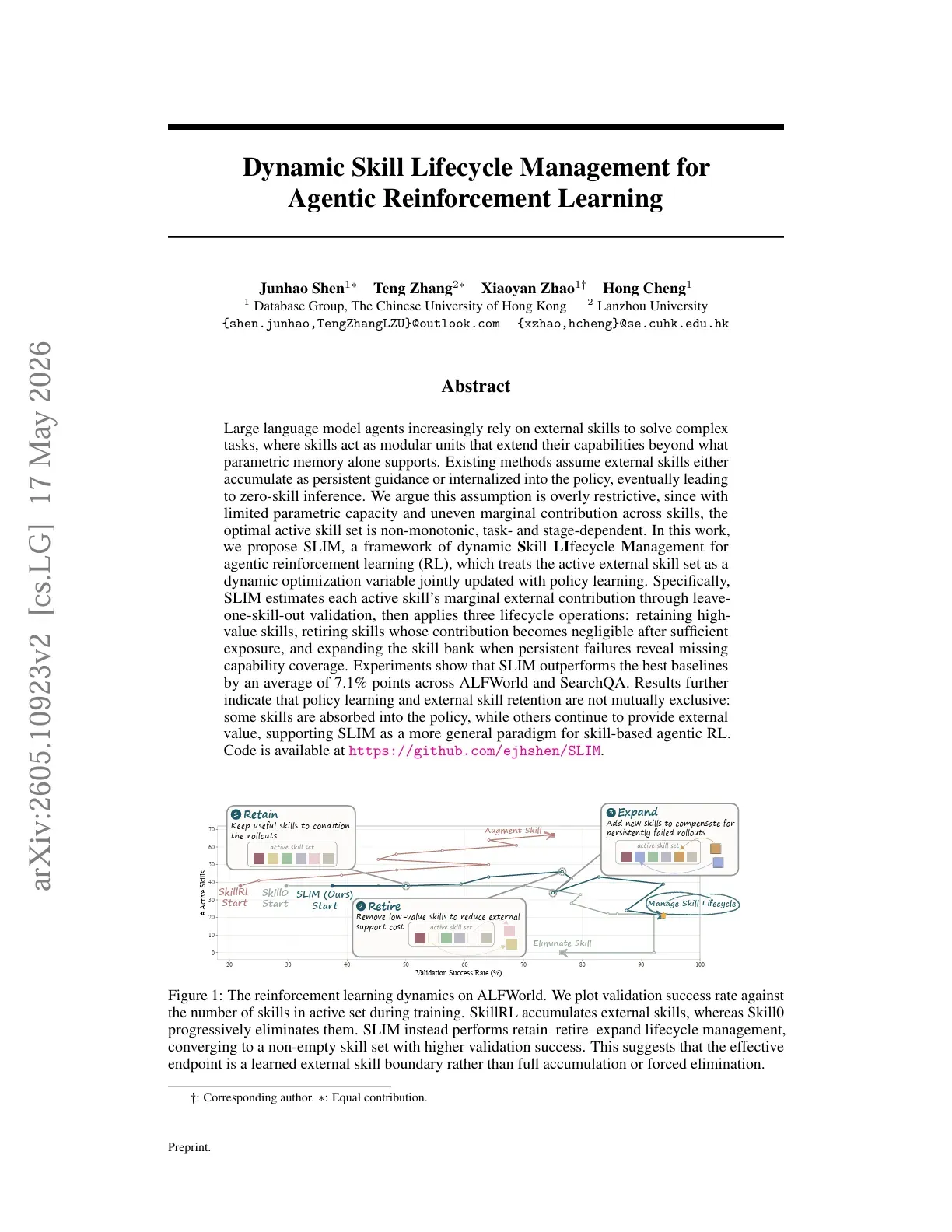
The first is the continuous accumulation paradigm (e.g., SkillRL): external skills only increase and never decrease, leading to overly long contexts, increased routing noise, and eventual performance degradation. The second is the gradual internalization paradigm (e.g., Skill0): skills are gradually absorbed into the policy until zero‑skill inference is achieved, but this overlooks that some skills retain high external value at certain stages.
The team argues these assumptions are too absolute. Under limited parameter capacity and uneven marginal contributions of skills, the optimal active skill set should be non‑monotonic, task‑dependent, and stage‑dependent. Existing methods struggle to dynamically balance "internalization" and "external invocation", causing agents to become inefficient or to degrade in capability on long‑horizon tasks.
SLIM is proposed to solve this core contradiction. It no longer treats the skill set as static or unidirectionally evolving, but as a dynamic variable jointly optimized with policy learning.
Core Principles of the SLIM Framework
The core innovation of SLIM is the introduction of a skill lifecycle management mechanism, which includes the following three key operations:
- Marginal External Contribution Evaluation — SLIM uses a Leave‑One‑Skill‑Out (LOSO) validation method: periodically remove a single skill and observe changes in policy performance to quantify that skill's marginal external value. This mechanism accurately identifies which skills are worth retaining and which can be internalized by the policy.
- Three lifecycle operations:
- Retain: Continuously keep high‑value skills for external invocation.
- Retire: Gradually retire skills whose contribution falls below a threshold after sufficient exposure, reducing context noise.
- Expand: Actively expand the skill library by introducing new capabilities to cover missing scenarios when the agent repeatedly fails.
- Joint optimization with policy learning — SLIM tightly couples skill lifecycle decisions with the reinforcement learning process (e.g., GRPO), achieving dynamic balance through periodic lifecycle audits. Experiments used Qwen3‑4B as the backbone policy model and were extensively validated on ALFWorld and SearchQA tasks.
The core idea of the framework is that skill management should not be a static rule set but a dynamic process co‑evolving with the policy.
Experimental Results and Comparative Analysis
The research team conducted comprehensive experiments on two representative benchmarks: ALFWorld (multi‑task household environment) and SearchQA (complex search QA):
- ALFWorld: SLIM improves by about 7.8 percentage points over the best baseline.
- SearchQA: SLIM improves by about 6.4 percentage points over the best baseline.
- Average improvement: 7.1 percentage points.
More importantly, results show that policy learning and external skill retention are not mutually exclusive: some skills were successfully internalized into the policy, while other high‑value skills remained available externally over the long term. This finding challenges the traditional binary thinking of "either fully internalize or fully externalize" and provides a more flexible paradigm for agentic RL.
Compared with baselines such as SkillRL (continuous accumulation) and Skill0 (gradual internalization), SLIM demonstrates significant advantages in long‑horizon task stability, computational efficiency, and final performance, especially in complex, multi‑step tasks requiring long‑term memory.
Significance and Future Directions
The SLIM framework has multiple important implications:
- It offers agentic RL a dynamic and interpretable new paradigm for skill management;
- It effectively mitigates computation overhead and noise caused by long contexts;
- It lays a technical foundation for future, more complex multi‑agent collaboration systems.
The research team has open‑sourced the SLIM implementation on GitHub to facilitate further community exploration. Future directions include extending SLIM to multi‑agent scenarios, combining it with larger backbone models, and exploring more efficient marginal contribution evaluation methods.
▶️ Enjoyed this piece? Creating it took real effort!
Follow our YouTube channel:
AI Rosetta
Your likes, subscriptions, and shares are our greatest support! 🙏
More AI news at: https://www.airosetta.com