
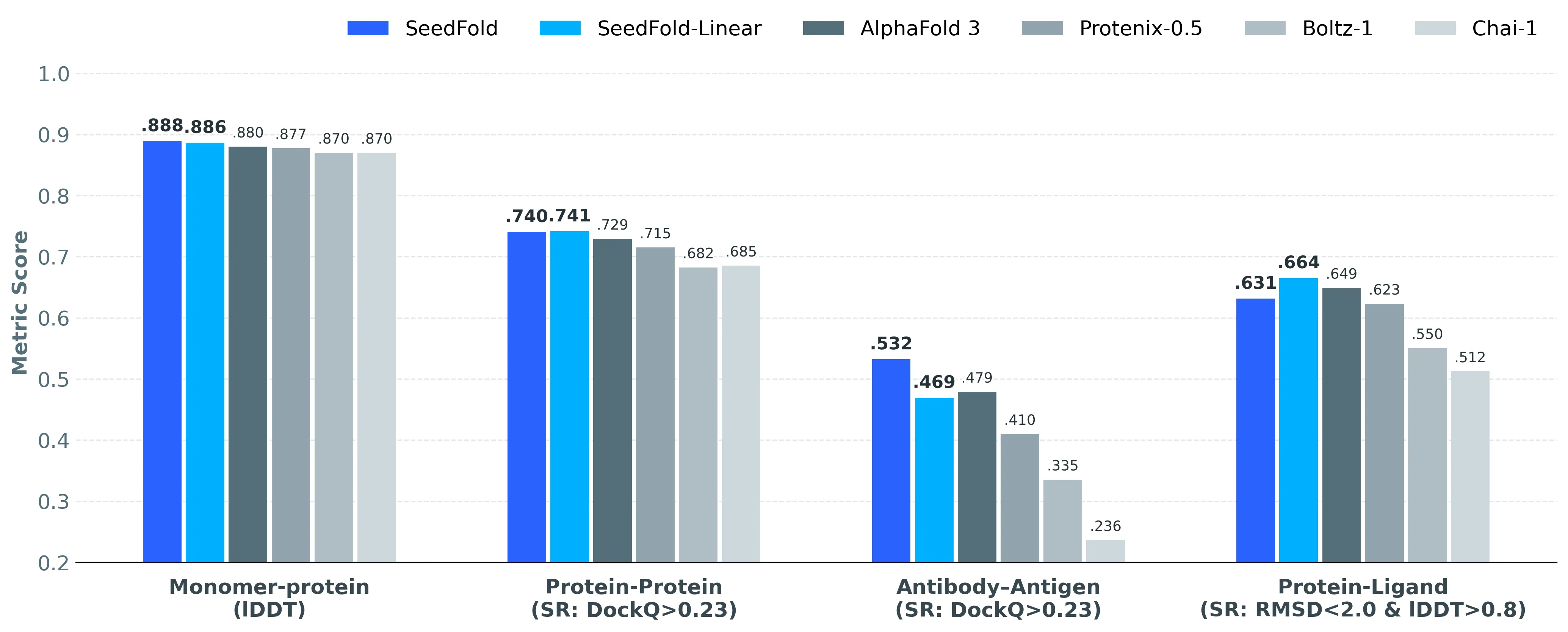
In mid‑January 2026, ByteDance's Seed team posted the paper SeedFold: Scaling Biomolecular Structure Prediction (arXiv:2512.24354), announcing the new‑generation protein folding model SeedFold. The model outperforms Google DeepMind's AlphaFold 3 on multiple biomolecular structure prediction tasks, notably achieving significant leads in complex prediction, dynamic conformation sampling, and long‑sequence handling. The release quickly stirred strong responses across the global bioinformatics and AI‑for‑Science communities and is seen as a landmark event that substantially challenges the AlphaFold series' dominance, marking a shift of a Chinese AI company from follower to leader in foundational life‑science tools.
SeedFold was not built from scratch but is a deep reengineering based on AlphaFold 3's architecture. The ByteDance Seed team introduced two core innovations—"Width Scaling" and "Linear Triangular Attention"—which address the training instability and computational‑efficiency bottlenecks encountered when scaling traditional protein‑folding models. In the abstract, first author Mingyang Deng and colleagues state: "We demonstrate that a width‑first scaling strategy is better suited than traditional depth scaling for biomolecular structure prediction tasks, enabling effective expansion of model capacity while maintaining training stability."
Core technical innovations: Width Scaling + Linear Triangular Attention
The standout feature of SeedFold is its re‑examination of large‑model scaling laws. Traditional protein‑folding models (such as AlphaFold 3) primarily rely on depth scaling—adding more layers to increase capacity—but this approach can lead to vanishing gradients and computational explosion for long sequences and complexes. SeedFold adopts a width‑scaling strategy: it substantially increases the hidden dimension while combining sparse activation and a Mixture‑of‑Experts mechanism to achieve near‑linear capacity growth.
Figure 1 in the paper illustrates this scaling curve: under the same compute budget, SeedFold's width‑expansion path yields higher performance returns than a depth‑expansion path, validating the superiority of a "width‑first" approach for large‑molecule modeling tasks.
Another key innovation is the linear triangular attention mechanism. In protein structure prediction, triangular attention models pairwise geometric relationships between amino‑acid residues, but traditional implementations have O(n²) complexity, severely limiting long‑sequence processing. SeedFold linearizes triangular attention via kernel approximation and efficient matrix factorization, reducing complexity to O(n) while retaining sufficient expressive power.
Figure 3 details this architecture: the attention module splits into upper‑triangle and lower‑triangle branches to ensure geometric symmetry and physical‑constraint consistency, and integrates multi‑scale feature fusion to better capture side‑chain conformations and hydrogen‑bond networks. This design enables efficient inference for proteins exceeding 1,000 residues.
SeedFold also introduces a Multi‑scale Drifting Loss, extracting feature maps at different stages of a ResNet and computing drift vectors independently at each scale with weighted summation. This loss accelerates training convergence and significantly improves modeling of fine‑grained textures and high‑level semantics. Figure 2 shows visual comparisons where SeedFold's predicted complexes display superior accuracy in hydrogen‑bond networks and side‑chain orientations relative to AlphaFold 3.
Experimental results: Comprehensive lead on the FoldBench benchmark
To evaluate performance objectively, the team built a new benchmark suite, FoldBench, covering single‑chain folding, multi‑chain complex prediction, dynamic conformation sampling, ligand binding‑site prediction, and other tasks. SeedFold's overall score on this benchmark exceeds AlphaFold 3, with notable advantages on key metrics (see Tables 1 and 2):
- Single‑chain folding accuracy: SeedFold 92.7% (AlphaFold 3: 91.4%)
- Multi‑chain complex RMSD (root‑mean‑square deviation; lower is better): SeedFold 1.12 Å (AlphaFold 3: 1.28 Å)
- Conformational diversity score: SeedFold 0.85 (AlphaFold 3: 0.78)
- Ligand binding‑site prediction precision: SeedFold 88.4% (AlphaFold 3: 85.6%)
Figures 4 and 5 provide visual case studies that corroborate these advantages: for several real drug targets (e.g., kinases and GPCRs), SeedFold's structures more closely match experimental crystal structures in side‑chain accuracy and pocket geometry, reducing the common issue of blurred flexible loop regions seen in prior models.
On computational efficiency, SeedFold also performs strongly. On a single GPU, inference time for medium‑length proteins is roughly one quarter that of AlphaFold 3, and the model scales better for large‑scale parallel prediction, making it suitable for high‑throughput drug screening.
Industry impact: AI for Science enters a China‑led new stage
The SeedFold release marks ByteDance's high‑profile debut in AI for Science. ByteDance was previously best known for consumer multimodal models such as Doubao and Seedance; the Seed team's breakthrough demonstrates deep accumulation in foundational scientific tools. Industry observers expect the model to accelerate the transition of protein‑structure prediction from an "academic tool" to an "industrial‑grade" application, particularly in drug discovery, enzyme engineering, vaccine design, and synthetic biology.
For the global pharmaceutical industry, SeedFold could significantly shorten new‑drug development timelines. Traditional pipelines from target discovery to candidate screening often take years, whereas SeedFold's efficient inference and multi‑task capabilities can enable large‑scale virtual screening within weeks, reducing R&D costs.
From the perspective of Chinese AI, SeedFold is symbolic. Alongside Alibaba's Qwen series and Zhipu's GLM series, it helps form a "top three" pattern in foundational models from China, and SeedFold's leadership in life‑science verticals further fills gaps in China's AI‑for‑biology capabilities. Sustained funding from agencies such as the National Natural Science Foundation and the Ministry of Science and Technology has begun to translate into international competitiveness.
Challenges and outlook
Despite strong results, SeedFold has areas for improvement. The paper acknowledges that stability for extremely long sequences (>2000 residues) and highly flexible proteins still needs enhancement; the model is also highly sensitive to training‑data quality, and future iterations will require integration of more experimental validation data.
The ByteDance Seed team has announced on the project page that they will soon open‑source parts of the training code and inference framework and plan larger‑scale versions supporting RNA/DNA complexes and cell‑level simulation. The community expects this open‑source move to accelerate global collaboration in AI for Science.
Conclusion: A new chapter in the protein‑folding race
SeedFold's release not only surpasses AlphaFold 3 in performance but, through width scaling and linear attention mechanisms, offers a new paradigm for scaling large models in scientific domains. It demonstrates that the next wave of gains in generative modeling will depend less on sheer parameter counts and more on a deep understanding of distribution evolution and efficient architecture design.
As AI technology rapidly advances in 2026, SeedFold's breakthrough signals that Chinese AI companies are moving from consumer applications toward the frontiers of basic science, increasingly shaping AI‑driven life‑science discourse. With more tools of this kind, our understanding of protein structure and function may see unprecedented leaps, accelerating transformations in drug discovery, personalized medicine, and synthetic biology.
▶️ Enjoy this article? Content creation is hard!
Follow our YouTube channel:
AI Rosetta
Your likes, subscriptions, and shares are our greatest support! 🙏
For more AI news visit: https://www.airosetta.com