
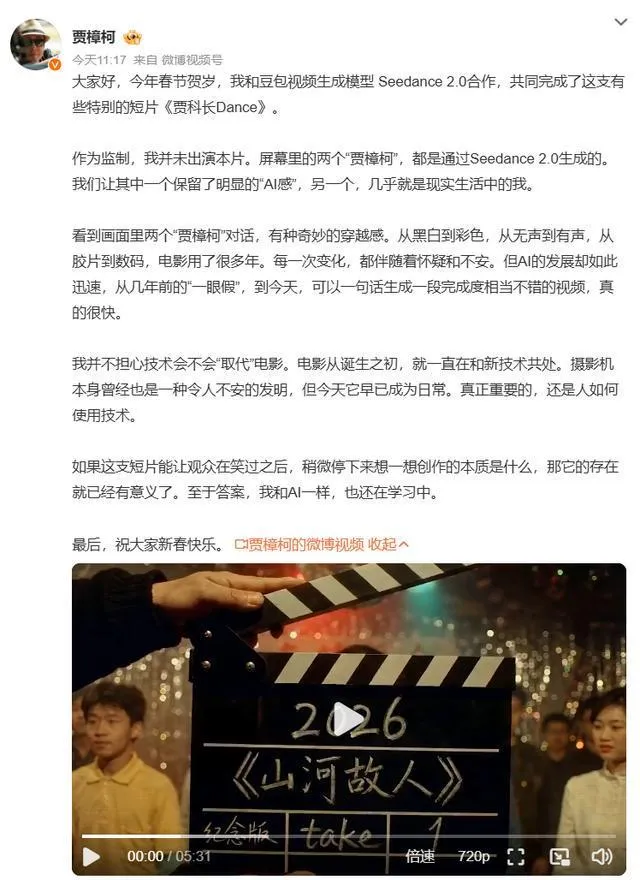
 Late on the night of February 16, 2026, coinciding with the 10th anniversary release and rebroadcast of the film "Mountains May Depart", China’s renowned director Jia Zhangke posted on social media: "Seedance 2.0 is indeed impressive, I’m going to use it to make a short film." The remark quickly went viral, marking the realist sixth‑generation director’s formal entry into AI video creation and signaling that ByteDance’s multimodal AI video generation model Seedance 2.0 has earned recognition from professional filmmakers.
Seedance 2.0 began internal testing on February 7 and was officially released on February 12. Developed by ByteDance’s Seed team, it adopts a unified multimodal audio‑video joint generation architecture and supports text, image, audio and video inputs, allowing up to nine reference images, three videos and three audio clips simultaneously. The model reaches industrial‑level standards in character consistency, audio‑visual synchronization, multi‑shot camera movement and physical realism, with notable improvements in generation quality and controllability, making it suitable for professional scenarios such as film, advertising and e‑commerce. Jia Zhangke subsequently supervised the New Year short "Jia Kezhang Dance", in which two versions of "Jia Zhangke" appear—one retaining an obvious AI quality and the other nearly identical to the real‑life director—becoming an emblematic case of dialogue between AI and realist cinema.
The emergence of Seedance 2.0 instantly pushed the film industry to a crossroads of "AI vs. tradition." Is it a nightmare for traditional cinema, or a catalyst for the industry’s rebirth? This question has become a shared challenge for directors, producers, actors and tech practitioners.
Technical breakthrough: from "experimental toy" to "industrial‑grade tool"
The core of Seedance 2.0 lies in its native audio‑video joint generation architecture, which generates sound and image synchronously rather than producing video first and dubbing later, ensuring high consistency among lip movement, actions and sound. The model supports extremely realistic audiovisual effects, high physical accuracy, and can faithfully reproduce complex interactions and motion scenes. At the same time, it offers one of the industry’s most comprehensive multimodal reference and editing capabilities: users can control character appearance, performance style, camera language, and even lighting and ambient sound through reference materials, enabling a "director‑like" generation experience.
Official data show that, compared with Seedance 1.5, version 2.0 has greatly improved availability in complex scenarios, and its generation quality, realism and controllability all meet professional production requirements. It is currently available on platforms such as Jimeng AI, Doubao App and the Volcano Ark experience center, supporting high‑quality multi‑shot 15‑second outputs suitable for 1080p film‑level content creation.
Jia Zhangke’s short is a vivid demonstration of this capability. As producer, he did not appear personally but used Seedance 2.0 to generate two highly realistic versions of himself and set the story within the time‑space background of "Mountains May Depart", exploring questions of artistic ownership and technological boundaries. Jia later wrote: "I am not worried about technology ‘replacing’ cinema; what really matters is how people use technology." His stance reflects the realist director’s openness and caution toward new tools.
Nightmare argument: traditional film ecology faces disruption
For many practitioners, the arrival of Seedance 2.0 is nothing short of a "technological tsunami." Traditional film production relies heavily on human labor: screenwriters, directors, cinematographers, actors, editors and VFX teams collaborate in layers, producing high costs and long cycles. The arrival of AI video generation models may automate many of these links.
First is the employment impact. Low‑cost AI tools can rapidly produce storyboards, effects and even complete short films, likely compressing the market for VFX companies, post‑production teams and extras. Internationally acclaimed director Christopher Nolan has publicly expressed concern that AI could "destroy the soul of cinema," arguing that overreliance on generative tools could weaken human narrative depth. Domestic directors have bluntly asked: "If AI can generate a film in a day, what value remains for traditional crews?"
Second is the crisis of copyright and authenticity. Seedance 2.0 supports using real‑person material as references (requiring the person’s verification or authorization), but as technical thresholds drop, the risk of deepfake abuse rises. Disputes over celebrity portrait rights and intellectual property could intensify. A deeper issue is the collapse of "authenticity": when audiences cannot distinguish AI‑generated from live‑shot content, the credibility of documentaries and news films may be challenged, and the cultural status of cinema as an art form could be unsettled.
Finally, there is a worry about creative decline. AI excels at imitating existing styles but struggles to truly innovate. Jia Zhangke’s realist aesthetics stem from long‑term observation of reality and humanistic concern; if creators over‑rely on AI’s instant results, will they lose sensitivity to life? Some industry voices fear AI could push film creation toward "fast‑food" culture, where outstanding works are drowned by a flood of low‑quality content.
Rebirth argument: AI empowers a new era for film
Countering the "nightmare" view, many see Seedance 2.0 as a catalyst for the film industry’s rebirth. It significantly lowers creative barriers and makes "anyone can be a director" closer to reality.
For independent filmmakers and small teams, Seedance 2.0 represents a cost revolution. Traditional short film production can cost tens of thousands, while AI generation can cut budgets by over 90%, allowing creators to focus energy on story, emotion and aesthetic expression. Jia’s short is an example: he retained a strong personal style while exploring the philosophical boundary between "the real and the generated." This did not weaken his authorship but expanded expressive possibilities.
For commercial filmmaking, AI will accelerate industrial workflows. High‑cost elements such as VFX shots, virtual environments and crowd scenes can be handled efficiently by AI, enabling producers to allocate resources to script refinement and actor performances. ByteDance emphasizes that Seedance 2.0 is "deeply adapted to industrial content creation" and has provided significant efficiency gains for film, advertising, e‑commerce and gaming scenarios. In the future, AI may spawn new narrative forms: interactive films, personalized endings and real‑time generated storylines, shifting audiences from passive viewers to active participants.
More importantly, AI and human creativity can be symbiotic. Jia’s statement that he is not worried about replacement but about "how to use it" represents the attitude of mature creators: AI is a tool, not a replacer. Just as digital photography did not end cinema after replacing film stock, but led to new classics, Seedance 2.0 may eliminate inefficient production methods and free creators who truly have stories to tell, transforming the industry from "resource‑intensive" to "creativity‑intensive."
Industry reaction and regulatory outlook
Jia Zhangke’s involvement triggered a chain reaction. Luo Yonghao reposted and commented: "Next, making a movie will only require one director." Many young directors say they will try AI‑assisted creation but emphasize that "AI can never replace human insight into life." Internationally, models such as OpenAI Sora 2 and Google Veo 3 have sparked similar debates, and the industry generally expects AI to reshape rather than destroy the film ecosystem.
However, challenges remain. ByteDance has restricted the public version of Seedance 2.0 from using real‑person images/videos as primary references without the person’s verification or authorization to prevent misuse. Going forward, global regulators may introduce stricter standards on AI content labeling, watermarking and ethics. China’s Interim Measures for the Administration of Generative Artificial Intelligence Service have already drawn regulatory boundaries for the industry, and related rules are expected to be further refined.
Conclusion: coexistence, not replacement
The arrival of Seedance 2.0 is both a "technical earthquake" and a "creative rebirth" for the film industry. It will not destroy traditional film overnight, but it will accelerate natural selection: inefficient, process‑dependent productions will be phased out, while creators with real stories, emotions and unique perspectives will gain unprecedented freedom.
Jia Zhangke’s actions provide an answer: in the AI era, the core value of a director has not changed—to tell the stories of the times well. Seedance 2.0 may make "anyone a director," but only those who truly understand cinema can make works that move people.
The film industry stands at a crossroads. Nightmare or rebirth, the answer lies in the hands of every creator. 2026 may well be the inaugural year of genuine collaboration between AI and human filmmakers.
▶️ Like this article? Creating content is hard!
Follow our YouTube channel:
AI Rosetta
Your likes, subscriptions and shares are our greatest support! 🙏
More AI news at: https://www.airosetta.com