

In an age of information explosion, the torrent of data facing humanity is less a readily accessible "treasury" and more an "information landslide"—hard to distinguish truth from falsehood, highly fragmented, and blocked by high cross‑domain barriers. Traditional platforms like Wikipedia are broad but static and English‑dominated; ArXiv is detailed but focuses on final results and pays less attention to process reconstruction and cross‑validation; xAI's Grokipedia, despite ambitious aims to reshape encyclopedias with AI, received mixed reactions after launch and has not effectively solved pain points in scientific communication such as dynamic updates and verifiability. On October 28, 2025, China‑based DeepModeling, together with the Beijing Academy of Science Intelligence, the Institute of Theoretical Physics of the Chinese Academy of Sciences, Lanzhou University, Peking University, Shanghai Jiao Tong University, the International Alliance for Scientific Intelligence and the DeepModeling open‑source community, made a new attempt: formally launching SciencePedia, a dynamic scientific knowledge base built around "thought chains." This project is more than an "AI encyclopedia" — it is a "knowledge operating system with signs of life" capable of thinking, evolving and connecting, helping users move from "knowing answers" to "understanding processes" and revealing hidden links between knowledge. This article, based on authoritative sources including Qubit (量子位), the Bohrium website, the GitHub repository, 36Kr comparative analysis and the CB Insights 2025 AI report, analyzes SciencePedia's technical architecture, functional mechanisms, and differences from Wikipedia, ArXiv and Grokipedia, and explores its revolutionary potential in the AI for Science field.
Project Background: Filling the "Black Hole" in Scientific Knowledge Communication
SciencePedia was born from a deep reflection on existing knowledge platforms. Qubit noted that while the internet has made knowledge accessible, it has amplified distortion in dissemination: Wikipedia excels at mainstream presentation but is weak in cross‑application and the Chinese ecosystem; ArXiv is detailed on conclusions but overlooks the discovery process; AI assistants like ChatGPT are good at quick responses but shallow retrieval struggles to build systematic cognition. Elon Musk's Grokipedia aimed to rewrite the encyclopedia with xAI's Grok model, emphasizing real‑time updates and AI generation, but 36Kr reported that its fast content generation often produced "hallucinations" and factual deviations, failing to win full trust from the academic community. SciencePedia therefore emerged, led by DeepModeling in collaboration with institutes such as the Institute of Theoretical Physics of the Chinese Academy of Sciences, to build a "scientific knowledge universe"—a dynamic graph framed by disciplines with knowledge points as the smallest units. Project goals: reshape the rigor, openness and consensus of scientific knowledge; provide explorers with a "scientific navigator"; generate personalized "learning paths" to guide users to the frontier.
The v1.0 version of SciencePedia is now online, covering 200+ disciplines, a 4 million‑entry thought‑chain knowledge base, 40,000 coarse‑grained chapter pages, 200,000 fine‑grained knowledge points, and over 100,000 exercises. It is not a static database but an "evolvable" cognitive infrastructure that supports AI for Science and enables autonomous research innovation. The GitHub repository shows the project is open source (MIT license) and emphasizes "knowledge boundaries, structure and verification mechanisms."
Technical Architecture: A Thought‑Chain Driven "Dual‑Engine" Evolution System
The core of SciencePedia is a ternary architecture of "long thought chains + inverse thought‑chain search + human–machine collaborative evolution," addressing the human‑knowledge shortfall of missing processes.
1. Long thought chains: restoring the "living fossils" of scientific discovery
Traditional encyclopedias like Wikipedia list conclusions only; SciencePedia replays the process using "thought chains." Based on a 4 million‑entry knowledge base of chains generated by large language models, it reasons from first principles: for example, a query on "quantum entanglement" will not only define the term but trace back to the EPR paradox, the derivation of Bell's inequalities, experimental validation paths, and onward to quantum computing applications. This addresses a flaw in human corpora: records are often results‑focused and neglect chains of reasoning. SciencePedia uses AI to extract, rewrite and self‑check so that each chain is traceable and verifiable. The GitHub README emphasizes that this "re‑enactment of thinking" lets learners "experience the full discovery process" rather than passively accept conclusions.
2. Inverse thought‑chain search: a cross‑disciplinary "invisible connector"
SciencePedia builds a "deep logical network" to achieve concept‑level associations: a query for "topological insulator" links condensed‑matter physics fundamentals, materials fabrication, mathematical topology and quantum devices. This differs from ArXiv's linear search by "reverse tracing": it backtracks from a problem to its premises and downstream impacts to reveal "cross‑disciplinary inspirations." Bohrium's site demonstrates that this navigation turns "serendipitous discovery" into "systematic prediction," suitable for frontier research exploration.
3. Human–machine collaborative evolution: a breathing mechanism for knowledge
AI handles automated workflows (collection, filtering, verification) while the expert community arbitrates and expands content. After new papers are published, the system automatically identifies related or conflicting items and updates via community voting—"AI at scale, experts as gatekeepers." The GitHub supports PR contributions: visitor mode (fork‑edit‑submit) and developer mode (branch PR), with community roles including members (feedback), contributors (editing) and committees (arbitration). Transparent mechanisms ensure full openness, and citation relationships are coming soon.
The foundation is a "first‑principles" database: reasoning from zero, verifying scientific facts and mining associative links. The paper "Inverse Knowledge Search over Verifiable Long Chain of Thoughts" (GitHub link) details the algorithm: combining Long CoT reasoning with inverse inference to achieve verifiable search.
Features and Applications: A Full‑Chain Closed Loop from Learning to Innovation
SciencePedia covers 200 disciplines, 240,000 knowledge points and 100,000 exercises, supporting personalized pathways.
Learning scenarios:
- Dynamic planning: an AI study companion customizes curricula based on prerequisites, such as "Foundations of Quantum Mechanics."
- Interactive explanation: highlight‑and‑ask lets the AI provide multi‑angle explanations, examples, or "alternate approaches."
- Practical closed loop: each point is paired with classic exercises and the AI unfolds the problem‑solving thought chain.
Research applications:
- Knowledge maps: generate panoramic views to identify frontiers and focal points.
- Inverse search: discover cross‑domain links, e.g., connecting "topological insulators" to quantum computing.
- Innovation pathways: systematically construct interdisciplinary research and predict inspirations.
Bohrium's demonstrations show a user searching "backpropagation" receives vivid scenario explanations plus exercises, far surpassing Wikipedia's static entry. X posts note user praise for "thought‑chain visualization making learning engaging."
Comparison with Wikipedia, ArXiv and Grokipedia: A Cognitive Leap from Static to Dynamic
SciencePedia is not a simple copy but an optimization targeting pain points. The following comparisons are based on reports from 36Kr, NPR, PBS and MoneyControl.
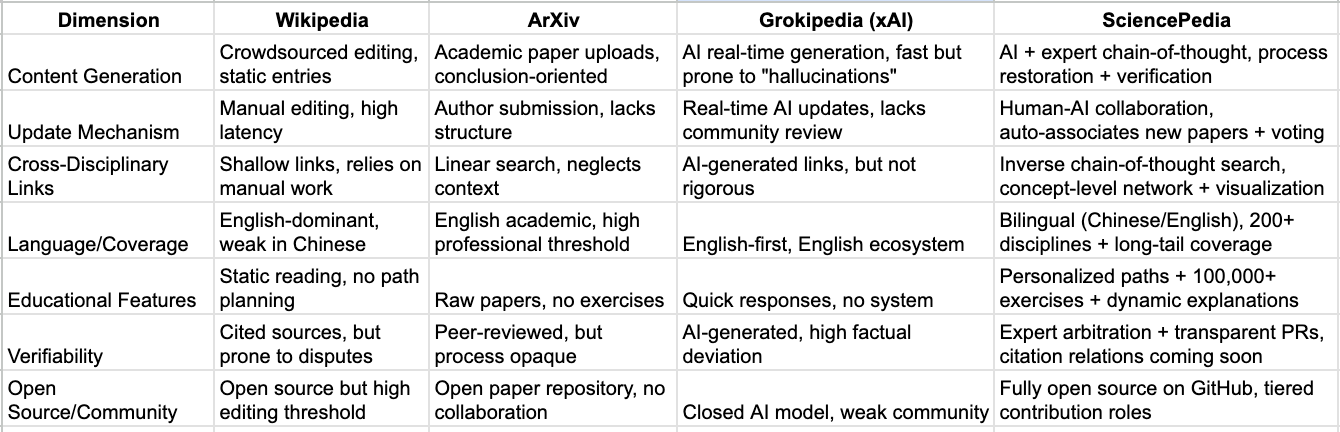
Key differences:
- vs Wikipedia: Wikipedia aggregates mainstream content while SciencePedia excels in dynamic graphs and thought chains; Wikipedia's English ecosystem is strong, whereas SciencePedia is bilingual (Chinese and English) and fills long‑tail scientific gaps.
- vs ArXiv: ArXiv focuses on conclusions; SciencePedia reconstructs processes and builds "discovery chains."
- vs Grokipedia: Grokipedia is real‑time but prone to hallucination (NPR noted edit histories are visible but users cannot modify), while SciencePedia emphasizes rigorous evolution with community governance.
Community and Open Source: Co‑building a "Scientific Knowledge Universe"
SciencePedia is open source under the MIT license. Contribution paths include visitor forks and PRs or developer branch submissions. Roles are layered: members for feedback, contributors for editing, committees for arbitration, and technical developers for innovation. Future plans include automated updates, a global community and citation relationship integration. X posts show the Bohrium team promoting "open‑source science and visualized thought chains," hailed as a "new benchmark for AI encyclopedias."
Outlook: From Tool to Cognitive Infrastructure
SciencePedia's vision is a complete system for each discipline, a personalized path for every person, and automatic integration of each frontier. Through collaboration with universities, it aims to create new ways of acquiring knowledge. In the AI for Science wave, CB Insights predicts the AI education market could reach $50 billion by 2025. SciencePedia may become a "scientific operating system," but challenges include scaling the community and governing AI hallucinations.
In short, SciencePedia centers on thought chains to construct an evolving knowledge network, surpassing static encyclopedias and leading dynamic cognition — a promising new experiment. For more information, visit https://www.bohrium.com/sciencepedia to begin your scientific exploration.