
On December 20, 2025, San Francisco experienced a major power outage that left roughly 30% of the city in the dark and affected more than 130,000 households. The incident not only exposed the fragility of urban infrastructure but also highlighted differing performances of autonomous driving systems under extreme conditions: Alphabet's Waymo robotaxis collectively stalled, creating traffic jams, while Tesla's Full Self‑Driving (FSD) system demonstrated greater adaptability and continued operating. The contrast has prompted industry debate over autonomous system design philosophies, emphasizing trade‑offs between autonomy and reliance on external systems.
The outage originated from a fire at Pacific Gas & Electric (PG&E)'s substation at Eighth and Mission streets. Around 7 p.m. that evening the blaze triggered a cascading loss of service that quickly cut power to neighborhoods including Sunset, Richmond, Haight‑Ashbury, Pacific Heights and the Presidio. By Sunday afternoon nearly 19,000 households remained without power, with full restoration expected by Monday afternoon. Mayor Daniel Lurie urged residents to avoid travel, and law enforcement was deployed to manually direct traffic to ease the chaos caused by darkened signals. The episode tested the resilience of San Francisco as a major testing ground for autonomous vehicle companies such as Waymo and Tesla.
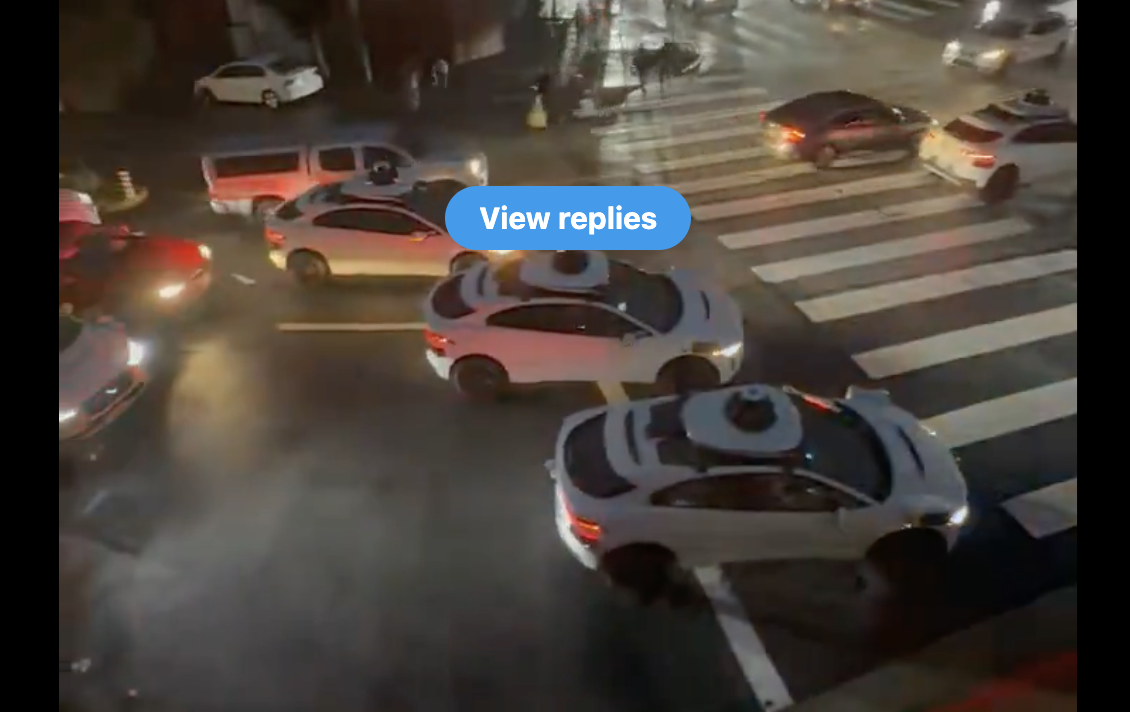
Waymo's robotaxis were among the first affected. Waymo vehicles rely on a suite of sensors—including LiDAR, cameras and radar—to build environmental maps, but their system design also integrates heavily with external infrastructure such as traffic signals and wireless traffic data. When signals fail, Waymo vehicles default to an all‑way stop behavior, requiring a full stop and observation before taking the right of way. However, given the scale of the outage, vehicles spent extended periods confirming intersection status and ended up collectively "stalling." Witness videos showed queues of 2–6 Waymo cars blocking lanes at intersections in Mission (such as 16th and Guerrero) and at Divisadero and McAllister, hazard lights flashing but unable to proceed. Social media was filled with derisive comments—"Waymo shut down and clogged the streets during the blackout 😂😂😂"—reflecting public frustration.
Waymo spokesperson Suzanne Philion said the approach prioritized passenger safety and keeping emergency routes clear, but did not provide detailed technical explanations. Experts noted the company may lean on remote assistance; when cellular networks are unstable vehicles can enter conservative modes to avoid potential risks. Professor Matthew Wansley commented, "The technology is supposed to handle communication delays or outages, but remote intervention may be more critical than we thought." As a result, Waymo suspended ride‑hail service in the Bay Area at about 8 p.m. that night and did not resume until Sunday at 3:30 p.m. While there were no reported injuries or accidents, the incident caused traffic congestion and tow crews removed vehicles overnight. City officials expressed concern and urged Waymo to pause operations to relieve pressure on roadways.
By contrast, Tesla Robotaxis and FSD‑equipped vehicles continued to traverse intersections with no signal. Tesla CEO Elon Musk posted on X that "Tesla Robotaxi was not affected." User‑shared videos showed Tesla vehicles making left turns or proceeding straight through darkened intersections without intervention. This advantage stems from Tesla FSD's design philosophy: it primarily relies on onboard hardware—cameras, ultrasonic sensors and neural network processors—and largely avoids dependence on external signals. FSD uses a vision‑first, end‑to‑end learning model that mimics human driving behavior, treating a dark signal as a stop sign and making decisions based on real‑time observation of other traffic. Unlike Waymo, Tesla reduces the risk posed by network outages by minimizing remote dependencies.
Technically, Waymo adopts a multimodal perception stack that integrates LiDAR for precise 3D mapping, but that approach also increases dependence on high‑definition maps and real‑time data updates. During the outage, missing signals and potential cellular interference amplified that vulnerability. Tesla pursues a pure‑vision path, training models to handle ambiguous scenarios—such as unlit intersections—by iterating on millions of miles of fleet data. On Reddit, users noted Waymo generates vast amounts of data daily in San Francisco, while Tesla's FSD appears more robust when infrastructure fails. Nonetheless, Tesla is not flawless: FSD remains under supervision in many contexts and has been controversial in complex urban environments.
The incident is a wake‑up call for the autonomous driving industry. Waymo's stoppage underscored the risks of overreliance on external systems, particularly in cities prone to disasters. Experts call for greater system autonomy, such as integrating backup power and smarter decision algorithms. Tesla's performance drew praise but also regulatory concern: is FSD's treatment of dark signals sufficiently safe? The California Public Utilities Commission (CPUC) could use the episode to reassess permitting standards. Broadly, the outage highlights challenges in moving from testing to large‑scale deployment: Waymo operates hundreds of vehicles in San Francisco, while Tesla Robotaxi remains in more limited pilots.
Looking ahead, the industry will need to balance innovation with reliability. Waymo said it will learn from the event to improve system resilience. Tesla continues to push FSD updates aimed at achieving full hands‑off operation. The blackout is more than a technical incident—it is a snapshot of the evolving autonomous driving ecosystem and a reminder that preparedness for uncertainty must accompany the pursuit of efficiency.
▶️ Enjoy this story? Creating content is hard work!
Follow our YouTube channel:
AI Rosetta
Your likes, subscriptions and shares are our greatest support! 🙏
For more AI news visit:
https://www.airosetta.com