
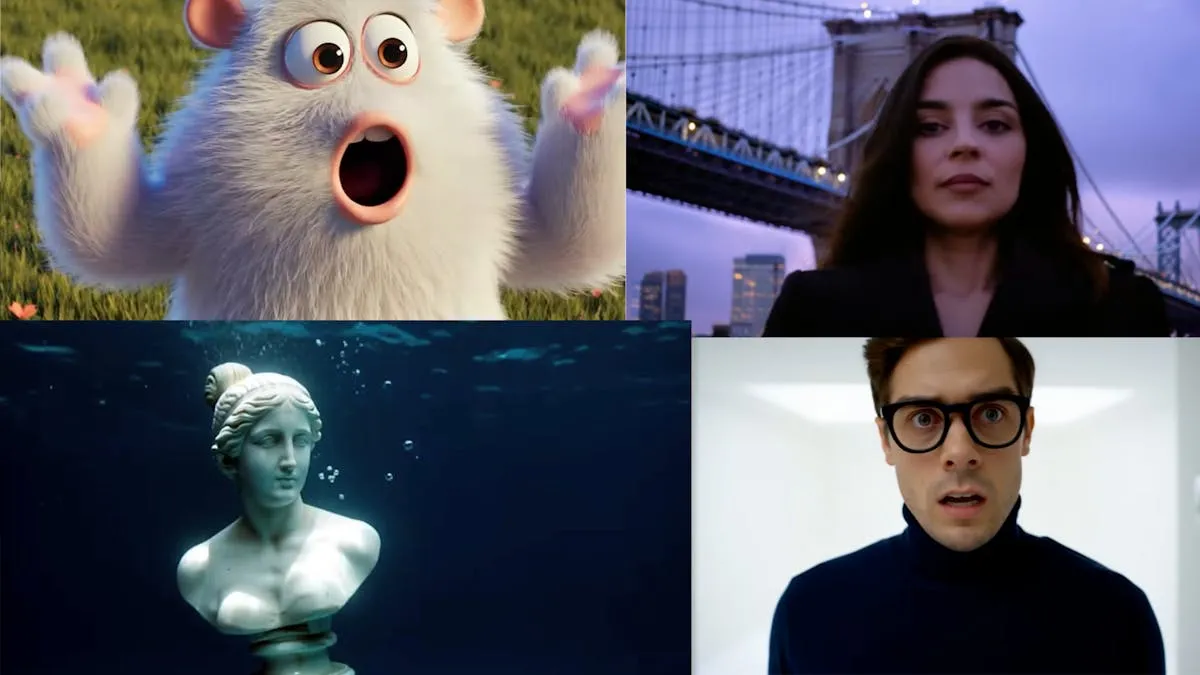
A recent report by The Information reveals that AI startup Runway has released its latest model, Gen‑4.5, which can generate smooth short videos with consistent lighting and shadows from a single still image. In internal and external tests, the company found that many participants in blind trials could not reliably distinguish real‑shot video from clips synthesized by Gen‑4.5.
The report describes the generation quality in detail: the model can maintain facial expressions, head turns and continuity of environmental lighting; the generated motion paths and camera‑angle changes connect naturally. Distortions appear occasionally, mostly during extreme expressions or complex background transitions. Samples shown to The Information span portraits to street scenes, with some clips lasting several to a dozen seconds, and even after compression and noise processing these short videos still conveyed a high degree of realism.
More worryingly, Runway’s tests included existing deepfake detection tools. The report states that some mainstream detectors behaved inconsistently when faced with Gen‑4.5 outputs, sometimes labeling AI‑generated videos as “real” and at other times misclassifying real footage as “synthetic.” Runway’s internal researchers therefore warn that current automated detection systems show clear weaknesses against the new generation of models.
The report goes beyond technical showcase. Multiple interviewed policy researchers and security experts noted that the ability to produce realistic short videos from a single image—especially when tools are accessible and generation is fast—would significantly lower the threshold for creating targeted deepfake content. The Information cites comments from those responsible for platform content moderation and election security, warning that the technology could be used to produce political messaging, extortion material or misleading news clips.
In response to these risks, Runway said in a release it will pursue both detectability improvements and accountability measures: proposals include embedding watermarks (including approaches aimed at being detectable by tools), collaborating with third‑party detection organizations, and providing researchers with access for broader evaluation. The report cautions, however, that vendor‑provided detection or watermarking cannot fully eliminate the potential for abuse, particularly if open‑source or commercialized versions spread across ecosystems, making tracking and provenance more difficult.
On the technical side, Gen‑4.5’s advances stem from stronger motion modeling and improved single‑frame semantic understanding. The article cites examples of improvements in skin detail, lighting consistency and handling of camera micro‑movements (camera jitter), while noting the model still has flaws with extreme actions and complex mappings such as reflections and transparent objects—flaws that may provide short‑term angles for detection algorithms.
The Information frames the story around the tension between technical progress and real‑world risk: on one hand, generative models are expanding the boundaries of filmmaking, visual effects and creative expression; on the other, generation quality approaching live‑action heightens urgency around regulation, platform governance and public media literacy. Faced with tools like Gen‑4.5, policymakers, platforms and researchers must find a new balance between availability and safety.
▶️ Enjoyed this article? Creating great content takes effort!
Subscribe to our YouTube channel:
AI Rosetta
Your likes, subscriptions and shares mean the world to us! 🙏
For more AI news, visit:
https://www.airosetta.com