
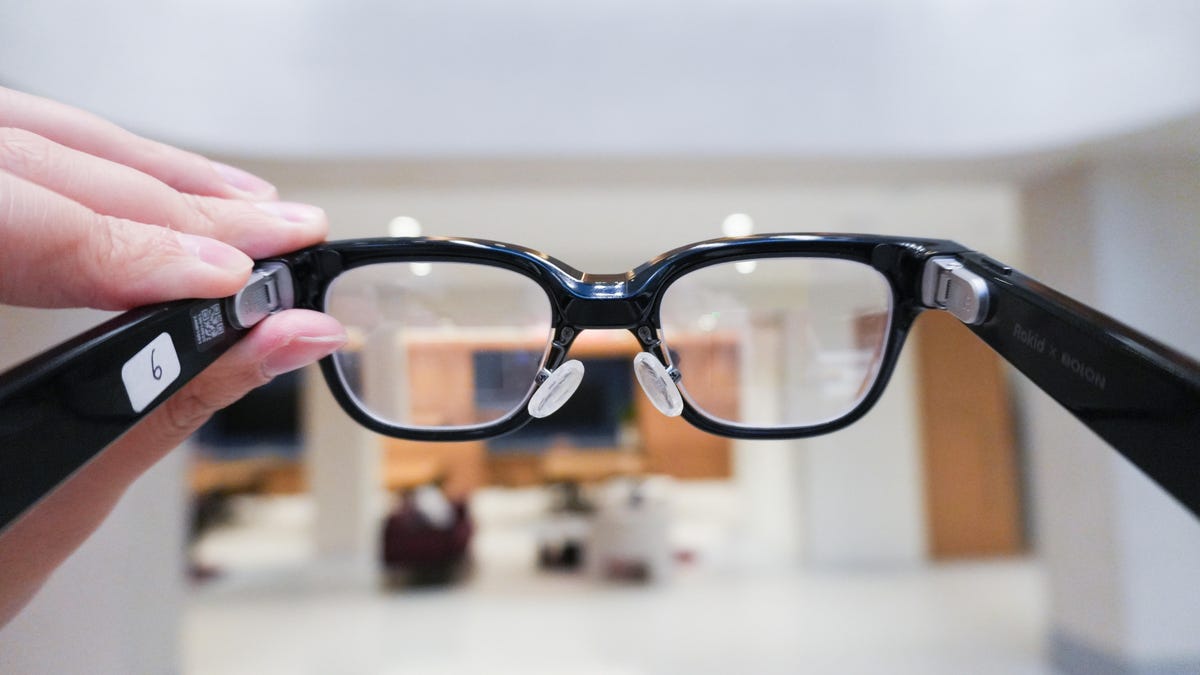
On September 4, 2025, ZDNet reported that Chinese company Rokid's next‑generation AI glasses launched on Kickstarter amassed over $1 million in preorders within the first 72 hours of presales. The product page promotes it as "combining the portability of Ray‑Bans with next‑generation AI capabilities," and the early‑bird price is $120 cheaper than the later retail price, attracting many tech enthusiasts.
ZDNet's report lists several design choices and feature positions that differ from Meta Ray‑Bans. In terms of appearance, Rokid preserves a sunglasses‑like frame silhouette but integrates more prominent sensor modules and camera bumps on the temple and frame side; the product description states the design emphasizes "multimodal interaction and expanded hardware interfaces," intended to support broader developer extensions.
Audio experience is another key point of comparison. ZDNet notes Rokid has invested more in speaker and microphone arrays, with the company claiming clearer call quality and improved environmental sound awareness; the article also mentions the manufacturer highlights "open audio tuning options" to allow third‑party apps greater flexibility in accessing the hardware.
For AI capability and privacy, Rokid positions the product as a hybrid solution that "balances local and cloud computing." ZDNet reports the official page emphasizes offline voice recognition and low‑latency on‑device inference to reduce reliance on continuous cloud connections, while offering optional cloud enhancements to enable more complex AI models when connected.
Regarding the developer ecosystem, ZDNet specifically mentions Rokid provides an SDK and more open APIs, aiming to avoid the third‑party restrictions seen on some closed devices. The Kickstarter wording also leans toward "platformization," encouraging independent developers to deploy new features, effects, and interaction modes to the glasses.
ZDNet interprets the early Kickstarter sales surge as a consumer signal for "greater expandability and richer AI experiences." The article also notes that while Meta has first‑mover advantages in hardware and social integration, the market is not one‑dimensional; Rokid has quickly captured a group of early adopters with differentiated design and a lower presale threshold.
The article does not ignore potential risks: supply‑chain fluctuations, actual battery life, and the maturity of the software ecosystem remain key metrics for follow‑up evaluation. ZDNet suggests watching post‑delivery user feedback, especially camera privacy controls, voice recognition performance in noisy environments, and the speed at which third‑party apps appear.
For younger users seeking "value and playability," Rokid's approach has sparked heated discussion in communities and on the Kickstarter comment pages. Whether viewed as a direct challenge to Meta or as a successful new‑brand platform strategy, September 4, 2025 added a new footnote to the wearable AI device market.