
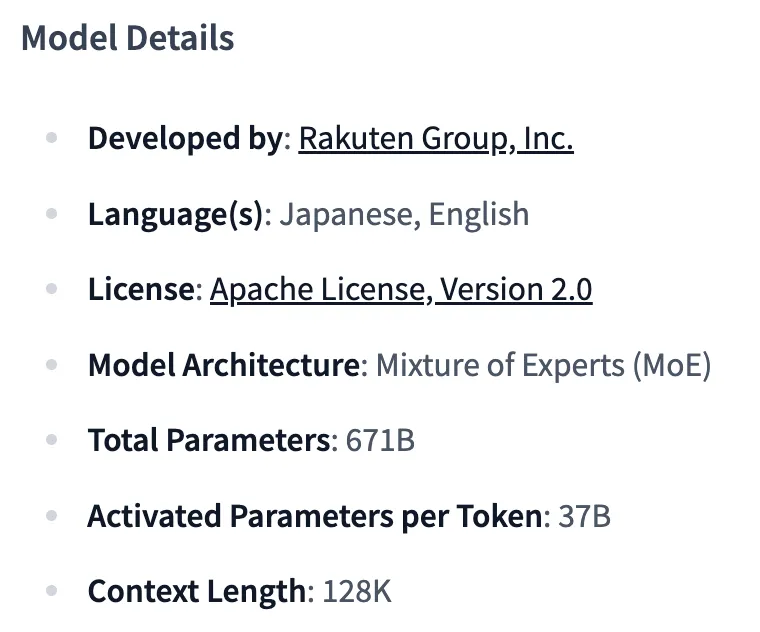
On March 17, 2026, Japan's Rakuten Group publicly released what it called the "largest high‑performance AI model in Japan," Rakuten AI 3.0. The model reportedly has about 671 billion total parameters and approximately 37 billion activated parameters, uses a MoE architecture, is optimized for Japanese, and is claimed to surpass GPT‑4o on several benchmarks related to Japanese language, culture, history and instruction following. Rakuten emphasized that the model is the result of the GENIAC (Generative AI Acceleration Challenge) project, developed by combining "the best results from the open‑source community" with its own bilingual data and released for free on Hugging Face under an Apache 2.0 license, earning widespread praise in Japan.
However, less than 12 hours after the release, the technical community discovered a surprising fact in the Hugging Face repository: the model's core configuration file config.json clearly shows "model_type": "deepseek_v3", with the architecture field set to "DeepseekV3ForCausalLM" and parameter settings and scale identical to China's DeepSeek V3. Users quickly found that this was not an "independently developed" model but a rebranded version of DeepSeek V3 fine‑tuned for Japanese. More seriously, Rakuten initially removed DeepSeek's original MIT license file (LICENSE) from the upload and only kept its own Apache 2.0 declaration. This action was seen as a serious violation of open‑source protocol and immediately ignited controversy online.
Violation Details and Conflict with Open‑Source Principles
DeepSeek V3 was open‑sourced by the Chinese company DeepSeek under the permissive MIT license. The core requirement of MIT is that any derivative work must retain the original copyright notice and license text. Rakuten, however, removed the LICENSE file from the repository and in its official press materials vaguely referred to "making full use of the open‑source community's best results," never mentioning DeepSeek by name and attempting to present the work as "Japan‑developed."
Japanese users and the open‑source community quickly captured evidence: config.json exposed the underlying details, and the model's answers on culture‑related questions showed a clear bias toward the Chinese perspective. Even more egregiously, Rakuten initially did not indicate copyright attribution; only after exposure did it hurriedly add a file named NOTICE to the repository containing "Copyright (c) 2023 DeepSeek" and the full MIT text, with a commit message of merely "Add the permission notice." This post‑hoc fix was criticized as "poorly handled"—legally borderline (MIT does not mandate the filename be LICENSE), but a serious breach of the open‑source community's transparency and respect norms.
Multiple media outlets and tech forums quickly followed up: Huxiu, ITHome, Landian News, AIBase and others consistently reported that Rakuten's action not only risked misleading the public but also ran counter to the GENIAC project's intent to "cultivate domestic AI" with subsidies. Some users said bluntly: "Using taxpayer‑subsidized projects to rebrand a Chinese model and try to pass it off as local?"
Rakuten's Response and Community Backlash
Under public pressure, Rakuten has not issued a formal apology but has made remedial commits to the repository. The Hugging Face page now shows an Apache 2.0 license alongside a NOTICE file, and the model card was updated to state it is "based on excellent results from the open‑source community." Some analysts suggest Rakuten's move may have been driven by branding considerations: Apache 2.0 appears more corporate and helps build an ecosystem, while explicitly naming DeepSeek could have undermined claims of producing "Japan's strongest AI."
Nevertheless, Japan's tech community reacted strongly. Reddit, X and domestic forums were full of complaints: "Previous Rakuten AI‑7B explicitly credited 'based on Mistral'—this time they just disappeared it?" "Six of the top ten Japanese AI models rely on DeepSeek or Qwen fine‑tuning; now they can't even admit it?" Voices also questioned whether heavy reliance on overseas open‑source projects truly reflects 'domestic AI' capability.
A Warning for the Open‑Source Ecosystem
Legally, DeepSeek V3's MIT license allows commercial use and further development, so Rakuten's behavior does not necessarily constitute infringement. However, the open‑source community stresses that transparency is the soul of open source. Removing the original license file not only harms the rights of DeepSeek contributors but could trigger a cascading effect—if other companies follow suit, global open‑source trust will be further eroded.
The incident also exposes a current reality in AI development: even a model billed as "Japan's largest" can still be heavily dependent on international open‑source foundations (Nikkei previously reported that many leading Japanese models are based on DeepSeek/Qwen). As US‑China AI competition intensifies in 2026, how Japanese firms balance "domestic innovation" messaging with actual open‑source dependence has become a hot topic.
Conclusion: Transparency Is the Greatest Competitive Advantage
Rakuten AI 3.0 went from "Japan's pride" to a rebranding controversy in just 12 hours. The emergency fixes may achieve legal compliance, but they have seriously damaged community trust. The case reminds all AI practitioners that open source is not a carte blanche for appropriation; respecting original authors and openly acknowledging sources are fundamental to sustainable development.
As the story continues to unfold, whether Rakuten will disclose fine‑tuning details or training‑data sources may become the next focal point. Regardless of the outcome, the controversy has sounded a global warning for the open‑source AI ecosystem: in the race for the "strongest" label, basic integrity must not be forgotten.
▶️ Enjoy this article? Creating content is hard!
Welcome to follow our YouTube channel:
AI Rosetta
Your likes, subscriptions and shares are our greatest support! 🙏
More AI news at: https://www.airosetta.com