
On May 19, 2026, the Alibaba Cloud Tongyi Qianwen team officially released the Qwen3.7 family of large models. The flagship Qwen3.7‑Max demonstrated remarkable strength on coding and agentic tasks, achieving breakthrough results across several authoritative agentic benchmarks, with some key metrics approaching or even surpassing OpenAI's GPT‑5.5. This performance quickly became an industry focus and is regarded as an important milestone for domestic large models in complex engineering development and autonomous coding.
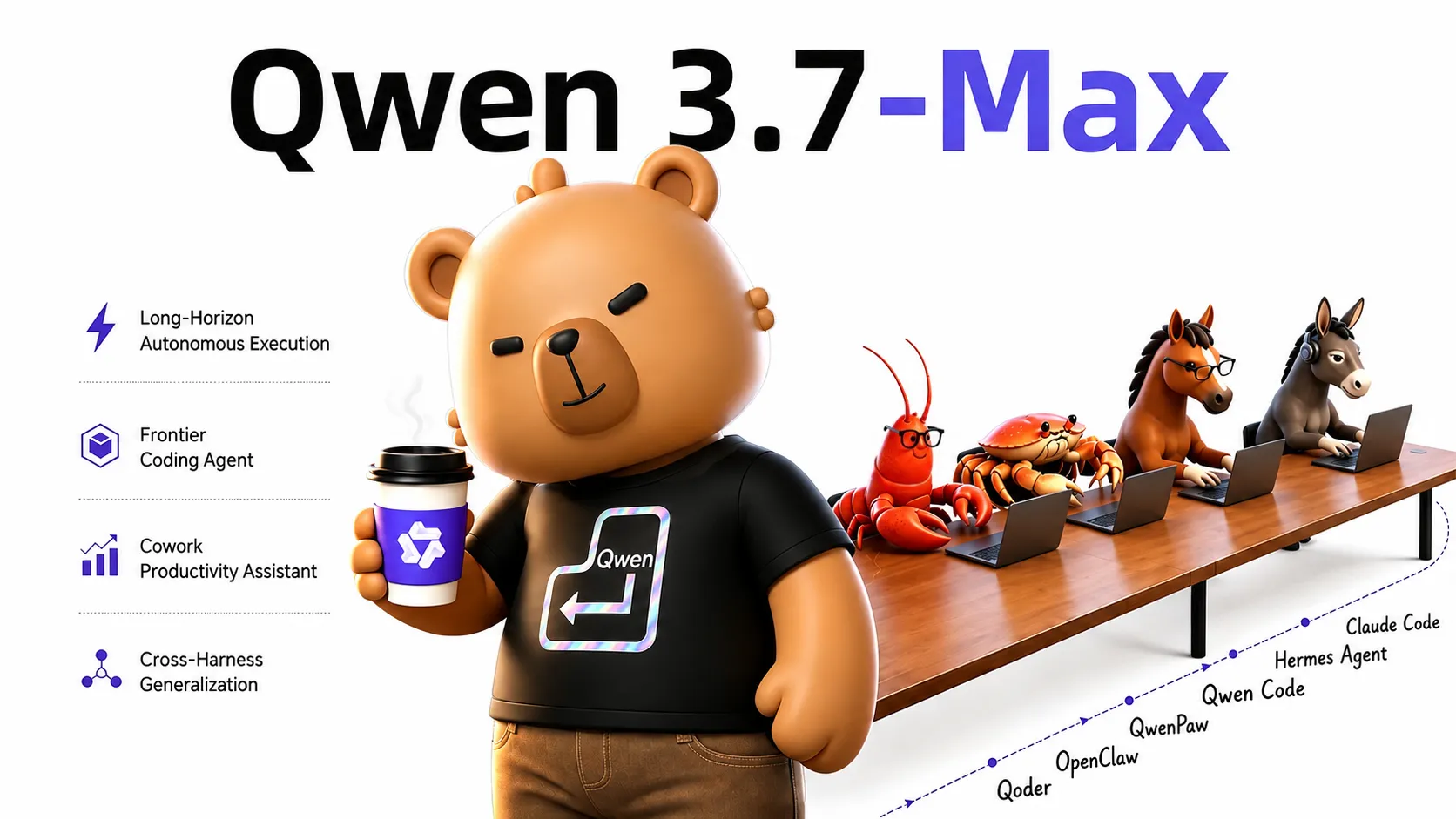
According to the latest evaluations from Artificial Analysis, Terminal‑Bench, SWE‑Pro and others, Qwen3.7‑Max ranked first in Terminal‑Bench 2.0 with a high score of 69.7%, ahead of DeepSeek‑V4‑Pro Max (67.9%) and Claude Opus 4.6 (65.4%). On engineering‑focused benchmarks such as SWE‑Pro and BigCodeBench, Qwen3.7‑Max also placed in the global top three, and some subtask scores have already surpassed GPT‑5.5.
Core Breakthroughs of Qwen3.7‑Max
The Qwen3.7 series adopts a design that combines a Mixture‑of‑Experts (MoE) architecture with dense models; the flagship supports million‑token ultra‑long context and natively integrates a toggle between “Thinking Mode” and “Non‑Thinking Mode.”
In real developer tests, Qwen3.7‑Max demonstrated the following notable advantages:
- Long‑period autonomous execution: In a complex engineering task lasting 35 hours with over 1,000 tool calls, Qwen3.7‑Max maintained high stability and task completion rates.
- Multi‑step agentic capability: It excelled in real development scenarios requiring planning, debugging and iteration, effectively handling issue localization and refactoring in large codebases.
- Multilingual programming support: It scored 78.3% on the SWE‑Multilingual benchmark, showing strong cross‑language coding ability.
- Cost‑performance advantage: Inference costs are significantly lower than GPT‑5.5 and Claude Opus 4.7, offering developers a balance of high performance and lower cost.
Although GPT‑5.5 still leads on the traditional SWE‑Bench Verified benchmark with a high score of 88.7%, Qwen3.7‑Max has shown strong competitiveness in tests that emphasize practical agentic scenarios (multi‑step tool calls, long‑term planning, real engineering workflows), even achieving wins in some sub‑dimensions.
Why Qwen3.7 Breaks Through in Coding?
The Tongyi Qianwen team applied highly targeted optimization strategies when training Qwen3.7:
- Extensive incorporation of real GitHub repositories, issue records and full‑process data from open‑source projects for training;
- Focused strengthening of long‑context understanding and multi‑step tool invocation mechanisms;
- Introduction of self‑iterative training methods that let the model continually reflect on and improve its outputs during execution;
- Optimization of MoE routing efficiency so it can more effectively call specialized knowledge in complex coding tasks.
These engineering‑focused optimizations make Qwen3.7 more practical in real software development workflows, especially suited for AI programming assistant scenarios that require long periods of autonomous work.
Far‑reaching Impact on the Industry Landscape
- Significant boost to domestic large‑model competitiveness — Qwen3.7's breakthrough breaks the long‑standing dominance of frontier international models in high‑end coding, providing domestic developers with a more cost‑effective option and injecting important confidence into China's AI industry on the global stage.
- Acceleration of the Agentic AI race — As Qwen3.7, GPT‑5.5 and Claude Opus 4.7 fiercely compete on agentic coding capabilities, AI programming assistants are rapidly evolving from “code completion tools” into “autonomous development partners,” fundamentally changing software development productivity models.
- Exploration of the open‑source vs. commercialization balance — Alibaba Cloud has opened parts of Qwen3.7's small‑ and medium‑scale models to the public, further promoting the open‑source community. This contrasts with some international closed‑source strategies and offers more choices to global developers.
- Potential challenges and future directions — Despite strong coding capabilities, Qwen3.7 still trails GPT‑5.5 and Claude in some areas of general reasoning and conversational fluency. How to further improve model stability and interpretability while maintaining high performance remains a key next‑stage task.
Conclusion: An Important Milestone for Domestic AI in the Coding Track
The release of the Qwen3.7 series, and especially its performance approaching or surpassing GPT‑5.5 on multiple agentic benchmarks, marks a shift in which Chinese large models have moved from “fast followers” to “competitors” and in some areas to “partial leaders” in practical engineering domains.
This achievement not only provides developers with powerful and practical tools, but also injects new competitive vitality into the entire AI industry. With Qwen3.7's gradual commercialization and continued community follow‑up, 2026 may become a key year for explosive growth in AI programming tools. In the future, those who maintain sustained leadership in complex engineering tasks and autonomous agent capabilities will take the lead in the wave of AI application deployment.
▶️ Enjoy this article? Creating it is hard work!
Follow our YouTube channel:
AI Rosetta
Your likes, subscriptions and shares are our greatest support! 🙏
For more AI news visit: https://www.airosetta.com