
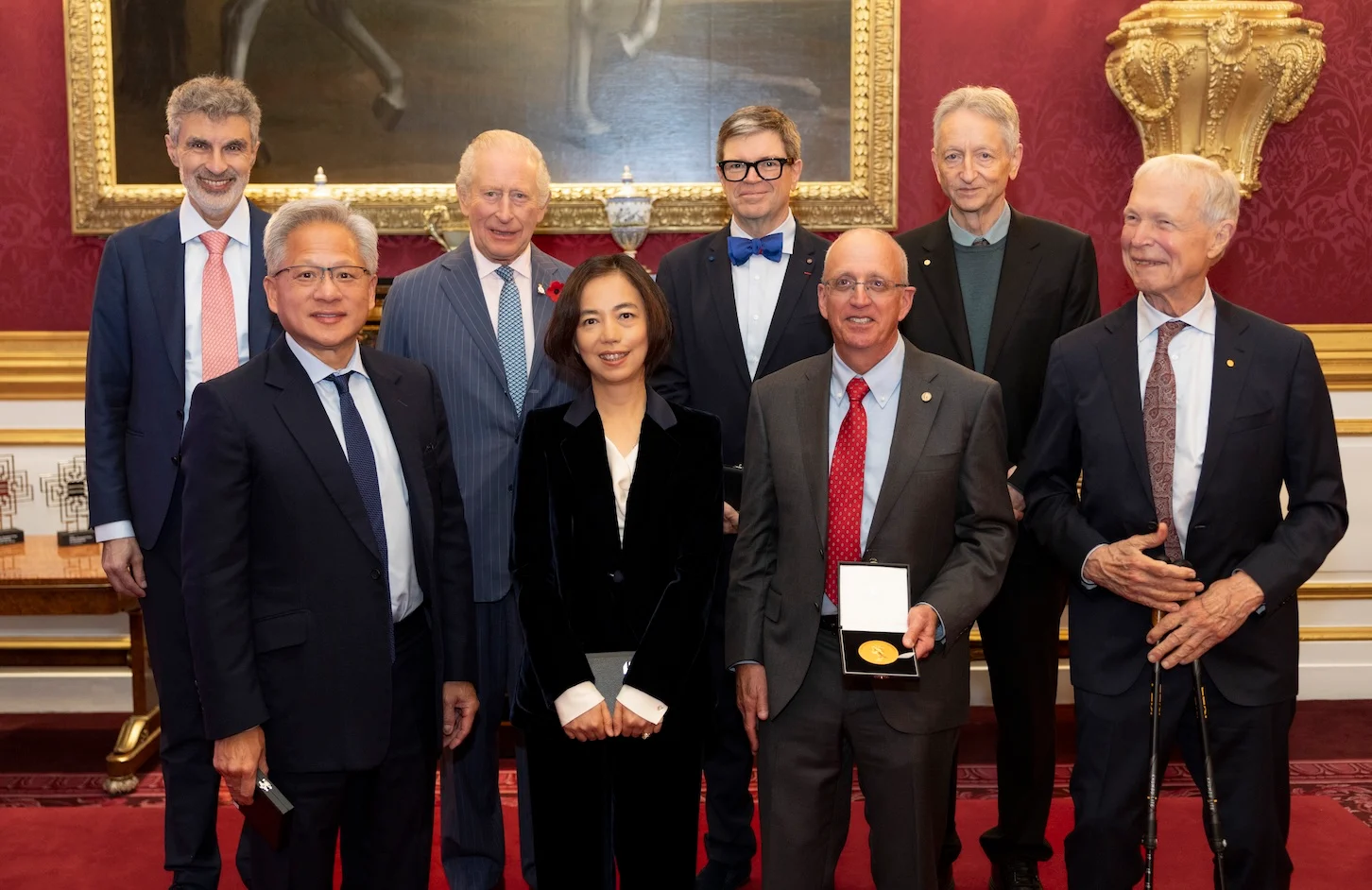
On 6 November 2025, at a ceremony held in Buckingham Palace, King Charles III presented the prestigious Queen Elizabeth Prize for Engineering (QEPrize) to seven leading scientists in artificial intelligence, calling them the "founding architects of modern machine learning." Often described as the "Nobel Prize of engineering," the award recognizes engineering breakthroughs that have delivered significant benefit to humanity. This year’s laureates — Yoshua Bengio, Geoffrey Hinton, John Hopfield, Yann LeCun, Jensen Huang, Bill Dally, and Fei‑Fei Li — together represent the full arc of contemporary AI from theory to practice. The ceremony drew global technology leaders, policymakers and dignitaries, underlining the UK’s commitment to advancing AI with an emphasis on both innovation and ethics.
The QEPrize was established in 2013 to mark the 60th anniversary of the Queen’s accession and is awarded biennially. The £500,000 prize is shared among the winners to honor engineering feats that benefit society. In 2025 the Royal Academy of Engineering selected these seven scientists in recognition of their collective contributions to modern machine learning, technologies that have transformed fields from healthcare to climate modeling. In his remarks, King Charles warned that AI is a "double‑edged sword," praised the laureates for "laying the foundations of our digital future," and urged vigilance against misuse.
The award comes at a pivotal moment — just over a year after the 2024 Nobel Prize in Physics was awarded to John Hopfield and Geoffrey Hinton for their foundational contributions to neural network theory (Hopfield and Hinton are among this year’s QEPrize winners). However, the QEPrize represents a broader AI prize than the 2024 Nobel Prize in Physics. Whereas the Nobel recognised the theoretical foundations of machine learning (notably Hopfield networks and Boltzmann machines, which helped seed today’s deep learning), the QEPrize spans the complete ecosystem from algorithmic innovation and data infrastructure to hardware acceleration and ethical frameworks. It honors not only theorists but also practitioners who have scaled AI from laboratories to global deployment, encompassing seven collaborators across continents. Unlike the Nobel’s focus on a single discipline‑related breakthrough, this prize celebrates a multidisciplinary "septet" that connects theory, engineering and application to form a more complete picture of AI’s origins and responsibilities.
This article provides a concise introduction to the main contributions of the seven laureates and places their stories within the larger narrative of AI’s rise. Drawing on announcements from the Royal Academy of Engineering, the Stanford 2025 AI Index report, and archival material from institutions such as the Alan Turing Institute and DeepMind, we examine how these pioneers dismantled barriers to machine intelligence. Subsequent sections analyse each laureate’s breakthrough achievements, quantify their impact, and explain why the QEPrize surpasses the 2024 Nobel in breadth and timeliness.
Geoffrey Hinton: The Father of Deep Learning — Neural Networks and the Backpropagation Revolution
Geoffrey Everest Hinton, widely regarded as the "father of deep learning," is an English‑Canadian computer scientist whose work established the neural foundations of modern AI. Born in Wimbledon, London in 1947, Hinton’s academic lineage is distinguished. He studied experimental psychology at Cambridge (B.A., 1970) and earned his Ph.D. in AI at the University of Edinburgh (1978) under the supervision of Christopher Longuet‑Higgins, researching Boltzmann machines.
Hinton’s milestone contributions began in the 1980s with the revival of the backpropagation algorithm. In the 1986 paper "Learning representations by back‑propagating errors" (co‑authored with David Rumelhart and Ronald Williams), Hinton showed how errors could be propagated through multilayer neural networks, enabling networks to learn automatically byefficiently computing gradients for each network weight so networks could be trained by gradient descent. By 2006 his Toronto team used restricted Boltzmann machines (RBMs) for layer‑wise pretraining that initialized deep belief networks (DBNs). In 2012 the AlexNet model developed by his student Alex Krizhevsky reduced ImageNet’s top‑5 classification error to 15.3%, igniting the global deep learning boom.
Hinton’s influence also extends to generative models. In the early 2010s he helped advance ideas around variational autoencoders (VAEs) for unsupervised learning, powering later image‑synthesis tools. During his time at Google Brain (2013–2023) he proposed architectures such as capsule networks to improve spatial‑hierarchical understanding in vision tasks. In 2023 Hinton’s resignation from Google, motivated by concerns about AI risks, sparked widespread debate — a theme echoed in King Charles’s remarks at the ceremony.
Quantitatively, Hinton’s work helped catalyse an AI industry worth hundreds of billions of dollars; in contrast to the 2024 Nobel’s focus on Hopfield‑style associative memory, Hinton’s QEPrize recognition emphasizes practical scalability — training models with billions of parameters. His legacy spans theoretical elegance to the trillion‑parameter Transformer era; he both empowered machines and warned they could soon surpass humans.
Yann LeCun: Pioneer of Convolutional Networks — Foundations of Computer Vision and Autonomous Systems
Yann LeCun, a French‑American computer scientist and Meta’s chief AI scientist, is the creator of convolutional neural networks (CNNs), the cornerstone of visual AI. Born in Soisy‑sous‑Montmorency, France in 1960, he earned his Ph.D. from Université Pierre‑et‑Marie‑Curie in 1987 under Gérard Debreu. Early work at Bell Labs (1988–1996) focused on handwriting recognition; in 1998 he introduced LeNet‑5, a CNN that automated bank‑check processing and cut error rates dramatically.
LeCun’s insight was the convolution operation: filters sliding over images to detect edges, textures and objects hierarchically. His 1989 paper "Application of back‑propagation to handwritten zip code recognition" demonstrated CNNs’ efficiency by using weight sharing to minimize parameters — crucial for resource‑constrained devices. This lineage led to modern architectures such as ResNet (2015) and EfficientNet, enabling real‑time object detection in autonomous driving.
At New York University (from 2003) and Meta (from 2013) LeCun advanced self‑supervised learning (SSL), where models learn from unlabeled data using contrastive losses (e.g., SimCLR). His work on energy‑based models (EBMs) aims at common‑sense reasoning and critiques the data hunger of Transformers. LeCun advocates for open AI collaboration and co‑founded initiatives promoting technology paired with ethical oversight.
The QEPrize recognizes that LeCun’s CNNs power around 80% of computer vision applications. Unlike the 2024 Nobel’s theoretical homage to neural networks, LeCun’s award emphasizes applied vision: from facial‑recognition ethics to drone autonomy, his contributions let machines "see" the world. As he quipped at the ceremony, "AI sees what we teach it to see — let’s teach it to see justice."
Yoshua Bengio: Prophet of Deep Learning — Unsupervised Learning and Ethics Foundations
Yoshua Bengio, a Canadian AI leader and founder of Mila, is renowned for paradigms in unsupervised learning that drive deep neural networks. Born in Paris in 1964 and later emigrating to Canada, Bengio earned his Ph.D. from McGill University in 1991. His 1991 work with Yves Fréchet on probabilistic learning algorithms helped pioneer recurrent neural networks (RNNs) for sequence modeling.
Bengio’s breakthroughs include deep generative models from 2009 onward, such as denoising autoencoders for feature learning. In 2014 he and others accelerated the development of generative techniques including ideas influential to generative adversarial networks (GANs), which transformed image synthesis and found applications in medical imaging and art restoration. At the University of Montreal, his Theano framework (circa 2010) was an early deep‑learning library that influenced later tools like PyTorch.
As one of the "three giants" of deep learning, Bengio has also foregrounded safety concerns; his 2016 paper highlighted concrete issues in AI safety. He was a signatory of the 2018 Montreal Declaration, advocating a balance between innovation and security.
The QEPrize acknowledges that Bengio’s work on generative models underpins a large share of 2024’s research on generative AI. Beyond the 2024 Nobel’s physics‑oriented recognition, Bengio’s prize stresses unsupervised methods and ethics: from mitigating GAN bias to contributing to global AI governance, he has sought to ensure deep learning serves humanity.
Fei‑Fei Li: The ImageNet Catalyst — Vision AI and Human‑Centered Intelligence
Fei‑Fei Li, often called the "godmother of AI," is a Chinese‑American Stanford professor whose ImageNet dataset catalyzed the revolution in visual recognition. Born in Beijing in 1976 and moving to the United States at 16, she earned her Ph.D. from Caltech in 2005. Her 2006 ImageNet initiative built a dataset of some 14 million labeled images and launched the ImageNet challenge, creating the conditions for AlexNet’s 2012 breakthrough (reducing error rates) and later the 2015 ResNet advance that drove error rates even lower.
Fei‑Fei’s work spans object recognition (including the NEIL project on lifelong learning) and human‑AI collaboration (AI4ALL, 2017, promoting diversity in AI education). She led vision efforts at Google Cloud (2017–2018) and currently works at Stanford, where World Labs explores robotic spatial intelligence.
The QEPrize recognizes ImageNet’s role training roughly 90% of vision models. Compared to the 2024 Nobel’s abstract neural‑network focus, Fei‑Fei’s contribution is about data‑driven scaling of AI — from autonomous vehicles to accessibility — nurturing inclusive vision systems. As she has said, "Data is the new oil, but ethics are the refinery."
John Hopfield: Father of Associative Memory — A Theoretical Bedrock for Neural Networks
John Hopfield, a professor of molecular biology at Princeton, invented the Hopfield network, providing an associative memory framework for neural computation. Born in 1933 in the United States, Hopfield’s early work in solid‑state physics preceded a shift to neural computation. His 1982 paper "Neural networks and physical systems with emergent collective computational abilities" proposed an energy‑minimization model to simulate storage and retrieval in the brain.
Hopfield’s work helped revive neural computation in the 1980s and influenced Boltzmann machines and deep‑learning initialization. The 2024 Nobel Prize in Physics honoured his contributions, describing them as "opening the AI era."
The QEPrize includes Hopfield among the seven to emphasize the bridge his theory provides to engineering. More comprehensive than the Nobel alone, the prize connects Hopfield’s physical foundations to practical deployment, from memory models to generative AI.
Jensen Huang: The GPU Tsar — Hardware Acceleration in the AI Era
Jensen Huang, co‑founder and CEO of NVIDIA, transformed graphics chips into AI engines. Born in Taiwan in 1963 and emigrating to the United States, Huang earned a degree in electrical engineering from Oregon State University in 1984. He founded NVIDIA in 1993; its CUDA platform (2006) enabled parallel GPU computing for general‑purpose tasks.
Huang’s vision produced tensor‑core GPUs such as the A100 and H100, powering a large share of AI workloads. By 2025 NVIDIA’s market capitalization reached $5 trillion, driven by advances including the Blackwell architecture.
The QEPrize recognizes GPUs as the "pick and shovel" of AI. Beyond the Nobel’s theoretical lens, Huang’s engineering enabled global‑scale AI — from datacenters to edge devices.
Bill Dally: Pioneer of Accelerated Computing — Engineering NVIDIA’s AI Hardware Revolution
Bill Dally, NVIDIA’s chief scientist, is a foundational figure in accelerated computing, driving the transition of GPUs from graphics to AI. Born in the United States in 1959, Dally earned a Ph.D. in computer science from Caltech in 1986. His early work on parallel architectures at Bell Labs and later at Stanford advanced programmable chips.
Joining NVIDIA in 2009, Dally led development on Volta and Ampere architectures, optimizing Tensor Cores for training large language models. His work helped GPU performance scale from teraflops to exaflops, supporting models such as ChatGPT.
The QEPrize recognizes Dally’s hardware innovations as underpinning roughly 90% of AI infrastructure. Unlike the Nobel’s theoretical emphasis, this award highlights engineering practice, from chip design to trillion‑parameter training.
QEPrize’s Breadth: A Larger Canvas than the 2024 Nobel
The 2024 Nobel Prize in Physics honoured Hopfield and Hinton for fundamental contributions to artificial neural networks, while the QEPrize’s seven laureates paint a more complete picture of this wave of AI revolution. The Nobel focused on neural‑network theory; here Hopfield and Hinton are joined by figures in vision (Fei‑Fei Li), hardware (Jensen Huang and Bill Dally) and algorithms (Yoshua Bengio and Yann LeCun). The QEPrize is broader in both diversity (gender and geography) and scope (theory to deployment). As King Charles said: "This is the Magna Carta of AI."