
Introduction
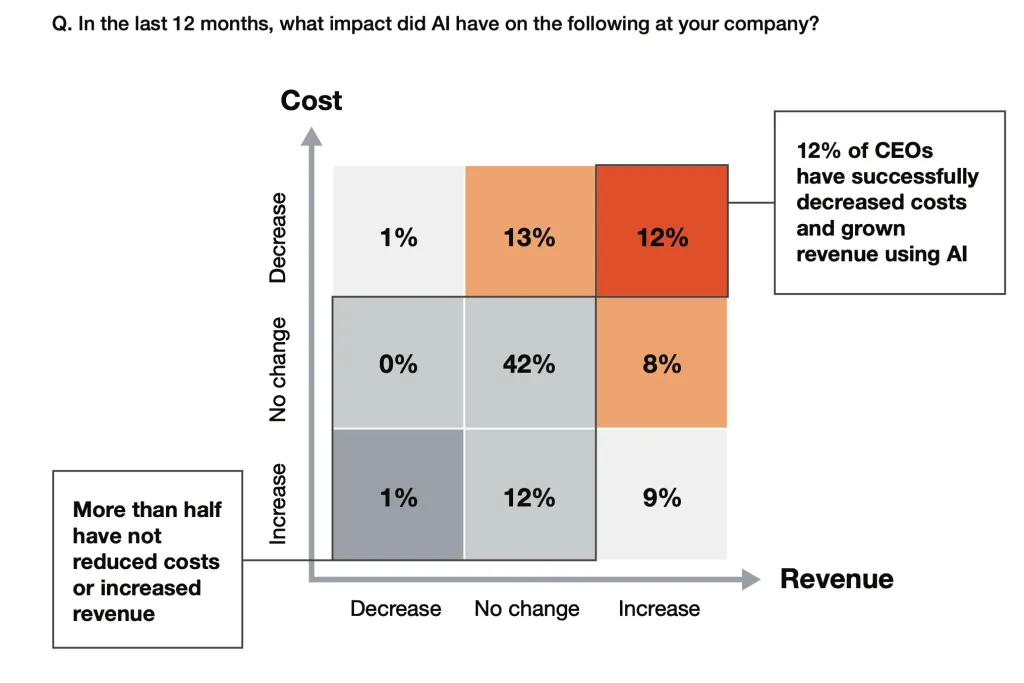
At the start of 2026, although investment momentum in artificial intelligence (AI) remains strong, the actual returns have come under scrutiny. PwC released its 29th Global CEO Survey on January 19 during the World Economic Forum in Davos, showing that in the past 12 months 56% of CEOs surveyed said their companies have not seen significant financial returns from AI investments, neither revenue growth nor cost reduction. The finding is based on interviews with 4,454 chief executive officers from 95 countries; the report is titled "Leading Through Uncertainty in the Age of AI." PwC Global Chair Mohamed Kande told Fortune that many leaders "have forgotten the basics," resulting in widespread experimentation with AI projects that are difficult to convert into measurable business value. The report echoes a 2025 MIT study that found 95% of generative AI pilots failed to scale to deliver ROI. Media analyses from outlets such as Business Insider and The Register characterize the data as signaling a shift from AI's "hype phase" to a more "practical implementation" phase.
Survey background and key findings
PwC's Global CEO Survey, now in its 29th year, focused this edition on uncertainty in the age of AI. The survey was conducted from October to November 2025 and covered sectors including manufacturing, financial services and technology, with respondents drawn from large enterprises. The core insight of the report is a lag in AI investment returns: although companies have poured in large sums (global AI spending exceeded one trillion dollars in 2025), outcomes have fallen short of expectations.
Breakdown of specific findings:
- 56% of CEOs reported "no significant financial benefit": neither revenue growth nor cost reduction.
- 12% of CEOs said AI generated both cost reductions and revenue growth (dual benefits).
- 33% reported improvement in either costs or revenues (26% saw cost reductions, 30% saw revenue increases).
- About 20% reported costs increased, possibly due to continued investment in new solutions.
CEO overall confidence is also weak: only 30% are "very or extremely confident" in revenue growth over the next 12 months, down from 38% in 2025 and the lowest in five years (2022 peaked at 56%). The decline is attributed to geopolitical uncertainty, economic pressures and lagging AI returns. The report highlights an emerging "execution gap": many companies remain at the stage of "isolated, tactical AI projects" rather than enterprise‑wide deployment.
PwC also categorizes firms into "AI high‑fliers" and laggards: the former (around 12%) have built solid AI foundations—data governance, cross‑functional collaboration and organizational change—and achieve dual benefits; laggards see little effect due to lacking these fundamentals. A Medium article noted this reflects a bottleneck in moving from experimentation to scaled deployment.
Why AI investments are not delivering returns
PwC and related sources consistently point to a "foundations gap" as the root cause of AI failing to deliver value. Mohamed Kande emphasized that many leaders overlook data quality, training and cultural change, instead "stacking technology," which leads to failure. Specific causes include:
- Tactical projects dominate: Most companies run POCs (proofs of concept) but do not integrate them into business strategy. The Register reported these "isolated projects" are hard to quantify in value.
- Insufficient data and infrastructure: AI depends on high‑quality data, yet many firms have weak data governance. PwC found only a minority have mature AI foundations.
- Lagging organizational change: LinkedIn posts note AI requires cross‑department collaboration, but traditional corporate cultures struggle to adapt.
- Long investment cycles: Fortune analysis suggests AI returns require multiple iterations, and short‑term cost increases are common.
The mycpe one blog added that the 56% figure highlights the risk of an "AI bubble": semiconductor and data center investments surged in 2025, but practical applications have not kept pace. Microsoft CEO Satya Nadella has similarly warned in interviews that if adoption does not rise, AI investments could see a pullback.
Implications for companies and the AI industry
The report carries significant strategic implications. Fintool News described it as a "reality check" for AI: companies must move from hype to pragmatism and prioritize foundational investments. For AI vendors such as OpenAI and Google, this implies providing more "turnkey" solutions to help enterprises bridge the execution gap.
Industry impacts include:
- More cautious investment: Analysts at Gradient Group say the 56% figure may cool AI financing, though the success of "high‑fliers" shows potential remains.
- Regulation and ethics: PwC's findings echo IMF projections that widespread AI adoption could add 0.3 percentage points to global growth, but uncertainty must be addressed.
- Global divergence: The report indicates developed countries (for example, the U.S. growth upgrade to 2.4%) stand to gain more, while developing countries need accelerated infrastructure build‑out.
PwC's recommendations and outlook
PwC advises leaders to "return to basics": establish data governance, develop talent and integrate AI into strategy. The report stresses that "AI high‑fliers" achieve returns through enterprise‑level deployment. Kande calls for multi‑stakeholder collaboration to move AI from experimentation to value realization.
Looking ahead, PwC expects AI returns to improve in 2026 if execution barriers are overcome. A Medium article called the report a "wake‑up call" for the industry, pushing a shift from "investment frenzy" toward "sustainable growth."
Conclusion
PwC's 29th Global CEO Survey reveals a stark reality: 56% of leaders have not seen significant returns from AI investments. While alarming, the finding also points the way forward: with foundational investments and strategic integration, companies can capture AI's potential. As technology matures and organizations adapt, AI may yet drive global growth—but for now, companies should invest prudently and avoid following the crowd blindly.
▶️ Enjoyed this article? Creating it takes real effort!
Subscribe to our YouTube channel:
AI Rosetta
Your likes, subscriptions and shares are our greatest support! 🙏
For more AI news visit: https://www.airosetta.com