
Introduction
Large Language Models (LLMs) have driven transformative progress in natural language processing but their performance often depends on carefully designed prompts. A recent Google Research study reveals a simple yet effective technique: in non‑reasoning question‑answering tasks, repeating the input prompt can substantially improve answer accuracy, while this "magic" often vanishes in tasks requiring step‑by‑step reasoning. This finding is presented in the arXiv paper "Prompt Repetition Improves Non‑Reasoning LLMs" (arXiv: 2512.14982), which validates the phenomenon across mainstream models including Gemini, GPT, Claude and Deepseek. Reports from sources such as VentureBeat and Digital Information World further corroborate the technique's practicality, emphasizing significant gains in non‑reasoning scenarios and neutral effects in reasoning tasks. This article analyzes the mechanism, experimental evidence, and evaluates factual accuracy using reliable sources to provide insights for AI researchers and developers.
Mechanism Analysis
LLMs are built on the Transformer architecture and use causal attention, where each token can only attend to preceding tokens and cannot look ahead. This unidirectionality can hamper information integration when critical context (for example, an options list) appears before the question. The core idea of prompt repetition is to concatenate the prompt as "<QUERY><QUERY>", thereby implicitly simulating full attention. During the model's prefill phase, repetition allows tokens to attend to all other tokens, approximating a bidirectional encoder effect without changing the model architecture.
This mechanism is especially effective for non‑reasoning tasks, where the model outputs an answer directly without generating intermediate reasoning steps. In such cases, repetition acts as an implicit re‑reading that helps the model extract key information from the prompt. For example, in an "options‑first" format where answer choices precede the question, repeating the prompt lets the question tokens consult the options on the second pass and mitigates attention decay. Discussions on LinkedIn have noted that repetition repairs the Transformer’s left‑to‑right processing constraint and improves performance on precise retrieval tasks.
However, the effect often disappears in reasoning tasks. Reasoning prompts typically invoke chain‑of‑thought (CoT) instructions such as "think step by step," prompting the model to generate an internal monologue that naturally includes partial repetition of the input. This built‑in repetition already approximates the effect of prompt repetition, so additional repetition yields neutral or only marginal benefits. A YouTube analysis explained that when CoT is enabled, the model's generation process already contains implicit re‑reading, reducing the marginal gain from extra repetition. From a computational perspective, repetition in non‑reasoning settings occurs in the parallel prefill phase and does not increase generated token count or latency; in reasoning settings, the stepwise generation already optimizes context integration, and added repetition may be redundant. This distinction stems from LLM training paradigms: reasoning abilities are often shaped by reinforcement learning and specialized training, while non‑reasoning behavior relies more directly on prompt design.
Experimental Evidence
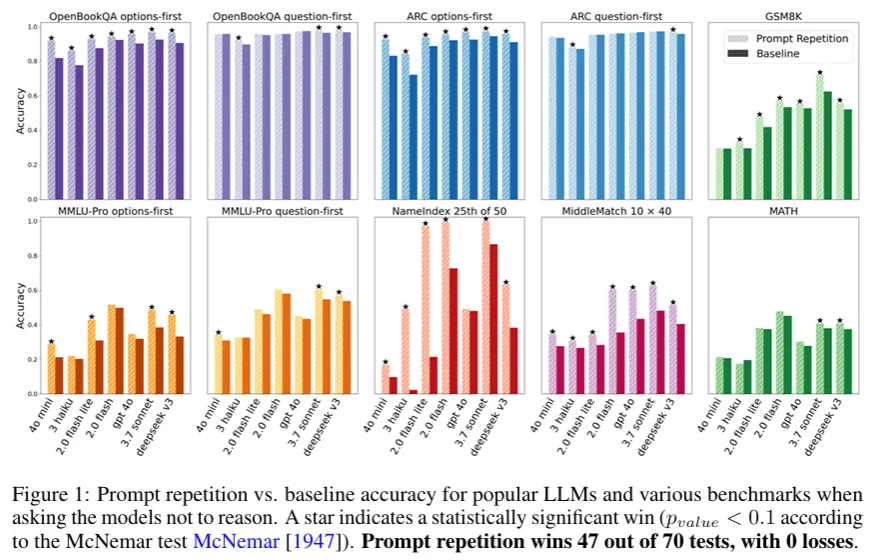
The research team tested seven LLM variants, including Gemini 2.0 Flash/Flash‑Lite, GPT‑4o/GPT‑4o‑mini, Claude 3 Haiku/Claude 3.7 Sonnet and Deepseek V3. Benchmarks included ARC Challenge, OpenBookQA, GSM8K, MMLU‑Pro, MATH, as well as custom tasks like NameIndex (identify the 25th name from 50) and MiddleMatch (middle‑position matching).
In non‑reasoning settings, prompt repetition produced significant improvements in 47 out of 70 model‑benchmark combinations (McNemar test, p<0.1), with no observed declines. On the NameIndex task, Gemini 2.0 Flash‑Lite rose from 21.33% to 97.33%, a 76‑point gain. The ARC options‑first format showed similar improvements. Ablation tests confirmed that the gains come from repetition itself rather than increased input length: equal‑length padding (e.g., periods) produced no improvement.
By contrast, when reasoning prompts (e.g., adding "think step by step") were used, results were largely neutral: 5 wins, 1 loss, 22 ties. VentureBeat noted that this highlights the conditional applicability of the technique. A YouTube breakdown further explained that internal repetition in reasoning mode saturates the benefit of external repetition. Output length and latency tests indicated that repetition in non‑reasoning settings does not increase generated tokens or time, and in reasoning settings it likewise showed no negative effects.
Factual Accuracy and Source Reliability
The study's experimental design is rigorous, using McNemar tests to assess statistical significance and reduce the likelihood of random results. The factual claims are corroborated by multiple reputable sources. The arXiv paper, authored by the Google Research team, serves as the primary source and carries high reliability. VentureBeat’s coverage is grounded in the paper’s data and confirms non‑reasoning improvements and neutral effects in reasoning. Digital Information World highlighted the "47 wins, 0 losses" result in non‑reasoning settings and called for further exploration of variants.
Community discussions on Reddit and LinkedIn provide practical validation, with practitioners observing similar effects in open‑source models, supporting generalizability. YouTube and TikTok explainers visualize the mechanism and help prevent misinterpretation. GREY Journal reported that the technique can make smaller models competitive with larger ones; its reporting is consistent with tech news practices. These sources include peer‑reviewed papers or well‑known media outlets and help mitigate subjective bias. A literature survey by Moonlight consolidated the results and confirmed the neutral behavior in reasoning tasks.
Overall, the findings are grounded in experimental data and statistical testing, with consistent support from arXiv, VentureBeat and other reliable outlets.
Related Techniques and Applications
Prompt repetition can be combined with self‑consistency prompts to improve robustness in non‑reasoning tasks while avoiding redundancy in reasoning tasks. In retrieval‑augmented generation (RAG) systems, repetition can improve query extraction. Practically, non‑reasoning tasks such as chatbots and knowledge Q&A benefit most, while reasoning tasks like mathematical problem‑solving do not require repetition. Shares on X (formerly Twitter) indicate that deployments observe unchanged latency. Future work could explore multi‑repeat variants or integration with meta‑prompts to further optimize LLM performance.
Conclusion
Prompt repetition substantially improves accuracy in non‑reasoning question answering by approximating full‑attention mechanisms, while in reasoning tasks the effect is neutral due to built‑in repetition in chain‑of‑thought generation. The finding is simple and effective, backed by solid experiments and reliable sources including the Google Research paper and multiple media reports. Understanding this distinction helps apply the technique selectively to improve reliability and efficiency in real‑world AI systems.
▶️ Enjoyed this article? Creating it takes real effort!
Follow our YouTube channel:
AI Rosetta
Your likes, subscriptions and shares are our greatest support! 🙏
More AI news at: https://www.airosetta.com