
In today's artificial intelligence landscape, surprises often arrive suddenly. In early February 2026, a model called Pony Alpha, described as a "stealth model," unexpectedly went viral among developer communities and AI enthusiasts. Offering zero cost, an extra‑large context window and strong performance, it quickly rose on OpenRouter's trending list and was hailed as a "free Claude Opus alternative." Its appearance not only challenges traditional paid AI models but has also sparked widespread speculation about who the dark horse belongs to. Analysis from several reputable sources suggests Pony Alpha is likely derived from Chinese AI firm Zhipu AI's GLM series, possibly a preview of the anticipated GLM‑5 — a theory that may explain Zhipu's stock surge. Others remain skeptical because Zhipu has just released GLM 4.7. Alternative guesses include DeepSeek V4, given its flurry of high‑profile papers early in the year, or even a Tencent project, as Tencent's boss is nicknamed "Xiao Ma Ge" (Little Pony). Other theories circulate as well. This event marks another milestone for the open‑source AI ecosystem; below we examine its technical strengths and market implications.
How it blew up: OpenRouter's "mysterious gift"
Pony Alpha quietly launched on the OpenRouter platform on February 6, 2026. As a "stealth model," it arrived without fanfare yet quickly gained traction based on performance alone. OpenRouter, a globally recognized AI model aggregation platform offering API access to multiple large language models, announced on LinkedIn: "We are rolling out a new stealth model, Pony Alpha. It is a next‑generation foundation model and performs well in coding, agentic workflows, reasoning and role‑playing." Even more striking is its pricing: free — both input and output tokens are available at no cost, a rare practice among high‑end AI models.
Within days of going live, Pony Alpha sparked heated discussion on Reddit's SillyTavernAI subreddit. User Juanpy_ wrote: "I'm impressed with this model; it performs well in role‑play (RP), but is very sensitive to presets and prefill." Many speculated it to be a variant of the GLM family, noting writing style similar to Claude Sonnet 4.5 but stronger in reasoning and coding. YouTube channels such as "AI Insider" quickly followed up with videos titled "Pony Alpha: This Completely Free Stealth Model Is Beating Opus!" which garnered millions of views. On the developer platform Threads, user @shikeb posted: "OpenRouter just dropped a stealth model, Pony Alpha — could be used as a Claude replacement." This viral spread took Pony Alpha from obscurity to an AI community sensation in a matter of days.
Technical highlights: 200K context, Opus‑level intelligence
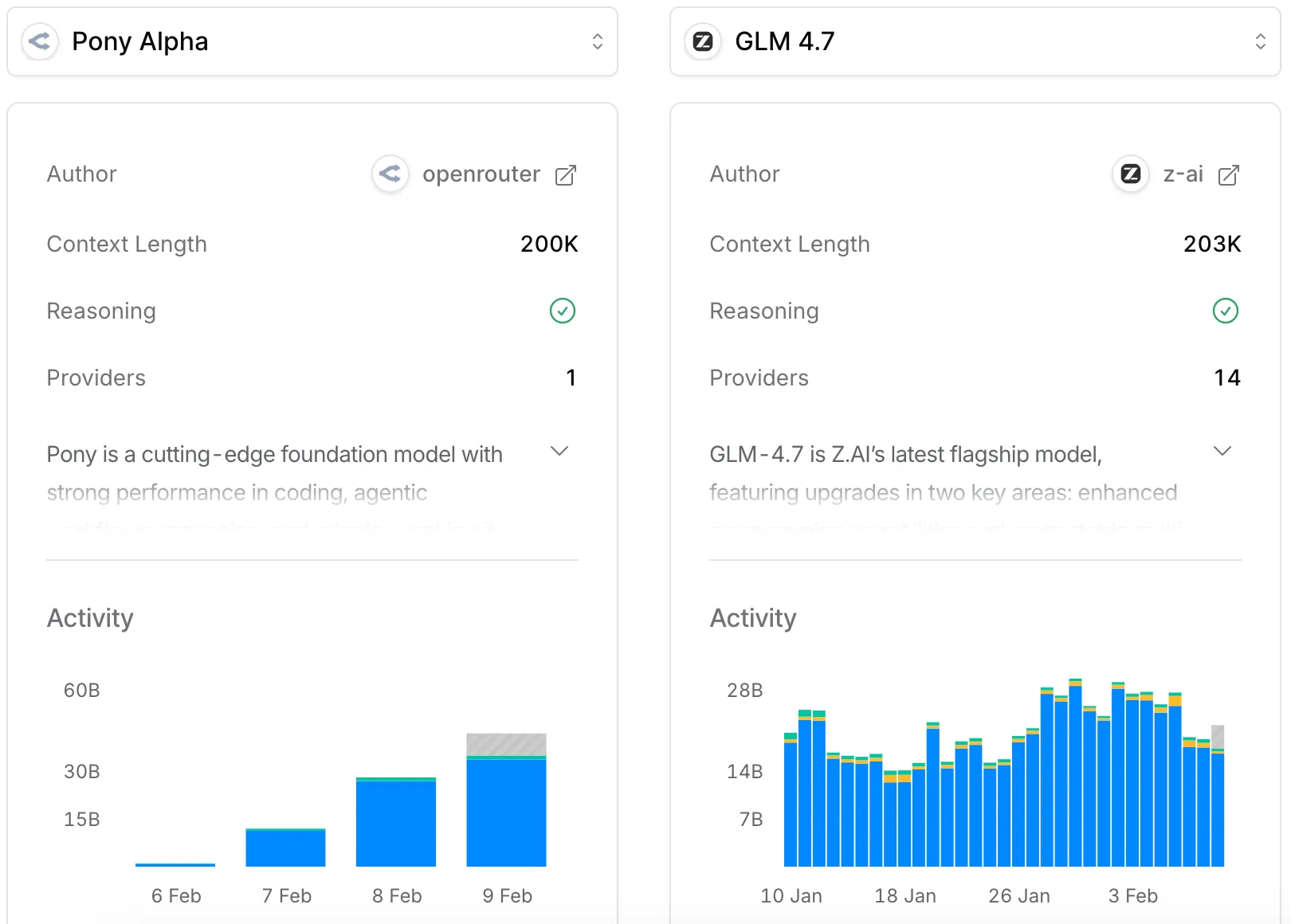
Pony Alpha's core competitiveness lies in its technical specifications and real‑world performance. According to OpenRouter, it supports a 200,000‑token context window and a maximum output of 131,000 tokens, far exceeding many commercial models and suitable for complex tasks such as long‑document analysis or extended multi‑turn conversations. In terms of capabilities, it excels at coding, agentic workflows and reasoning, and is optimized for "hands‑on coding and real‑world applications." The Kilo Code platform commented: "Pony Alpha performs well in structured outputs, JSON schema validation and extended reasoning, making it suitable for complex problem solving."
A hands‑on report from 36Kr further confirmed its potential. In tests, Pony Alpha handled tasks ranging from dashboard generation to algorithm visualization with ease, demonstrating "Opus‑level intelligence and architect‑level thinking." For example, in coding benchmarks it accurately invoked tools and produced efficient code; in role‑playing scenarios users reported smooth narratives and durable memory. Compared with Claude Opus 4.5, Pony Alpha's latency (p50 of 10.75 seconds) and throughput (17.0 tok/s) are slightly inferior, but its free availability makes it a top choice for many developers. On GitHub, some users reported compatibility issues when integrating Pony Alpha into projects like oh‑my‑opencode, which also underscores its popularity.
The community largely speculates that its lineage traces back to Zhipu AI's GLM series. Reddit user pip25hu wrote: "It's almost certainly a GLM model; it shares the same strengths and weaknesses." GLM‑4.5 is already known for multimodal capabilities and agent functions, and Pony Alpha is seen by some as a disguised test build of GLM‑5. As a Tsinghua‑affiliated AI company, Zhipu AI has released the GLM‑4 series domestically; Pony Alpha's free strategy could be intended to collect feedback and refine an official release.
Market impact: a free model that disrupts the AI ecosystem
Pony Alpha's rapid rise is not an isolated case; it reflects intense competition in the AI model market. TipRanks noted that the launch strengthens OpenRouter's appeal within the developer ecosystem, particularly in agent AI and automation. Offering cutting‑edge models for free may generate no direct short‑term revenue but can increase platform stickiness through data collection and attract enterprise users. OpenRouter emphasizes that all prompts and completions will be logged for model improvement, which has raised privacy concerns while accelerating iteration.
For Zhipu AI, if Pony Alpha is indeed its product, this would be a clever step in global expansion. The GLM series already leads domestically, and international testing can gather diverse feedback. A YouTube analysis observed: "Pony Alpha is optimized for agent workflows and high tool‑call accuracy, suitable for real‑world scenarios." This could challenge the dominance of OpenAI and Anthropic and promote AI democratization.
Nevertheless, challenges remain. Community feedback indicates Pony Alpha is sensitive to presets, which can cause inconsistent outputs. Moreover, the free model may be a limited testing phase; future pricing will determine sustainability.
Outlook: the dawn of the AI "dark horse" era
Pony Alpha's sudden popularity signals a shift from closed to open AI models. It is more than a tool; it is a beacon of ecosystem change. If it is indeed Zhipu AI's GLM‑5, it will bolster China's competitiveness in global AI and spur more free cutting‑edge models. For developers, this means more choices; for everyday users, it may usher in an era of "AI for everyone." The mystery of Pony Alpha has not been fully solved, but its meteoric rise is compelling. Who do you think is behind it? The answer may come with the next update.
▶️ Enjoyed this piece? Creating content is hard work!
Follow our YouTube channel:
AI Rosetta
Your likes, subscriptions and shares are our greatest support! 🙏
More AI news at: https://www.airosetta.com