
On June 26, 2026, OpenAI formally launched the GPT‑5.6 model series, including the flagship Sol, the everyday work edition Terra, and the fast economical edition Luna. OpenAI describes Sol as the "strongest model to date," showing significant performance gains in coding, biology and cybersecurity. However, at the request of the U.S. government (similar to restrictions on Anthropic's Fable 5 and Mythos), the Sol edition is currently available only to rigorously vetted “trusted partners” and a limited set of organizations; general users will need to wait for broader rollout. This limited release again highlights the balance between spreading frontier AI capabilities and national security considerations.
In its announcement, OpenAI said the GPT‑5.6 series continues the "number+name" naming logic (the number denotes the generation; Sol/Terra/Luna indicate capability tiers), intended to give clear choices for different user needs. This release is OpenAI’s latest advancement in model iteration speed and multi‑tier capability deployment, while also reflecting the regulatory environment’s strict control over high‑capability models.
Key innovations: layered capability design and strengthened safety mechanisms
The standout features of the GPT‑5.6 series are the deep integration of a layered capability design with built‑in multi‑layer safety mechanisms, achieving a balance between "inclusive intelligence" and "manageable risk":
- Sol flagship: As the series' most powerful model, Sol achieves major breakthroughs in complex reasoning, multi‑step agent workflows and professional tasks. It natively supports much longer context understanding (notably beyond the prior generation), efficient tool invocation and multi‑turn planning, making it particularly well suited for software engineering, scientific research and security‑related applications. OpenAI emphasizes that Sol demonstrates "expert‑level intelligence" on internal benchmarks and has reinforced protections for high‑risk domains.
- Terra everyday: Balances intelligence and cost, optimized for enterprise daily workflows and suitable for most developers and knowledge workers.
- Luna fast: Focuses on reasoning speed and economy, providing low‑latency responses for high‑frequency lightweight tasks and mobile scenarios.
Compared with the previous generation, GPT‑5.6 further strengthens native integration of chain‑of‑thought, tool usage capabilities and multimodal understanding. All models in the series also incorporate more robust classifiers and safety systems, with targeted optimizations against model‑extraction attacks, content misuse and other risks. This reflects OpenAI’s strategic shift toward "stronger capabilities, stricter safety."
Performance metrics: leading on multiple benchmarks, strong practical value
OpenAI published several key performance metrics for the GPT‑5.6 series, with Sol showing advantages in multiple high‑value scenarios:
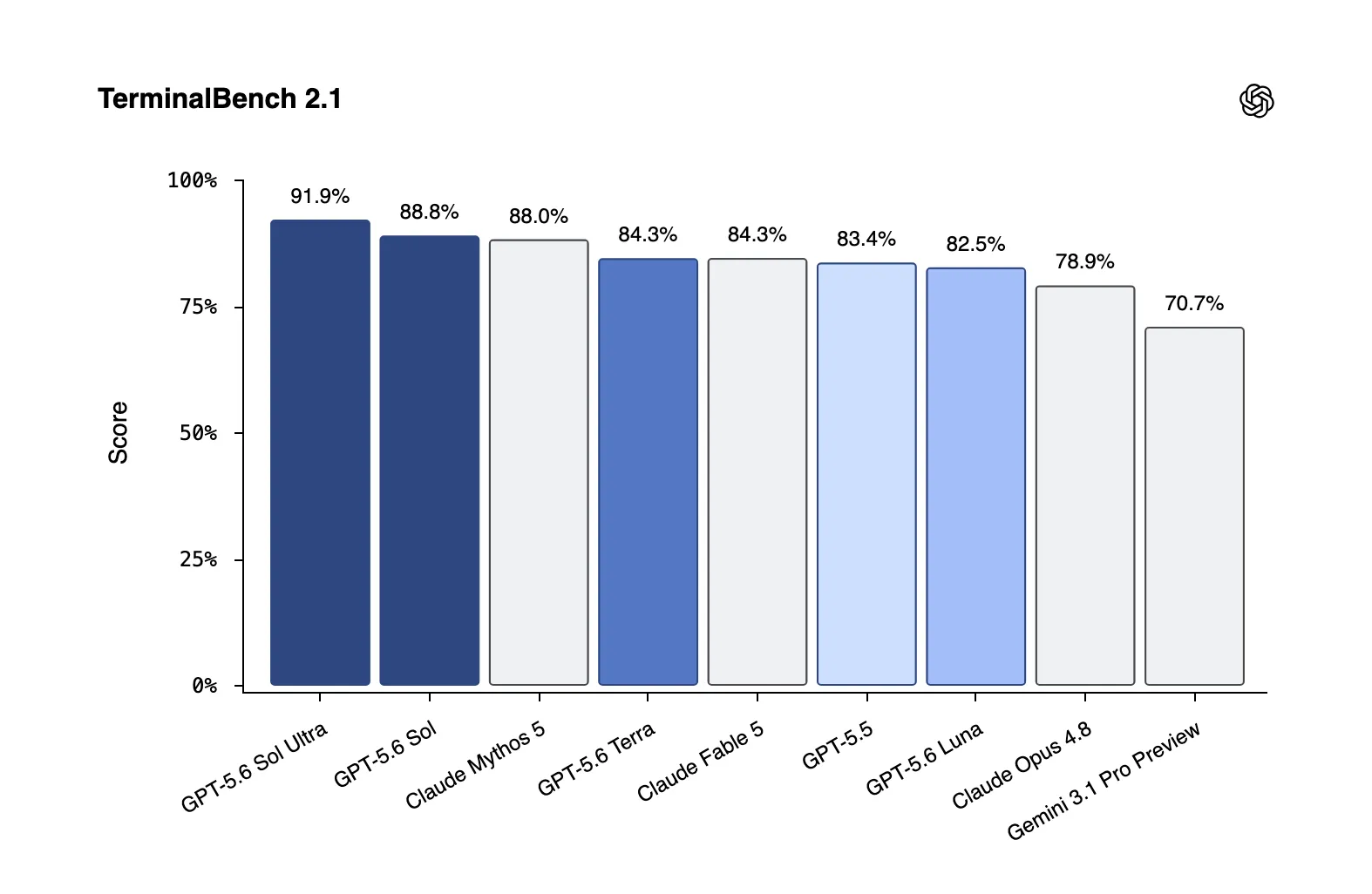
- Terminal‑Bench 2.1 (complex agent task benchmark): Sol scored at the top, substantially outperforming the previous generation and some competitors, demonstrating strong capabilities in real‑world multi‑step execution, tool‑chain integration and long‑term planning. This benchmark examines an AI’s operational effectiveness in open environments, and Sol’s performance suggests strong practical value for automated development and complex workflows.
- Coding and software engineering tasks: Sol performs strongly on specialized coding benchmarks such as SWE‑bench, supporting large‑scale codebase comprehension, bug fixing and architecture design—making it suitable for professional developers. OpenAI notes that its agentic capabilities have visibly improved over GPT‑5.5, especially in multi‑file collaboration and iterative development scenarios.
- Biology and scientific reasoning: Demonstrates strong analysis and simulation capabilities in biology and chemistry while including built‑in safeguards to reduce misuse risks.
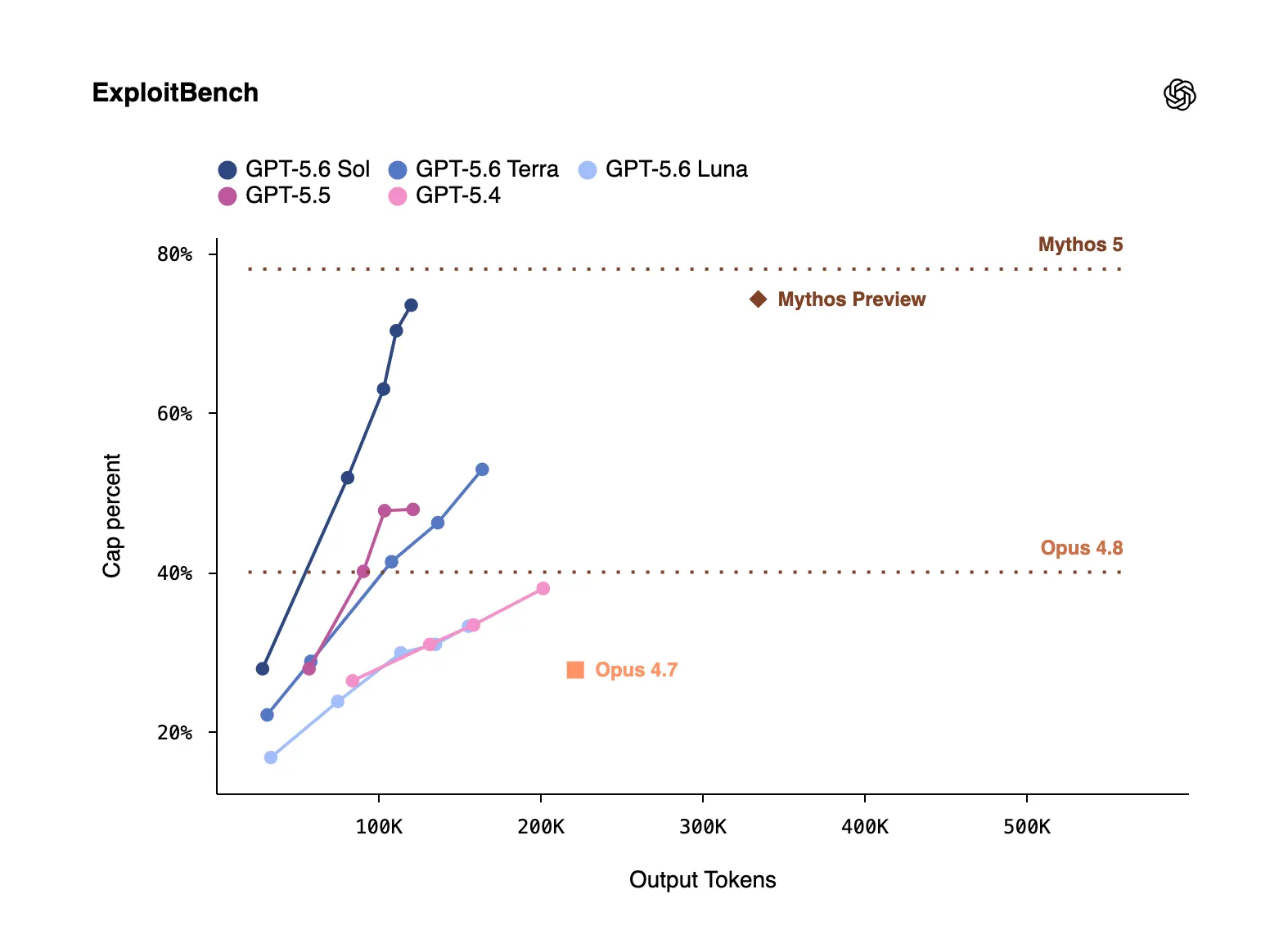
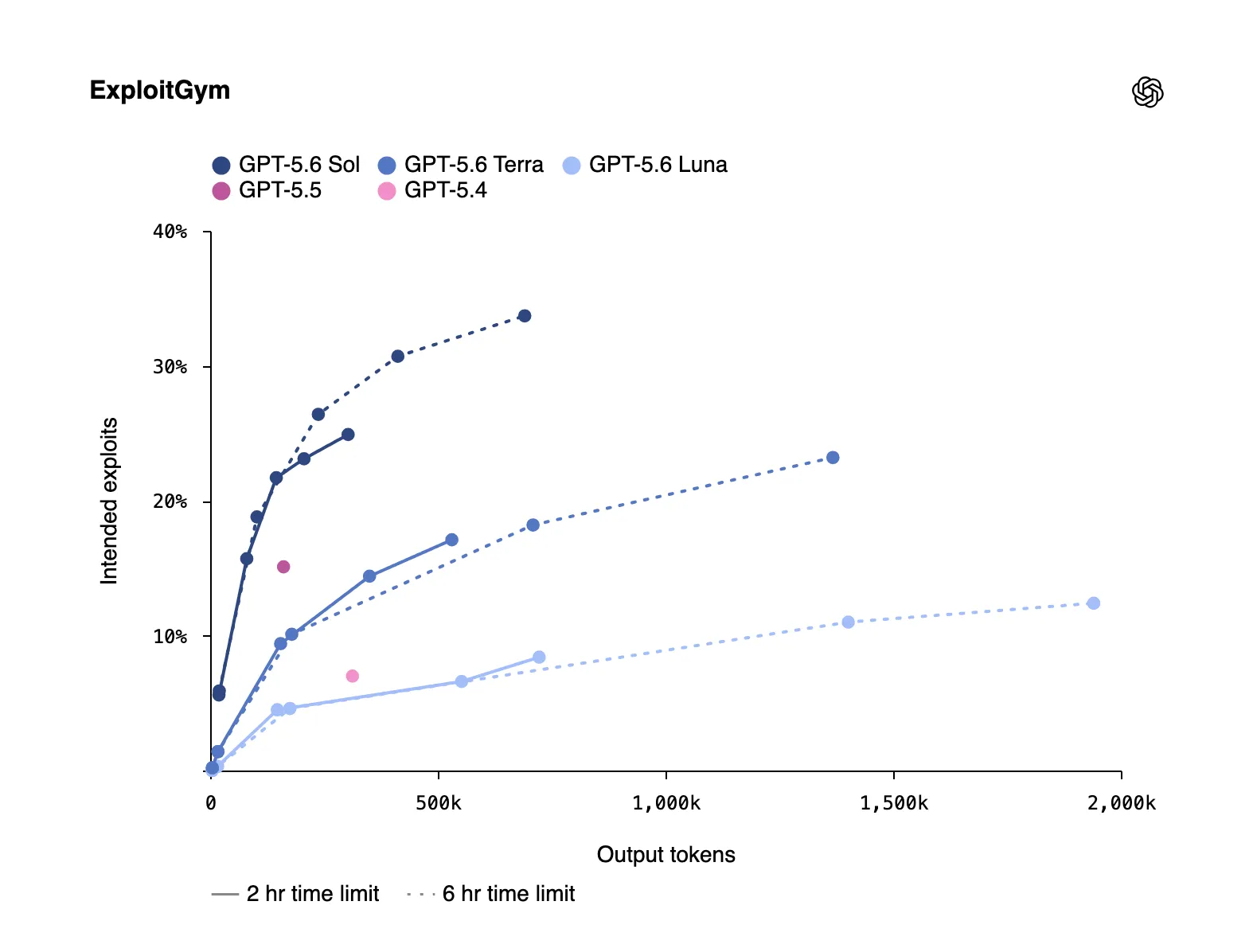
- Cybersecurity capabilities: OpenAI emphasizes that Sol is its "most capable model for cybersecurity," excelling at threat detection, vulnerability analysis and defensive strategy generation; internal tests indicate industry‑leading performance on these tasks.
- Overall intelligence density: Compared with GPT‑5.5, the 5.6 series shows improvements in speed, accuracy and complex problem solving, particularly in extended contexts (significantly expanded), multi‑turn interactions and domain‑specific tasks. Terra and Luna are optimized for cost‑effectiveness and responsiveness, with Luna suited for real‑time interaction scenarios.
Although a full independent third‑party benchmark is not yet available due to the limited release, early feedback from trusted users shows Sol’s usability in agent workflows and professional reasoning tasks has markedly improved, and it is seen as a direct competitor to Anthropic’s Mythos/Fable series.
Reason for limited release: security‑first strategy under government intervention
The limited rollout of Sol stems directly from explicit requirements by the U.S. government. OpenAI CEO Sam Altman noted in an internal memo that the government is approving access on a "case‑by‑case" basis to effectively control national security risks posed by frontier AI capabilities. This mirrors prior restrictions on Anthropic’s high‑end models and reflects regulators’ high level of concern about the potential diffusion of high‑capability models.
OpenAI says this measure is intended to gather sufficient safety assessment data ahead of wider public release and to ensure models undergo strict review before deployment. Terra and Luna are relatively more open, aiming to balance innovation speed with risk control. Other generative models such as Sora have faced similar regulatory pressure, highlighting that global AI governance is entering a new phase that weighs capability and security equally.
Impact on industry and users
Positive effects:
- Tiered access for broader benefit: Terra and Luna let more users quickly experience the advantages of the 5.6 series, accelerating AI adoption in enterprise productivity and everyday tools.
- Safety demonstration: Strengthened protections set an industry benchmark and help build more mature AI governance frameworks.
- Competitive stimulus: The GPT‑5.6 release will accelerate iteration from competitors such as Anthropic, Google and xAI, driving technological progress across the ecosystem.
Potential challenges:
- User waiting period: Independent developers and small‑to‑medium businesses may need to wait for broader access, potentially slowing short‑term productivity gains.
- Regulatory uncertainty: Government intervention, while protecting security, may slow the pace of broader access and affect global AI competitiveness.
- Cost pass‑through: Limited supply of high‑end capabilities could raise enterprise pricing, forcing smaller teams to seek open‑source or alternative solutions.
Outlook: AI governance enters a new balance
The limited release of the GPT‑5.6 series marks a shift from "race‑for‑speed" to a "safety‑first" phase in AI development. OpenAI has pledged to gradually expand access only where risks are manageable; future competition will hinge on combining model performance, ecosystem integration and compliance capabilities.
For developers, it is recommended to follow official updates and trusted partner programs while exploring open‑source models or optimizing existing GPT‑5.5 deployments. This event also reminds the industry that responsibility, innovation and governance must advance together alongside the pursuit of the most capable intelligence.
As flagship models like Sol are progressively opened up, the ChatGPT 5.6 series is positioned to become a new productivity benchmark in the second half of 2026. The industry expects OpenAI to deliver a more inclusive and more powerful AI experience under a robust safety framework.
▶️ Enjoy this article? Creating it takes real effort!
Subscribe to our YouTube channel:
AI Rosetta
Your likes, subscriptions and shares are our greatest support! 🙏
For more AI news visit: https://www.airosetta.com