
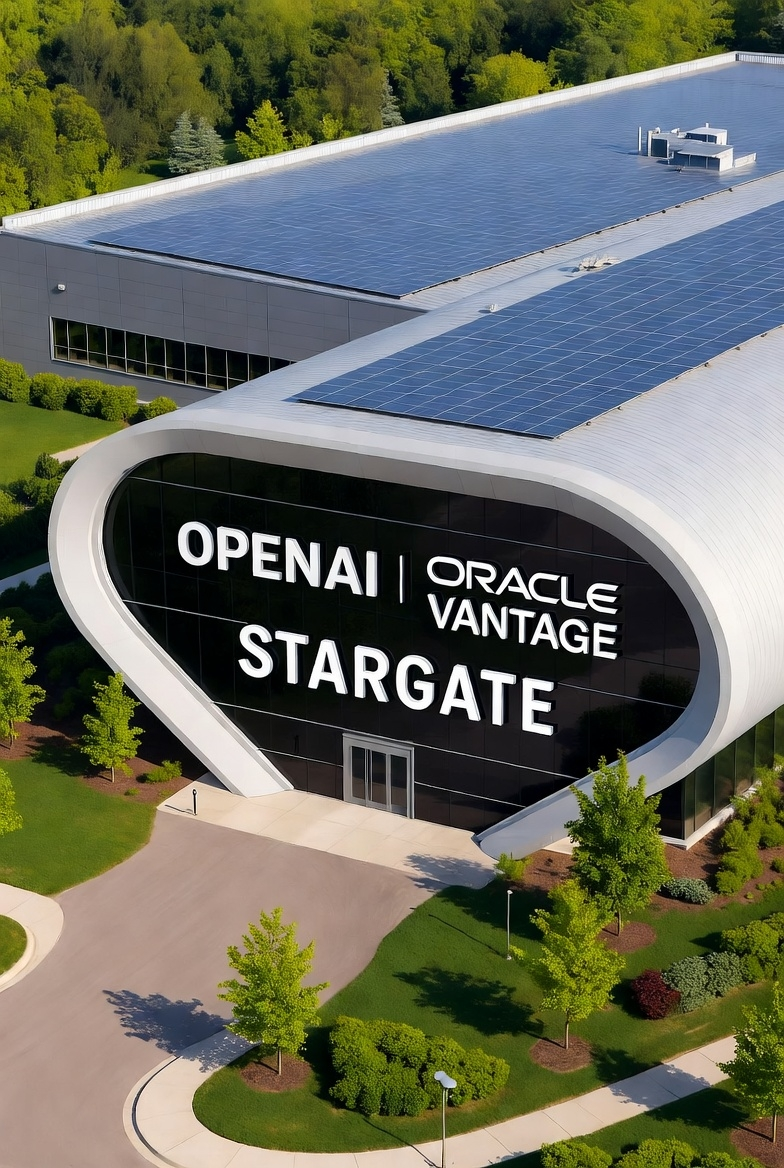
Against the backdrop of an intensifying global AI race, after a period of preparation and buildup, OpenAI, Oracle and Vantage Data Centers have jointly announced they will build a hyperscale AI data center campus called 'Lighthouse' in Port Washington, a suburb of Milwaukee, Wisconsin. The project is not only a major extension of the Stargate global AI infrastructure plan previously announced by OpenAI and Oracle, but also a milestone for domestic AI infrastructure in the United States. According to the official announcement, the campus represents an investment of more than $15 billion, is expected to provide about 1 gigawatt of compute capacity, and is slated to be fully operational in 2028. The move aims to solidify US leadership in AI and drive innovation from basic research to commercial applications.
Since its launch in July of this year, the Stargate project has been described as the 'Manhattan Project' for AI‑era infrastructure. The overall plan involves up to $500 billion in investment, aiming to deploy multiple hyperscale data centers across the United States over the next four years, with total power demand potentially exceeding 4.5 gigawatts. As the Midwestern inaugural site, the Lighthouse campus will include four advanced data center buildings and supporting facilities across several hundred acres. Vantage Data Centers, a leading global hyperscale data center operator, will develop and operate the campus. The company is backed by private equity giant Silver Lake and asset manager DigitalBridge; this investment underscores its ambitions in AI infrastructure. Peter Hoeschele, OpenAI's VP of Industrial Compute, said in the announcement that extending Stargate to Wisconsin is 'another major step in building AI infrastructure' that will help ensure everyone benefits from AI technologies and drive sustainable innovation.
From a technical standpoint, the Lighthouse campus will adopt cutting‑edge AI‑optimized designs, supporting high‑density GPU clusters and multimodal computing architectures. This will meet training needs for OpenAI's next‑generation large language models such as the GPT series and provide strong backing for Oracle's cloud services. The campus is expected to be equipped with advanced liquid cooling systems and high‑speed network interconnects, ensuring more than a 30% improvement in data processing efficiency. According to Reuters, the project will create over 4,000 skilled construction jobs, most of them union positions, and about 1,000 long‑term operational jobs. This is a major boost for Wisconsin's local economy. Dale Kooyenga, president of the Metropolitan Milwaukee Chamber of Commerce, stressed that 'these supercomputers will make our manufacturing more competitive and solidify the Midwest's leadership in digital economic growth.'
However, the grand plan comes with deep considerations about energy and the environment. Energy consumption of AI data centers has been an industry pain point; the Lighthouse campus centers on a 'zero‑emission' principle and commits to 100% matched zero‑carbon energy. Vantage will advance the addition of 2 gigawatts of zero‑emission energy capacity in Wisconsin, including solar, wind and battery storage systems. Seventy percent of that capacity will be dedicated to the campus, with the remaining 30% fed into the state grid to benefit residents. The campus will also use closed‑loop liquid cooling to greatly reduce water use and invest in local water restoration projects to ensure a 'net positive water' outcome—restoring more water than it consumes. Vantage plans to plant more than 2,000 native trees, enhance existing wetlands and build an 8‑foot‑high native vegetation sound barrier. These measures not only respond to global sustainability goals but also inject momentum into Wisconsin's clean energy transition.
On energy supply, Vantage reached an agreement with local utility We Energies to classify the campus's electricity under a separate rate category, avoiding upward pressure on prices for other consumers. The announcement noted the campus's actual power demand is about 1.3 gigawatts, of which 90 megawatts are used directly by AI equipment, with the remainder supporting systems such as mechanical and lighting. This arrangement ensures the project's economic viability while protecting state residents' interests. Dana Adams, president of Vantage North America, said the Upper Midwest has become a key market for data centers and AI demand, and that the investment reflects the region's solid digital growth foundation and supports scaled, sustainable AI innovation.
The announcement comes as the global AI infrastructure race intensifies. The U.S. government views Stargate as a strategic pillar for maintaining national competitiveness and has attracted follow‑on interest from giants such as Microsoft and Amazon. Wisconsin Governor Tony Evers welcomed the project on social media, saying the Lighthouse project will bring jobs, economic growth and innovation opportunities while committing to environmental protection. However, not all local responses are positive. Some communities in southeastern Wisconsin previously raised concerns about similar data center projects—Microsoft was forced to cancel a Caledonia plan last month. Vantage emphasized that Lighthouse will maximize use of existing infrastructure and rights‑of‑way to reduce disputes over transmission lines.
Looking ahead, the campus's operation will accelerate AI's transition from the lab to the real world. When Stargate launched, OpenAI CEO Sam Altman said the project is not only an expansion of compute capacity but 'a key step toward democratizing AI.' Through deep integration with Oracle, the campus will support a range of applications from medical diagnostics to climate modeling. Analysts expect that by 2028, Stargate overall will contribute over 10% of U.S. AI output and boost GDP by more than 1%.
In the global AI wave, this $15 billion investment is not only a deployment by tech giants but a statement about reshaping America's digital future. Wisconsin's Lighthouse, as its name implies, will illuminate the course of the AI era.